No Transfers, Shorter Transit Times, and Fare Savings? The “direct train operation” that you are familiar with but don’t know about.


Yamanote Line to Increase Fares Significantly, but…
On March 14 of this year, JR East revised its fares, raising them by more than 10% on lines in the central Tokyo area. Until now, fares on the Yamanote Line had been less expensive than those on other lines. However, the abolition of the fare classification within the Yamanote Line has resulted in a 16.4% increase in fares within the Yamanote Line, and in the case of tickets, the old fare of 210 yen from
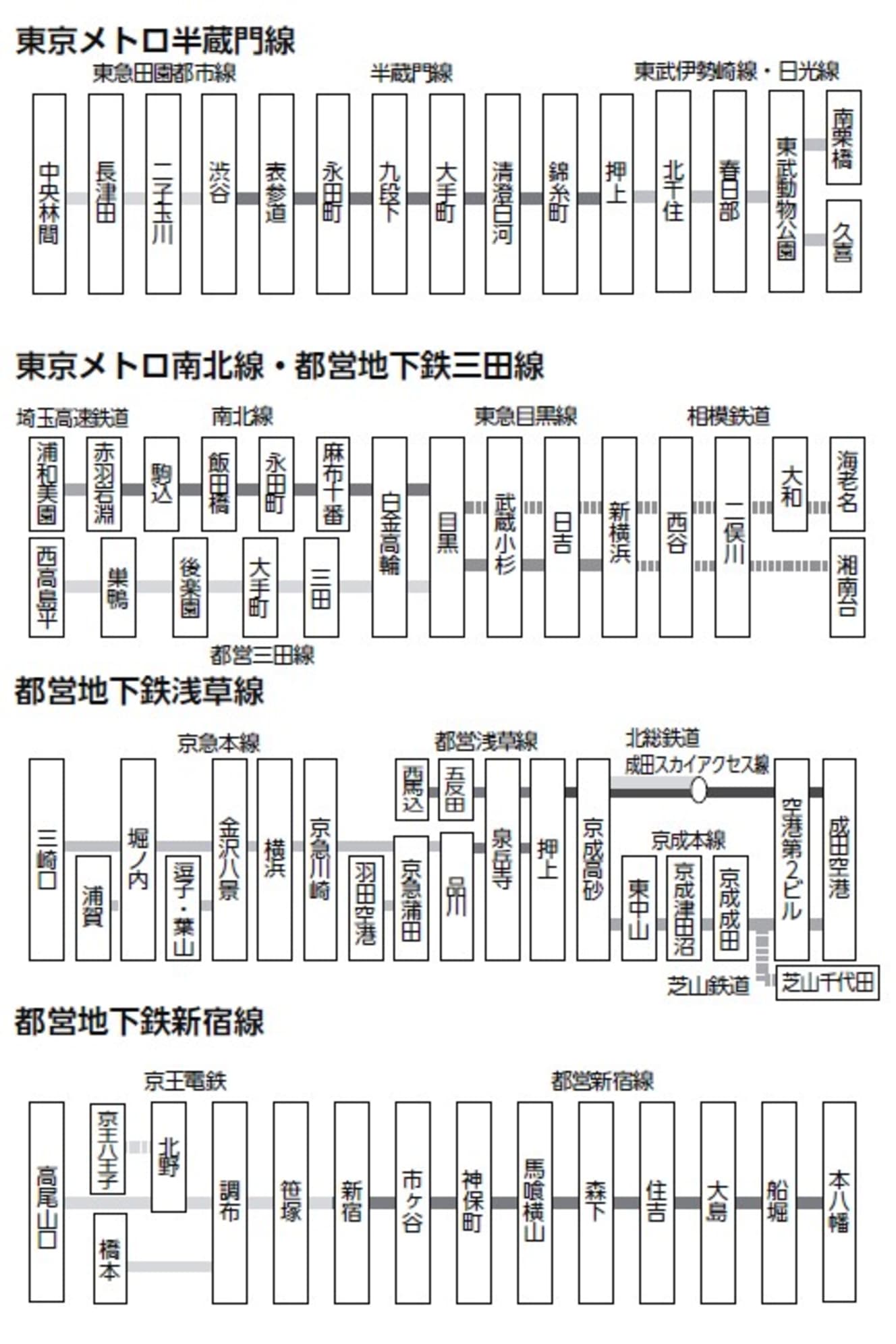
In order to avoid JR East’s large price increase, we would like to take advantage of direct service with major private railways. Direct service refers to a system in which trains operate across multiple lines, railroad companies, or sections. The term “mutual direct service” or “mutual transit” is used when two railroad companies operate trains by interconnecting each other’s trains, and a typical example is the connection between a subway line that goes into the city center and a JR or private railway line that runs in the suburbs.
The Tokyo Metro Tozai Line, which started as a bypass line to avoid congestion on the Chuo and Sobu Lines, mainly connects Nakano to Nishi-Funabashi. Although the number of direct trains has been greatly reduced since this spring, the fare from Mitaka to Nishi Funabashi is ¥803 for JR East only, and ¥533 for JR East and Tozai Line, a savings of ¥270. Various private railways serve the Tokyo metropolitan area, so you can avoid JR East or reduce the distance you travel. Let’s find a route that is also easy on the wallet.
This is according to Hiroyuki Nitta, author of “Railways: Exploring the Direct Passage System” (Kawade Shobo Shinsha), which was published in February. In this book, he explains how fares are determined and allocated for direct service. The book also includes information that will tickle the hearts of railroad fans, such as what is necessary for the smooth operation of different companies and which company manages shared stations. Non-railroad fans should also learn about direct service. This is because direct service is directly related to our daily lives and makes them more convenient.
In March 2001, the Yokohama Rapid Transit “Minatomirai Line” began direct service from Yokohama to Seibu Yurakucho Line and Seibu Ikebukuro Line via Tokyu Toyoko Line and Tokyo Metro Fukutoshin Line. The new direct service connects the Minatomirai Line’s Motomachi-Chukagai Station to the Tobu Tojo Line’s Morinokoen Station and the Seibu Ikebukuro Line’s Hanno Station via the Fukutoshin Line, a distance of over 80 kilometers.
No more waiting around for transfers during busy times.
The Tokyu Toyoko Line currently offers direct service across six operators: the Yokohama Rapid Transit Minatomirai Line, Tokyo Metro Fukutoshin Line, Seibu Ikebukuro Line, Tobu Tojo Line, and Sotetsu Line. Tokyu Corporation, the operator, is a railroad operator that is open to direct service.
In the beginning in 2001, people said that it was very convenient to go from Saitama to Yokohama or Chinatown by one train, which dramatically improved convenience. However, now that convenience has become the norm, and delays in one section of Saitama Prefecture can affect as far as Yokohama, and the demerits of the “chain of delays” caused by schedule disruptions can be seen on social networking sites. Nevertheless, the attraction of direct service is that it compensates for the disadvantages by eliminating the need for transfers and shortening the time required.
You can get to your destination in one train without changing trains. It also saves time. In addition, there is an undiscovered advantage of direct service.
I live in the Kansai region and often visit Tokyo, and I find the Yamanote Line to be uncommonly crowded. The large stations on the Yamanote Line are also terminal stations for major private railways, and it is natural for them to be crowded, as they border the Seibu and Tobu Lines at Ikebukuro, the Odakyu and Keio Lines at Shinjuku, and the Keikyu Line at Shinagawa. In recent years, there have been inbound travelers, many of them carrying large carry-on cases. When I decide to go on a business trip to Tokyo, I think about how to get to my destination without taking the Yamanote Line.
To give an example, when I used to come to Tokyo and take the Tokyo Metro Hibiya Line to Hiroo Station, I would get off at Shinagawa on the Shinkansen bullet train and take the Yamanote Line to Ebisu. The stress of carrying a large bag on the Yamanote Line is beyond description. However, since the Tokyu Shin-Yokohama Line opened in March 2011, I can get off the Shinkansen at Shin-Yokohama and take the Tokyu lines and the Hibiya Line from Shin-Yokohama to Hiroo, eliminating the need to take the Yamanote Line. Direct service also has the advantage of avoiding congestion.”
While the metropolitan area’s rail network seems to be a trade show of interconnecting direct service with JR and various private railways, direct service across regional JR lines and small and medium-sized regional private railways is also very attractive. One example is the “Super Hakuto” limited express train connecting Keihanshin and Tottori Kurayoshi. It is a direct limited express train between Osaka and Tottori.
All Seats with Ocean View” without Express Fare
Chizu Express, which connects Kamigori Station in Hyogo Prefecture to Chizu Station in Tottori Prefecture, is a third-sector railroad operator whose shares are owned by local governments in Hyogo, Okayama, and other prefectures along the line. Although a single-track, non-electrified line, the Chizu Express operates at a maximum speed of 130 km/h, and runs directly to Osaka in 2 hours and 30 minutes with Chizu Express and JR West.
Express buses often travel faster on local lines, but the Osaka-Tottori express bus takes 3 hours. This train is essential for Tottori residents, including former Prime Minister Shigeru Ishiba (69), who is known as a rail fan, to get to Keihanshin in a hurry.
However, JR West has approached Tottori Prefecture about turning back at Himeji Station, but Tottori Prefecture is taking a negative attitude toward the idea, since JR West would not have to pay for the use of the train car for the Chigashira Express if it turns back at Himeji Station.
The number of direct train services between JR and small and medium-sized regional private railways is on the decline nationwide, but considering the feelings of Tottori residents toward Super Hakuto, I hope that the line will continue to exist.
There are also lines in tourist areas that are served by both JR and local private railways. When going from Atami to Izukyu Shimoda, there is a luxury train on the Izu Kyuko Line called “Resort 21. All seats are ocean-view structures, and there are even seats with an observation deck, but there is no express fare, and passengers pay only the standard fare.
It is a resort train of the Izu Kyuko Line, which is part of the Tokyu Group, and is operated by JR Tokai up to Ito Station and by the Izu Kyuko Line from Ito Station onward. The Resort 21 trains have large windows that allow passengers to enjoy the Izu sea from a large window. There are various types of seats, including observation seats, box seats, and panorama seats. First-time passengers will be surprised to know that they can ride the train without paying express fares.
On the Izu Kyuko Line, you can enjoy a wide variety of different trains, from those that give you a resort atmosphere to those that worked hard in Shibuya in the past as the Tokyu Toyoko Line.
Direct train service is an indispensable convenience for both railfans and non-fans alike. This book covers a number of direct service operations throughout Japan and describes the reality of such operations. The book also details the depth of direct transit operations and the ingenuity of the railroad companies behind them. The more you learn about the reality of direct service, the more you will want to get on a train and go somewhere.




The book is published by Hiroyuki Nitta and published by Kawade Shobo Shinsha.
Interview and text by: Daisuke Iwasaki