The “same atmosphere” of Tokyo captured in the rebooted Hiroshige’s “One Hundred Famous Views of Edo” even though the scenery is 170 years later. | FRIDAY DIGITAL

The “same atmosphere” of Tokyo captured in the rebooted Hiroshige’s “One Hundred Famous Views of Edo” even though the scenery is 170 years later.

  • Share on Twitter
  • Share on LINE
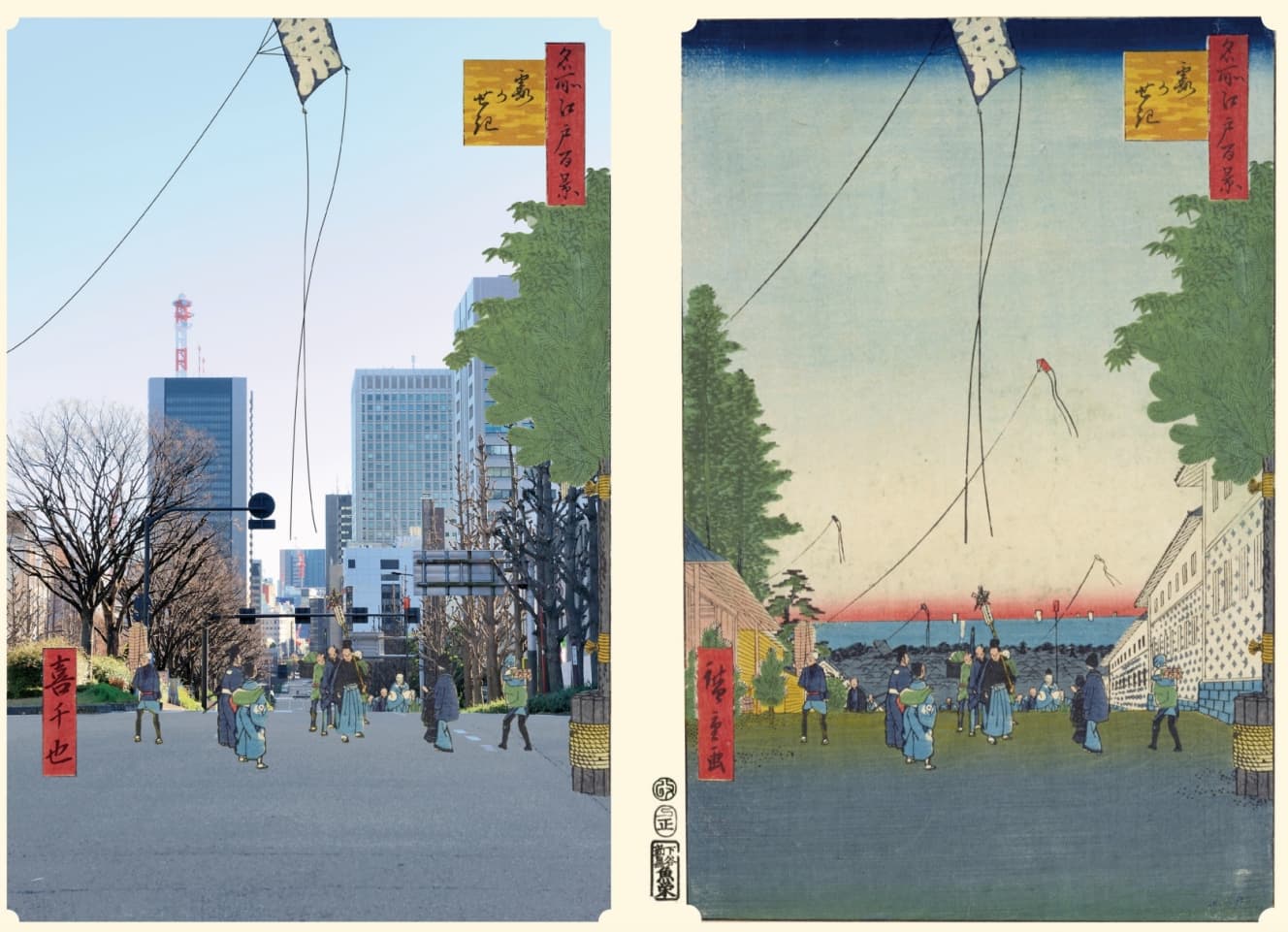
Kasumigaseki” (Chiyoda-ku, Tokyo). In Hiroshige’s time, the hill passing between the current Ministry of Foreign Affairs and the Central Government Buildings No. 2 and 3 was called “Kasumigaseki. Although the actual photo was taken on Shiomizaka, one street next to the hill, the image of the painting remains today (from “Hiroshige’s ‘One Hundred Famous Views of Edo’: A Visit to the Present,” hereafter).

Meisho Edo hyakkei” revived in the modern age

Hiroshige Utagawa’s “Meisho Edo hyakkei” (One hundred Famous Views of Edo) depicts the scenery of the era when “Edo” was changing to “Tokyo” along with the richness of the four seasons. Despite the title “One Hundred Famous Views,” even after Hiroshige’s death, 119 views and one inventory were produced, including works by his pupil Hiroshige II, and this masterpiece is considered a compilation of ukiyoe landscapes. It is known worldwide and is said to have greatly influenced Van Gogh and other Western painters.

The 119 views range in location from the entire city of Edo at that time to “Konodai” (present-day Ichikawa City, Chiba Prefecture) in the suburbs, “Inokashira Pond” (Mitaka City, Tokyo), “Senzoku Pond” (Ota Ward, Tokyo), and “Shinjuku” (Niijiku, Katsushika Ward, Tokyo), and depict scenes from all seasons and times of the year.

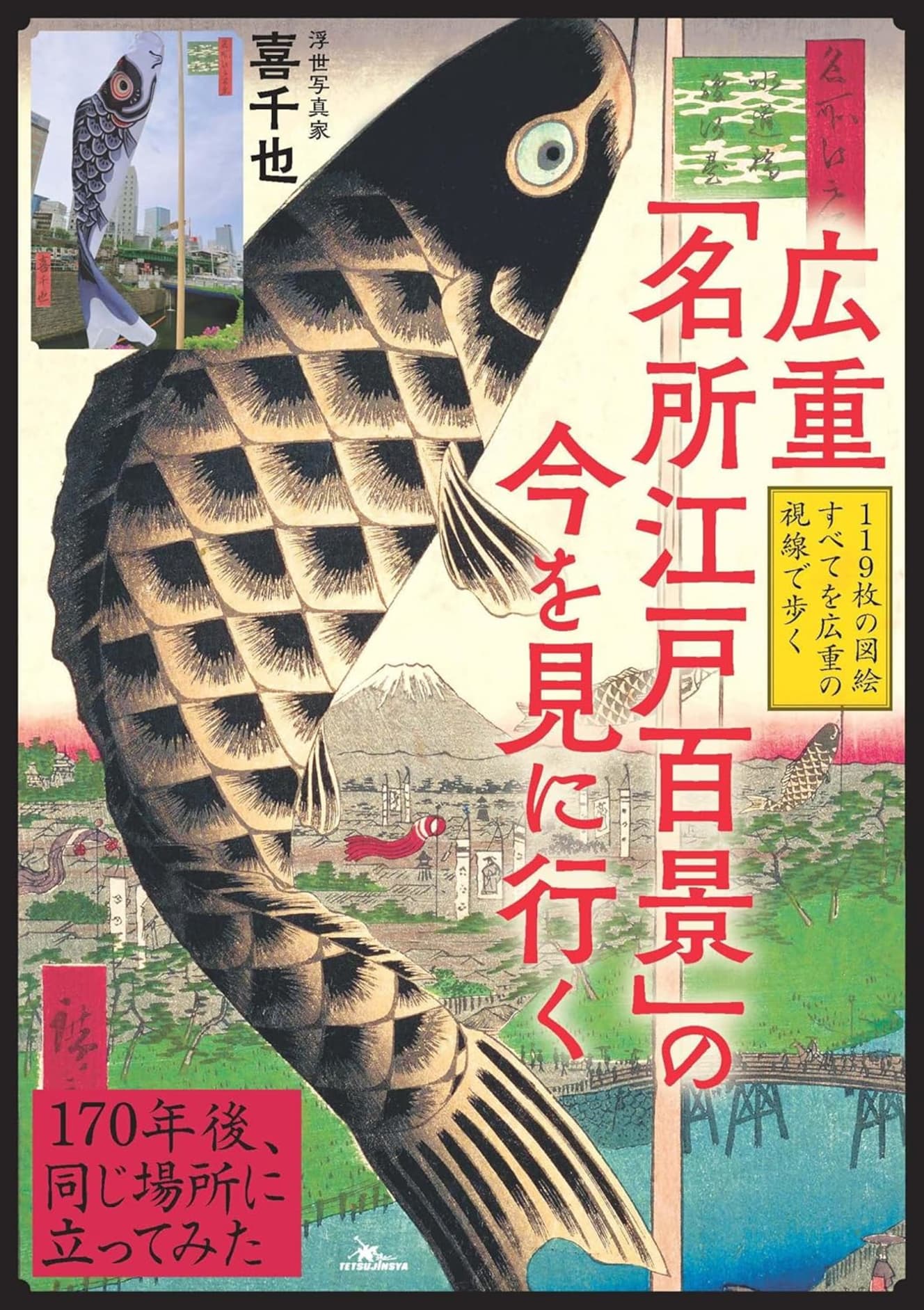
Ukiyo photographer Kicenya published “Hiroshige’s ‘One Hundred Famous Views of Edo'” (Tetsujinsha) in late March, which expresses the “connection” between these works and the Edo of that time by overlaying contemporary Tokyo scenery on them. He visited all 119 scenes and identified as many as possible, and by collaging and manipulating portions of the works into the present-day scenery as seen from Hiroshige’s point of view, he has brought the scenes even closer to the original paintings.

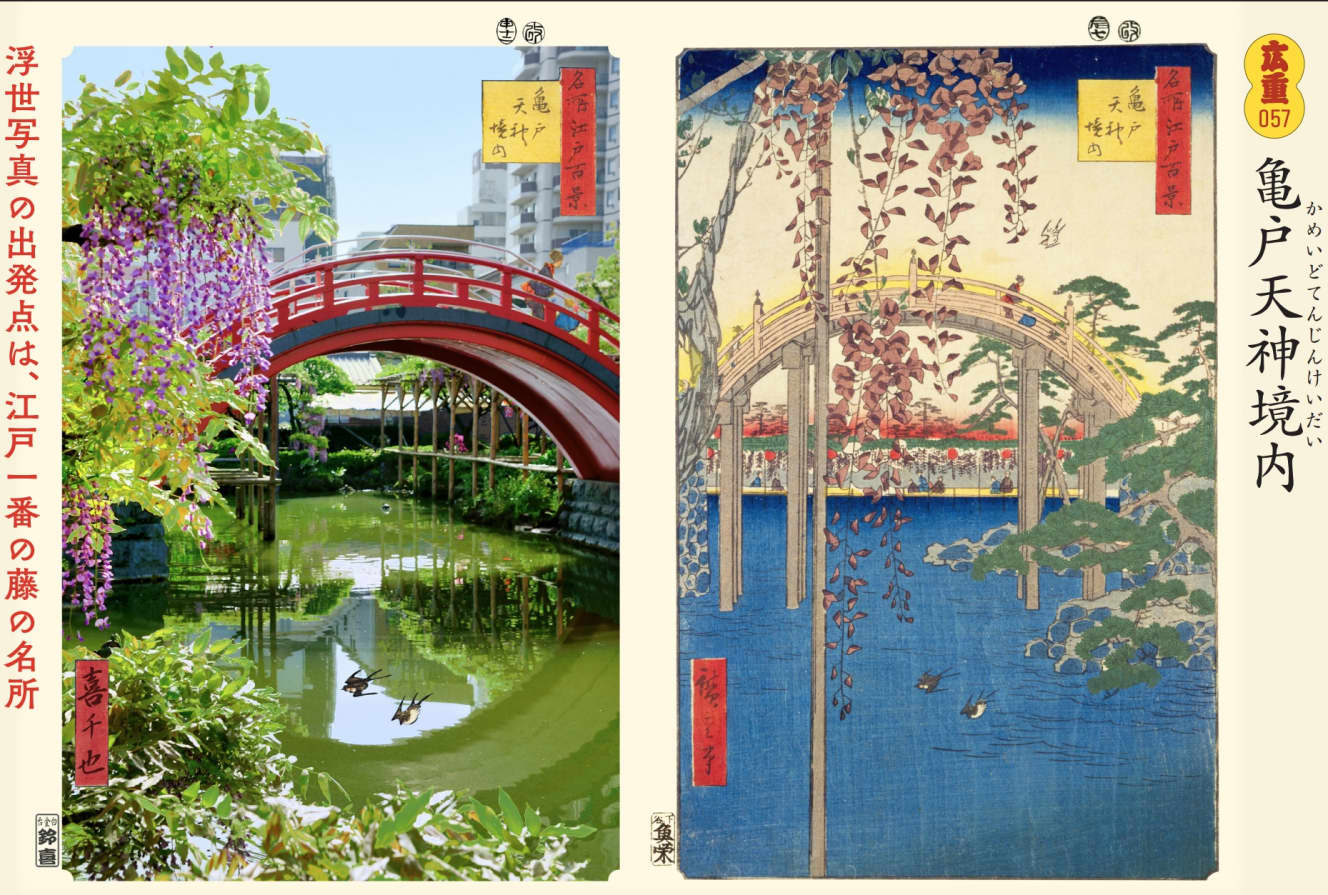
Kicenya’s fascination with “Meisho Edo Hyakkei” began with a photograph he took of the Taiko Bridge over the wisteria flowers at Kameido Tenjin in 2001. When he casually collaged a portion of the picture, he received an unexpected response on SNS. This led him to research “Meisho Edo hyakkei (One hundred Famous Views of Edo),” and his interest in the work grew deeper and deeper.

As I visited and photographed various places, I felt that Edo towns and people’s lives were connected to today’s Tokyo, and when I looked through the viewfinder, I felt as if I could see the people of Edo, and I naturally began to think of objects to collage into photographs. (From “Hiroshige’s ‘One Hundred Famous Views of Edo'”, “Introduction”)

(From “Introduction” of “Hiroshige’s ‘One Hundred Famous Views of Edo'”) He first took the name “Ukiyo Photographer Kicenya” in 2005, when he held his first one-man exhibition. In ’18, he began serializing his work on the information website Nippon.com, and in ’22, he completed a complete set of 119 views and even one catalog created in English.

One of the characteristics of Hiroshige’s style is his bold compositions, which include extreme cropping of near and distant views, and bird’s-eye and bird’s-eye views, making it difficult to create the same “picture” even if one could photograph the scenery as it appears to the eye. In many cases, the 170 years that have passed since the last time, the land that was once a river or the sea has been reclaimed, and in many cases, highways have blocked the view and obscured the scenery that would have been visible at that time.

Nevertheless, the two works in the exhibition still have something in common that transcends time. For example, the group of Sumiyoshi Odori dancers with large umbrellas in “Nihonbashi Dori 1-chome Sketch” seem to blend in with the women with parasols in front of COREDO Nihonbashi in mid-summer. Also, the street filmed in “Kasumikaseki” is actually Shiomizaka, one street away, but the atmosphere is the same.

This book reaffirms that the daily activities of the people of “Edo” are somehow connected to those of us who live in the present.

The location where Shiroki-ya once stood in Nihonbashi-dori 1-chome (1-chome, Nihonbashi, Chuo-ku, Tokyo) is now COREDO Nihonbashi. Hiroshige dared to express the heat by hiding people’s faces with hats. People wearing parasols today remind us of the scene of those days.
Van Gogh also copied this famous painting. The “big bridge” was the present-day Shin-Ohashi Bridge (near Nakasu, Nihonbashi, Chuo-ku), and the “atake” was the area on the opposite bank where the shogunate’s military port and other facilities were located. Hiroshige is said to have blurred out the military facilities so as not to depict them in detail.
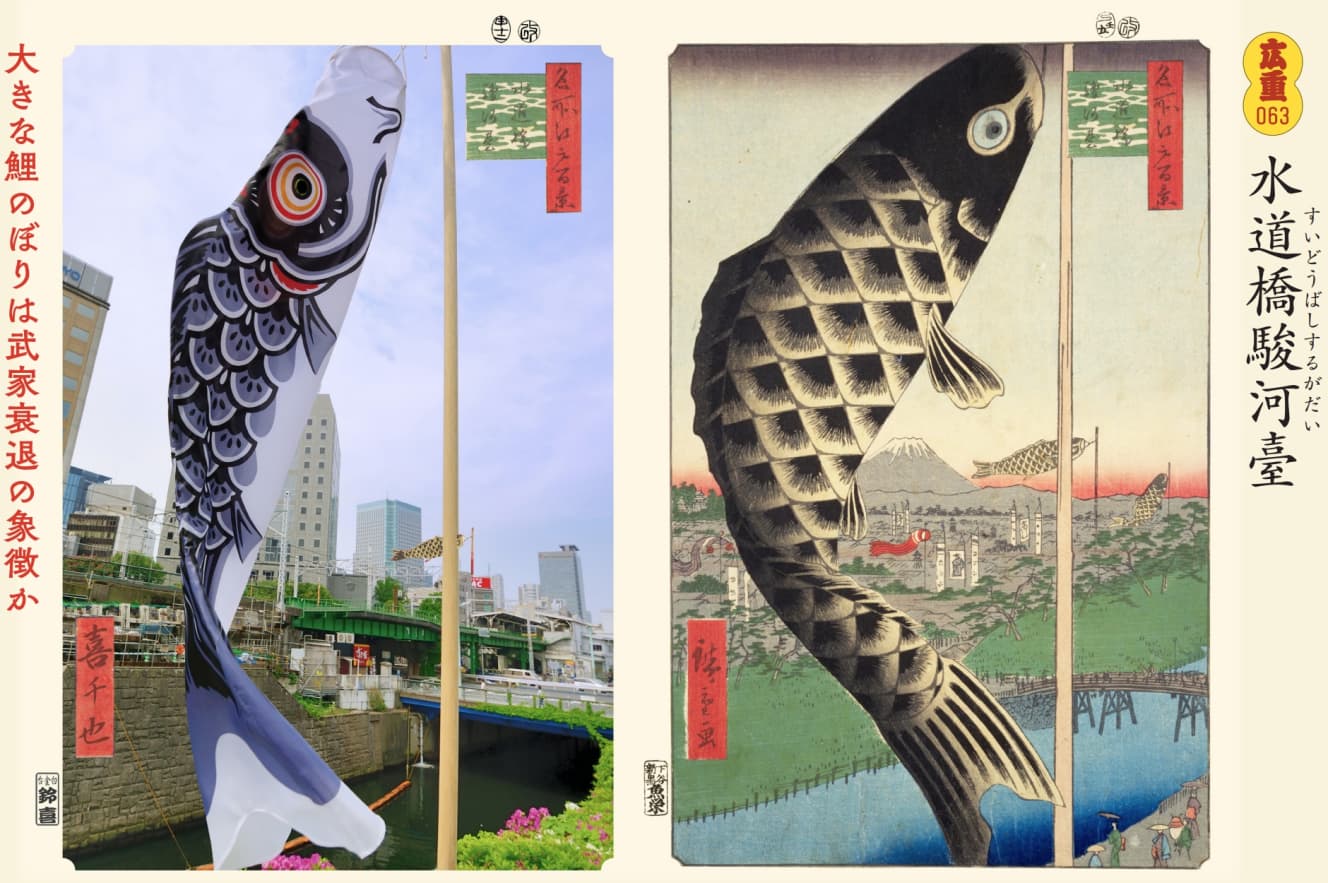
Near Hongo 1-chome, Bunkyo-ku, Tokyo. Fuji from the aqueduct over the Kanda River, but the actual Mt. Fuji is to the left of the frame of the picture. Mr. Kichiya took more than 400 shots until the carp streamers were fluttering nicely.
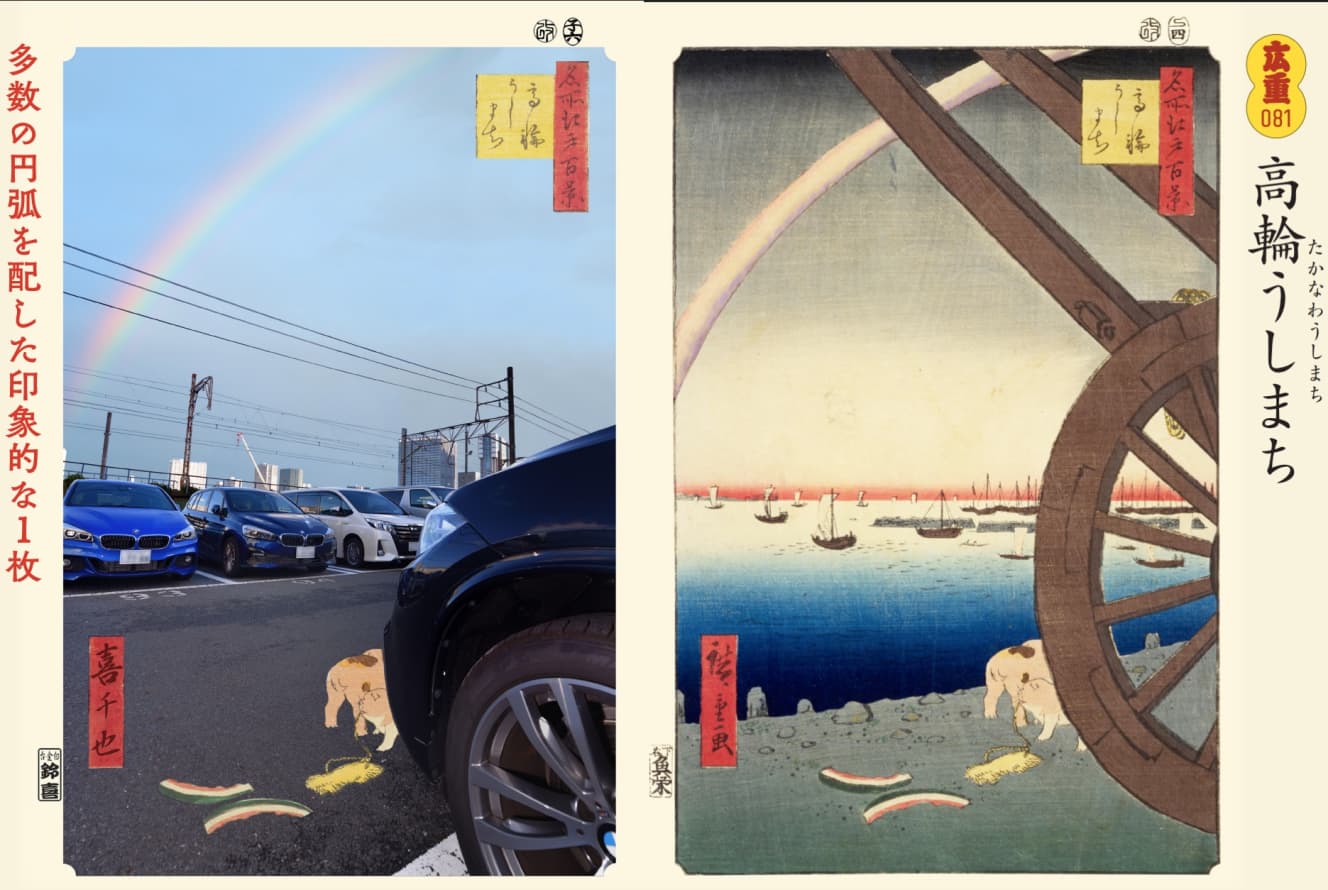
Takanawa Ushimachi (Takanawa 2-chome, Minato-ku) is a town along the west side of National Route 15 in front of the current Takanawa Gateway Station, with the sea to the east of the road. A beautiful composition with many arcs, including a wheel and a rainbow, was reproduced by compositing a rainbow taken at a different location
Kameido Tenjin (Kameido, Koto-ku, Tokyo) is the place that inspired Kicenya to start taking Ukiyo photographs. He said that he had taken a picture of a female bridge when the original picture was of a male bridge, so he re-shot the male bridge this time.
The original picture was a bird’s-eye view of the area from near Sakuradamon gate to near Koji-cho (now Kikamachi, Chiyoda-ku). The actual height of the bridge would have required a great deal of height to get close to the painting, and Hiroshige deformed it to match the composition, so the photograph was also processed to bring the atmosphere closer.
Chuo-dori Avenue (near Ueno, Taito-ku) leading from the current Matsuzakaya Ueno Store to Ueno Park. Ito Matsuzakaya” on the right burned down in the Ansei-Edo Earthquake, but was praised for continuing to operate while providing food to the victims. Matsuzakaya’s logo “Itoumaru” still stands on the same spot today.
Kicenya spent nine years creating the 119 views in this collection.

Hiroshige’s “Meisho Edo hyakkei” no present day” (written by Kicenya, published by Tetsujinsha).

Photo Gallery9 total

Related Articles