Scientists Warn of Multiple Large Earthquake Zones Threatening Eastern Japan


It could even trigger a directly beneath Tokyo earthquake
Japan Agency for Marine-Earth Science and Technology research team member and assistant professor Fumiaki Tomita of the International Research Institute of Disaster Science at Tohoku University has warned that the possibility of a megaquake occurring in Hokkaido and Tohoku is increasing. However, the risk is not limited to northern Japan.
A super-large earthquake could strike at any time. The entire eastern part of Japan could be placed in immediate danger, including the capital region.
Hiroki Kamata, emeritus professor at Kyoto University and a specialist in earth sciences, explains:
“The area beneath the Tokyo metropolitan region is one of the most geologically dangerous in the world, where three tectonic plates — the Pacific Plate, the North American Plate, and the Philippine Sea Plate — converge. If even one major crustal movement occurs within these interacting plates, it could trigger a directly beneath Tokyo earthquake.”
Kamata points to three major seismic zones in the Pacific region that could trigger such an event: (1) the offshore Chiba region where slow-slip events frequently occur, (2) the Boso offshore region where a magnitude 8-class earthquake occurred during the Edo period (Enpo era), and (3) the offshore area where a large outer-rise earthquake could occur.
First, regarding (1), where plates are sliding slowly and ominously, Kamata explains:
“This is an area where, between February and March 2024, the North American Plate above the Philippine Sea Plate moved, causing frequent magnitude 5-class earthquakes. According to Japan’s Earthquake Research Committee, a slow-slip event — where the plate boundary shifts gradually — also occurred.
In this region, slow-slip events happen every few years. Repeated small shifts accumulate stress, which could eventually trigger a major earthquake. In the 2024 activity, the plate boundary is estimated to have moved by up to about 2 centimeters.”
The Great East Japan Earthquake is not over
② refers to a region even farther offshore than ①. This area has also experienced major earthquakes in the past.
“In 1677, a magnitude 8.0 Enpō Bōsō offshore earthquake occurred as the Pacific Plate subducted beneath the North American Plate. A tsunami reaching up to about 19 meters struck the Pacific coast of Chiba Prefecture, causing more than 400 deaths.
The mechanism of the Enpō Bōsō offshore earthquake is also related to the rupture zone of the Great East Japan Earthquake. When a magnitude 9-class megaquake occurs, stress accumulates in the extended parts of the rupture zone, potentially triggering magnitude 8-class earthquakes years to decades later.
For example, after the December 2004 Sumatra earthquake (M9.1), a magnitude 8.6 earthquake occurred in April 2012 in the offshore continuation of the same region. According to estimates in Chiba Prefecture, if a magnitude 8.2 earthquake were to occur offshore of the Bōsō Peninsula, it could generate a tsunami as high as 8.8 meters, resulting in around 5,600 casualties.”
In area ③, numerous faults have been discovered and seismic activity is increasing. This is the outer-rise region located on the outer side of the rupture zone of the Great East Japan Earthquake, where stress conditions on the seafloor and tectonic plates were significantly altered by the megaquake, raising concerns about the possibility of magnitude 8-class earthquakes.
“There have been cases in the past where megaquakes triggered M8-class outer-rise earthquakes. Thirty-seven years after the 1896 Meiji Sanriku earthquake (M8.2), the 1933 Shōwa Sanriku earthquake (M8.1) occurred in the outer-rise region east of the rupture zone. The resulting tsunami reached nearly 29 meters, and the death toll and missing persons exceeded 3,000.
Since the Great East Japan Earthquake, the mechanics of stress across the Japanese archipelago have changed significantly, ushering in a once-in-a-millennium era of major crustal change. Even 15 years after its occurrence, it is not truly over.”
The only looming threat is not the government’s focus on the Nankai Trough earthquake. A serious crisis involving three major earthquake zones in the Pacific is already approaching Japan.
From “FRIDAY” (April 17–24, 2026 combined issue)
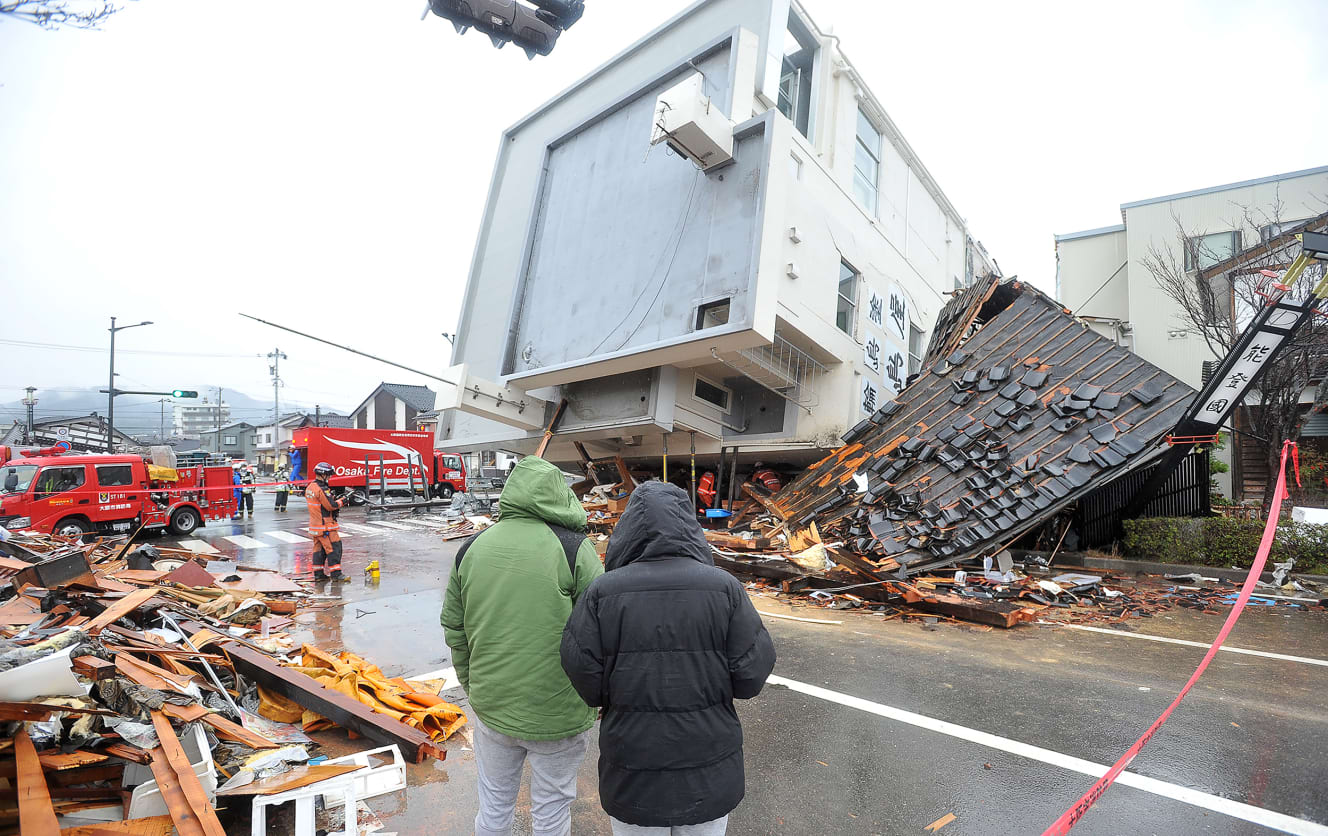

PHOTO: Aika Kano, Junpei Kota, Masayoshi Katayama, Kyodo News