‘I can’t tell my daughter to come home’…Sexual harassment, public scrutiny, no work. The day young women abandon the countryside



Why are young women abandoning their hometowns?
The concentration of people in Tokyo and other major metropolitan areas and the depopulation of rural areas have become serious social problems. What is the reason why young people, especially women, are leaving rural areas and not returning to their hometowns?
Regions with an exodus of young women are more likely to “disappear” in the future. This is because, based on the premise that only women can bear children, there is concern that the outflow of young women will lead to a cycle of fewer births. As a result, tax revenues and government services will become inferior to those of other regions, which could lead to a vicious cycle that accelerates the further outflow of residents.
Which are the worst prefectures for women fleeing?
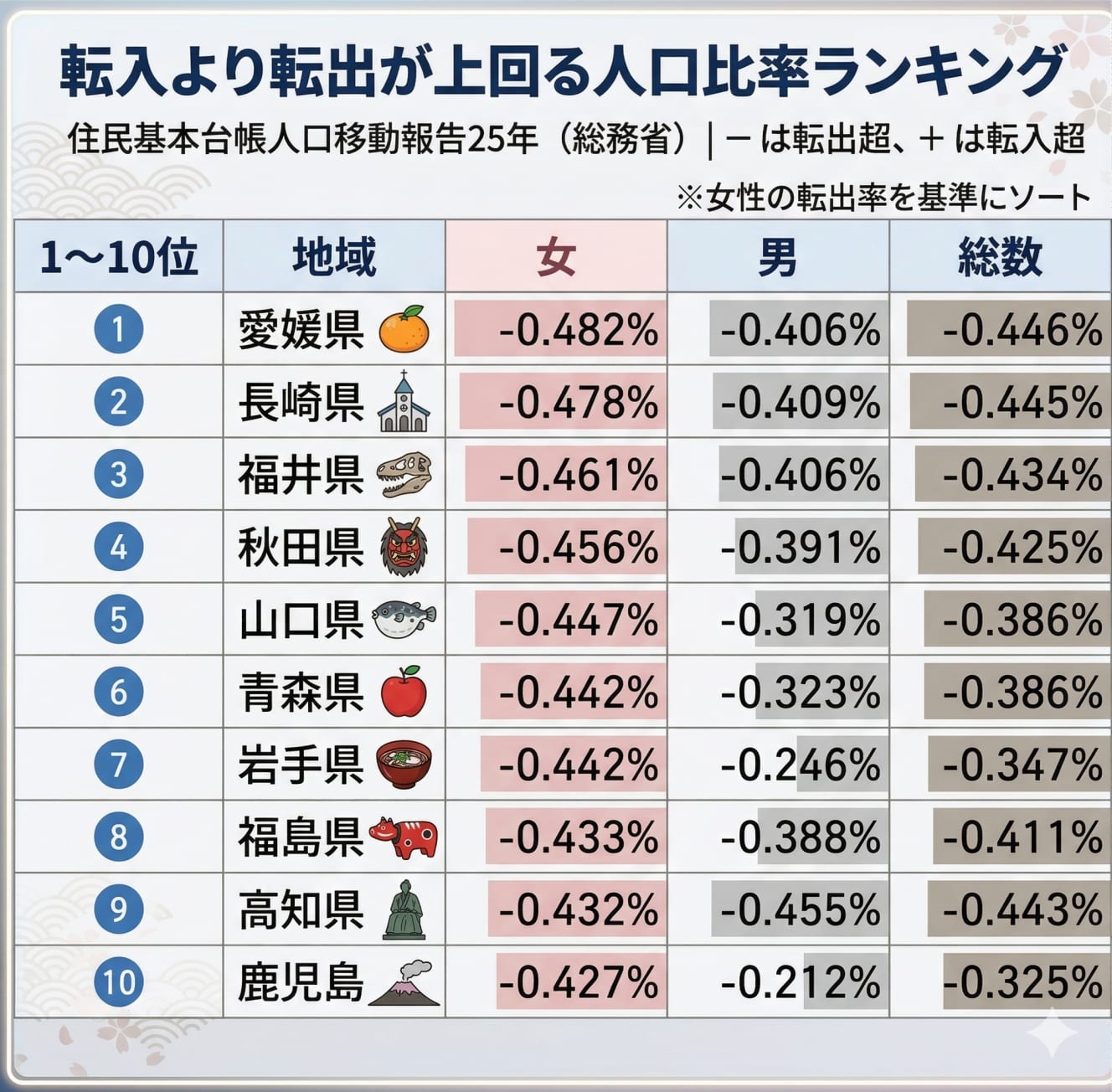
An analysis of the status of in-migration and out-migration by prefecture, based on data from the Basic Resident Ledger Population Movement Report (’25) of the Ministry of Internal Affairs and Communications, reveals a cruel reality.
The percentage of “excess transfers out,” which is a negative figure obtained by subtracting the number of transfers out from the number of transfers in from January to December, was ranked by the percentage of female residents. As a result, a total of 11 prefectures, from Ehime to Yamagata, had a ratio of “-0.4%” or less. All of these prefectures are located far from metropolitan areas, including Shikoku, Kyushu, and Tohoku. If the percentage of women leaving the labor market were to be expanded to 0.3% or less, the total would increase to 22 prefectures, including Gifu Prefecture.
Specifically, Ehime, Nagasaki, Fukui, Akita, and Yamaguchi prefectures have a high percentage of women leaving the labor market. On the other hand, only Shiga, Fukuoka, and Osaka prefectures, as well as four prefectures in the Tokyo metropolitan area, showed a slight increase in the number of women.
The figure of 0.4% may seem small. However, if this decline continues for 10 years, it will be about 4%, and if it continues for 20 years, it will be as much as 8%. Even 0.3% is a 3% decrease over 10 years and a 6% decrease over 20 years, so the problem will snowball as it repeats itself year after year.
Women who “can’t choose their hometown
In many cases, young people in their late teens to early 20s move from rural areas to metropolitan areas for higher education or employment. While a certain number of men leave their hometowns and eventually return, women tend to stay in urban areas.
According to an analysis of the government’s White Paper on Gender Equality and other sources, young women moving to cities are due to the concentration of rewarding and lucrative jobs in urban areas, and the fact that in some regions, women are still expected to give birth and raise children, or play a supporting role for men.
The website of the NPO “Rural Girls Project” raises the following issue.
The website of the NPO “Rural Women’s Project” raises the following question: “The exodus of women from rural areas, is that our problem?”
According to the website, the real problem is not that women are going to the cities, but that they cannot choose their hometowns.
When Ms. Ren Yamamoto, the head of the NPO, started working for a local company about five years ago, she experienced the current situation in which the roles of men and women are clearly divided, and saw firsthand the difficulty for newly graduated girls in working at local companies. This is how she came to establish this NPO about two years ago. Ms. Yamamoto describes how women work at local companies.
They may not be able to move up in terms of compensation, they may not be able to fully utilize the maternity leave system, there are few choices of industries, and women are sometimes limited to care work such as nursing care and nursing.
In addition, the human relations unique to rural areas are also a factor that keeps women away.
In some cases, communication has become a substitute for greetings, such as, “Aren’t you going to get married? In many places, when there is an event such as a festival, it is the women’s role to prepare the food.

Women are subsidized” a stifling reality in rural areas
Ms. Soe Eto, a part-time lecturer at Dokkyo University and an expert on gender issues, explains the structure underlying these problems as follows.
Japanese society has a patriarchal structure, and the sense of gender role division of labor remains considerably stronger than in other countries.”
The patriarchal system is one in which the older male is dominant, and the gender role division of labor is one in which “men do the work and women do the housework,” with men as the primary workers and women as assistants. In some rural areas, the custom of older men sitting at the top and younger men and women at the bottom still remains. Ms. Eto points out the following.
Women are often in a weaker position and feel uncomfortable.
In addition, the “public eye” peculiar to rural areas also makes women feel suffocated. In rural areas, gossip tends to spread easily, and the public’s eye makes women hesitant to live there. In contrast, in urban areas, human relations are loose and there is freedom. Ms. Eto describes the advantages of living in a city as follows: “I have to quit my job because of sexual harassment.
Even if you have to quit your job due to sexual harassment, it is easier to find freelance work in the city.
These differences in the environment are encouraging women to move away from rural areas.
Women who have studied gender issues at university do not want to return to the countryside. Mothers, who know firsthand the hardships that women face, often do not ask their daughters to return to their hometowns.
How can we get women to return to the countryside?
In order to encourage young women to return to their hometowns, the government and local governments are taking measures. The Secretariat for Regional Development, Cabinet Office, Government of Japan has positioned the promotion of “creating regions that are chosen by women” as important from the perspective of regional development.
The following are some examples of efforts to promote women’s activities using the Digital Rural City National Concept grant: a work support program in Ebetsu City, Hokkaido; a project to promote a town where women can live lively lives in Ena City, Gifu Prefecture; and a project to create a lively town by improving the attractiveness of the town targeting the child-rearing generation in Komatsushima City, Tokushima Prefecture. The city of Sapporo, for example, is a bedroom community for the city of Sapporo.
For example, Ebetsu City in Hokkaido, a bedroom community of Sapporo City, faced the problem that despite the large number of households raising children, there were few job opportunities in the city desired by the child-rearing generation. To address this issue, the company opened an employment support center in a major shopping center. A children’s space was set up next to the consultation space, and job postings specifically for local companies were posted on the wall, creating an environment where women raising children could easily seek advice.
While Ms. Eto appreciates that “some regions are doing well,” such as those where child-rearing support is enhanced and households with children move to the area, she points out that there are still some regions where women “do not have many work options and lack freedom” and that there are still challenges for them. She also emphasizes the need for men to share fairly the roles that have been borne by women in the past, such as household chores and supportive duties.
Ms. Yamamoto, who also serves as a member of the Nirasaki City Gender Equality Promotion Committee in Yamanashi Prefecture and as a member of the Cabinet Secretariat’s committee for promoting reform of local workplaces and work styles, also stresses the importance of changing attitudes.
Each local government holds workshops and listens to the voices of women. It is important for local governments to absorb the opinions of women through such events.
Ms. Yamamoto also suggests that men and women should share work roles fairly and be treated equally.
The way we work is important. If the system changes, people’s awareness will change as well.
While it is difficult to suddenly change the mindset of men and women to one of “gender equality,” she stresses the importance of working steadily to improve systems and structures.
In order to become the region of choice for young women, can rural areas provide rewarding jobs and build a society where people can feel freedom? Local regions now face the challenge of overcoming these difficult issues.


Interview and text by: Hideki Asai