Kei Ushikubo Says Supporting Hanshin Tigers Helps Health and Explains the Benefits of Oshi-katsu


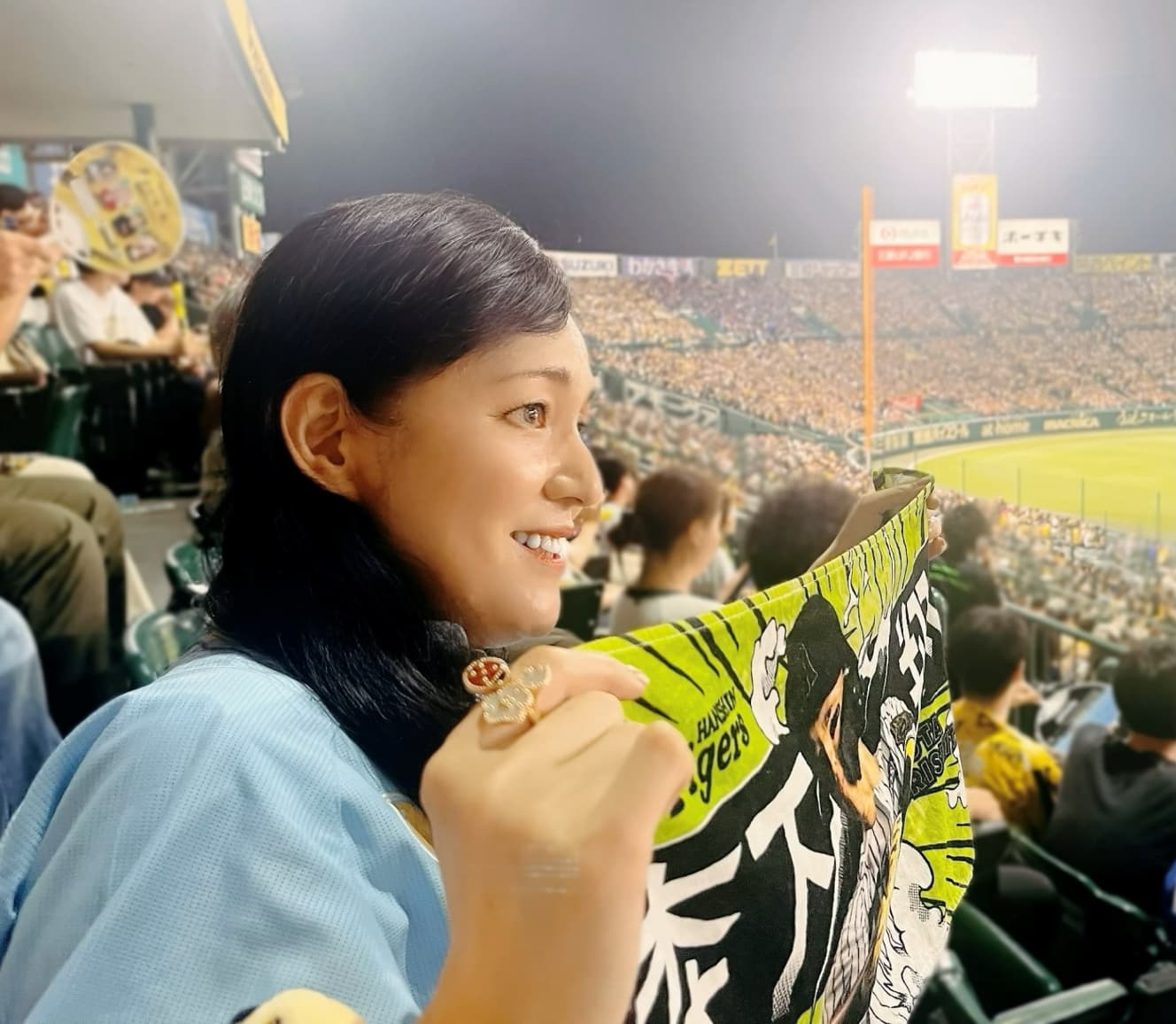
From idols and actors to anime characters and sports teams, “oshi-katsu” (fan devotion activities) has now spread across all genres. However, it is also true that there are people who look coldly upon such passionate fan activities, thinking things like, “There’s no point in getting emotionally invested in someone else’s wins and losses,” or “It’s just wasteful spending to support them.”
However, marketer Megumi Ushikubo argues in her book “If You Want to Be Filled with a Sense of Happiness, Learn About Hanshin Tigers Fans” that highly passionate fan activities significantly increase people’s sense of happiness. She also notes that they may contribute, to some extent, to physical health.
So just how much positive impact does “oshi-katsu” have on our mental and physical well-being? We spoke with Ushikubo, an MBA holder and author of numerous buzzwords such as “single life” and “grass-eater (low-romance type).”
Even watching on TV improves health indicators
—In your book “If You Want to Be Filled with a Sense of Happiness, Learn About Hanshin Tigers Fans,” you analyze the relationship between happiness and Hanshin fans based on numerous academic papers and a survey of about 3,000 female Hanshin supporters. I was particularly surprised by the research finding that symptoms improved among mild dementia patients who were Hanshin fans after the Tigers’ championship season.
“Yes. I write about it in detail in the book, but on the other hand, among people who do not watch sports or do not have a favorite team, there was either no change in the data or a tendency toward deterioration.”
—It is also fascinating that stress hormone levels dropped simply by watching Hanshin games on TV. What originally made you become a Hanshin fan?
“I was originally a huge Yomiuri Giants fan. But various things happened, and I went through a period of drifting as a fan of Seibu, Yakult, and even the Fukuoka Daiei Hawks (then managed by Sadaharu Oh, 85).
Then in 2003, on the day the Hanshin Tigers under the late manager Senichi Hoshino won the championship, it felt like I was struck by lightning—I became a Hanshin fan.
To be precise, I was moved by the coolness of manager Hoshino smiling while embracing Norihiro Akahoshi (49), who had hit the dramatic walk-off hit to clinch the championship. That was the moment I became a Hanshin fan.”
—Even with your busy schedule, do you actively engage in oshi-katsu as a Hanshin fan?
“Generally speaking it’s oshi-katsu, but for me it’s going into battle (laughs). Once the season schedule is announced, I try not to schedule work in Tokyo around the Japan Series or Climax Series period, because there is a chance the Tigers could clinch the championship in Koshien (Hyogo Prefecture).
Even so, I can only attend about 40 games a year. I watch the entire game live at the stadium from first pitch to the end, and then rewatch everything again on video from the top of the first inning.”
—Even though you already know the outcome and when runs will be scored?
“I want to review moments like replay requests (video challenges to umpire decisions), and situations that are hard to see clearly in the stadium. I also want to carefully observe things like players’ facial expressions at bat or in the dugout, or whether a player who was hit by a pitch looked seriously injured or seemed okay. I really want to reexamine those small details.”

—It really sounds like you’re completely immersed. So Hanshin oshi-katsu is effectively energizing your mind and body, isn’t it?
“Dopamine in the brain (a neurotransmitter) is released as part of the reward system, providing feelings of satisfaction and achievement when something you intended is fulfilled. However, dopamine is said to be released most strongly not at the moment of fulfillment, but during the period when you are excitedly anticipating that it will be achieved.
From that perspective, the most pleasurable moment is not actually when watching the game itself, but when you are imagining ‘I’m going to Koshien!’ and preparing for it with excitement. In other words, oshi-katsu provides happiness not only during the activity itself, but also in everyday life leading up to it.”

“Oshi-katsu needs serendipity!!”
—To begin with, what is the difference between oshi-katsu and simple fan activities?
“The most important aspect of oshi-katsu is mutually enhancing happiness with companions. Until around 2010, the trend word was moe. In a sense, it was a two-party relationship between the object of affection and oneself. Other fans around you were seen as rivals, or even closer to obstacles.
However, from around 2012 onward, with the spread of social media, people became able to connect with like-minded individuals through their ‘oshi’ and enjoy things together. Looking ahead in Japan, it is expected that by around 2035, about half of the population will be single, and more people will likely live with feelings of social isolation.
Even in such a society, what supports people is oshi-katsu as a form of social capital. In fact, there are research findings showing that happiness increases when people engage in oshi-katsu with multiple others.”
—It does seem that supporting together, watching works or live performances, and collecting merchandise would double the enjoyment when you have companions.
“The sense of unity among Hanshin fans at Koshien is truly like a family. Even people sitting nearby who have just met become like old friends as the game progresses. During moments like a Hanshin score or home run, everyone high-fives enthusiastically, and they even exchange goods, food, and alcohol. That is a uniquely Koshien scene—something I never experienced when I supported other teams.
So when I go to Koshien, alongside anticipation for the game, my heart also races with excitement about who I might meet today. When I take my seat at the stadium, I almost always greet the fans around me, saying, ‘Let’s enjoy the game together today.’”
—Many people still haven’t started oshi-katsu. For people starting later in life, how can they find something to become passionate about?
“It has actually become clear that dopamine release in oshi-katsu is similar to romantic love. If you have an object of affection, you feel excitement like ‘Did our eyes just meet?’ and sometimes even experience serendipitous encounters.
Recent research shows that people who stick only to fixed routines are less likely to experience serendipity. So I recommend intentionally introducing actions that break your daily routine—for example, walking a different route than usual, watching a film you normally wouldn’t choose, or buying a new product at a convenience store instead of your usual items. By deviating from your normal routine, the chances of serendipity bringing you a new oshi-katsu subject increase.”
—A 50-something man I know started idol oshi-katsu after hearing a song playing in an izakaya during a trip, which made him remember how much he used to like it in the ’80s.
“For middle-aged and older people, there are probably things they wanted to do when they were younger but couldn’t, or things they gave up on. That kind of idol oshi-katsu is one example. The object of support can be 2D or 3D—it doesn’t matter.
Today, the environment for oshi-katsu is much more accessible. In the past, following your oshi required money and time, but now there are free social media and video platforms. You can access them in your spare time.
However, you should not push yourself too hard. Make sure to sleep properly, maintain your autonomic nervous system, and first take care of your own health. I say this partly as self-reflection too (laughs). On top of that, finding an oshi and enjoying it is the key point.”

—While oshi-katsu is enjoyable, it seems there may be negative aspects if you do it too much. What points should we be careful about?
“First, don’t overspend money. It’s good to create a separate account for oshi-katsu. Enjoy oshi-katsu within a limited budget. However, I myself can’t really restrain myself (laughs). Even when the funds in my dedicated account run out, I sometimes break my own rules and think, ‘Just this once, I’ll pay with PayPay.’
Of course, it would be best if you could discipline yourself, but it’s also better to have people around you who can stop your oshi-katsu from going out of control. In my case, that role is played by my husband, who says, ‘You really need to stop already’ (laughs).
Also, I recommend having multiple oshi-katsu targets. If you get too deeply into just one, you tend to become overly dependent. If my only oshi were the Hanshin Tigers, I might end up focusing only on immediate wins or this season’s championship.
In that case, when they lose, you might become aggressive, thinking, ‘Why did the manager make such a decision?’ or feel helpless, like ‘I supported them so much, but they still lost.’
That’s why I consciously diversify my oshi-katsu and spread the risk. For example, I also enjoy travel, food tours, and other sports, so even if Hanshin loses, I can think, ‘Well, at least that rookie played well today,’ and feel satisfied by expecting medium- to long-term returns.”
—When someone feels strongly that “I’m supporting them so faithfully,” it can sometimes not look very happy. I know fans like that too (laughs).
“Having multiple hobbies or oshi-katsu interests also creates synergy effects. In my case, when I travel for Hanshin games, I can also enjoy sightseeing and hotel experiences, and I get excited about going to eat local specialties. Studies on well-being also show that people who have two or three oshis are happier than those who have zero or just one.”
It is desirable to start many oshi-katsu activities and aim for a life with longer hours of happiness.
Interview & text / Yutaka Sano
Sano Yutaka is a freelance writer. With business and humanities as his main fields, he is active across various media including magazines and online platforms, focusing on reporting and writing articles. He has authored many books.
PHOTO: Courtesy of the artist, Yutaka Sano (4th photo)