Akama Jiro, Kato Katsunobu, Mihara Junko, and Tanabe Masayo


Overcoming weaknesses
The World Super Bantamweight unification bout to be held at Tokyo Dome on May 2 is drawing worldwide attention as a match of the century.
Japan’s boxing prodigy Naoya Inoue (32), who needs no introduction, will headline the event. His challenger, Junto Nakatani (28), unified the bantamweight division last June and is ranked 7th in the pound-for-pound (PFP) rankings across all weight classes, demonstrating immense strength.
Both fighters are undefeated in 32 bouts. With the strongest champion facing the strongest challenger, it is one of the greatest fights in Japanese boxing history, and predicting the winner is extremely difficult.
Therefore, we asked politicians in Nagatachō—who are engaged daily in political power struggles—to predict the outcome of the top-tier showdown.
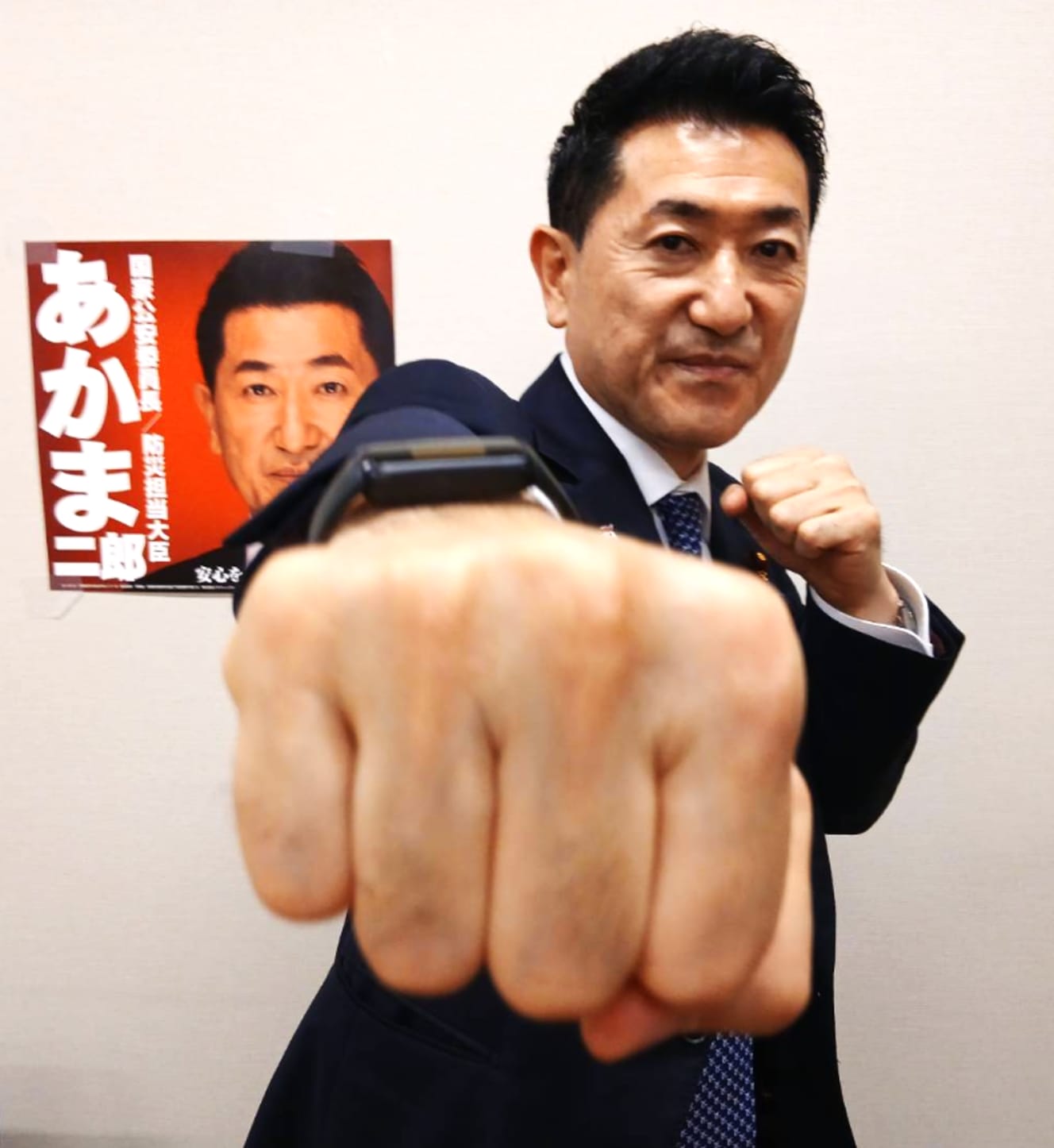
First, Akama Jiro (58), Minister of State for Special Missions (National Public Safety Commission Chairman), who fought both as an amateur and professional boxer. When asked to predict the winner, he folded his arms in silence for a while before answering:
“It’s difficult. The more I think about it, the more I can’t tell who will win.”
Akama began boxing at Rikkyo University and competed in official matches from his second year, mainly in the lightweight division, fighting 20 bouts. In his fourth year, he served as vice captain and led the team to a league championship, helping Rikkyo University Boxing Club rise from Division 3 to Division 2.
After graduating, he studied in the UK and later worked as a secretary to his father, a Kanagawa Prefectural Assembly member, while attending Yokota Sports Gym. At age 30—the last possible age for the pro test at the time—he obtained his professional license and made his pro debut in July 1998. He later lost by decision over four rounds to Sojiro Kato (48), who would go on to become the Japanese welterweight champion, and then retired. In 1999, he became a Kanagawa Prefectural Assembly member.
In 2005, he ran in Kanagawa’s 14th district and was elected for the first time, becoming a member of the House of Representatives. He later served in the Cabinet Office and as Vice Minister for Internal Affairs and Communications, and in October 2025, he was appointed for the first time to the cabinet as Minister of State for Special Missions under the Takaichi administration.
When asked about the fight details, the boxer minister suddenly stood up from his chair and took a fighting stance. He had the reporter adopt a southpaw stance to represent Nakatani, while demonstrating Inoue’s signature step-in combinations targeting the body and head.
“Boxing is a distance sport—the key is controlling your range. Nakatani is a tall southpaw. An orthodox fighter like Inoue would normally struggle against that. However, Inoue previously had difficulty with tall southpaws early in his career, but that is no longer the case.
Nakatani will likely use his long reach to probe with a right jab. Inoue will try to slip the jab, step in, and attack the left body. Inoue’s step-in speed is extraordinary, but Nakatani also has the skill to counter with a left uppercut.
In the early rounds, it will come down to who lands the jab first. They will measure distance, angles, power, and timing, resulting in highly technical exchanges and relentless rounds. Both have high-level technique, speed, and counterpunching ability, and both can control distance and build fights. I see no real difference between them, so I believe the winner will be the one in better condition on the day of the fight.”

Was unable to knock him down with a counter punch
Katsunobu Kato, former Chief Cabinet Secretary (70), who also serves as chairman of the Parliamentary League for Professional Boxing and is scheduled to watch the fight at Tokyo Dome, smiled and said, “It is truly a match of the century. I’m already looking forward to it.”
“I believe Naoya Inoue has the advantage in his ability to control his opponent and dominate the flow of the fight.”
As Kato points out, for a boxer, the ability to analyze and control an opponent is crucial. After the bell, fighters observe the opponent’s hand speed, punch extension, range, rhythm of footwork, and stride length. They mentally process differences between pre-fight footage and the opponent’s actual movements, building strategies to take control of the bout.
Inoue’s ability includes drawing opponents into throwing punches as planned, then aiming counterattacks—an example of his high-level ring intelligence. Kato continued:
“Against Inoue, even champions from other organizations and world-ranked fighters cannot fight at their own pace. Opponents try to read his movements and break his rhythm, but in most bouts, Inoue ends up controlling the entire flow of the fight. His boxing is orthodox, and he never underestimates any opponent.
On the other hand, Nakatani is not yet as capable as Inoue in controlling opponents. I’m not sure whether it will end in a knockout, but I see it as an Inoue victory by decision.”
Former Minister in charge of Children’s Policy Junko Mihara (61), who has 30 years of boxing-watching experience and claims to have watched Inoue and Nakatani fights live—including Inoue vs. Luis Nery at Tokyo Dome in 2024—gave a brief answer:
“Inoue.”
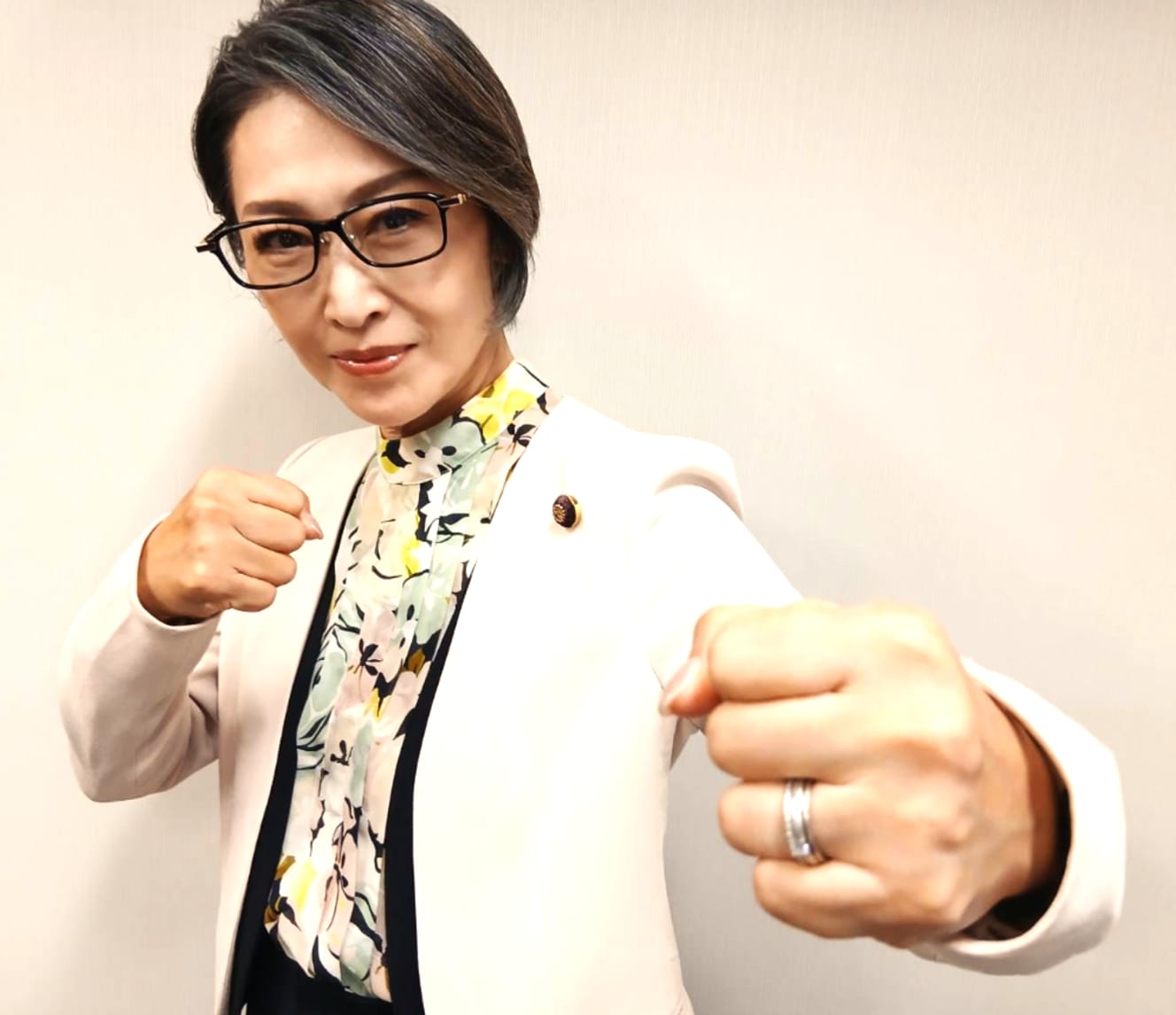
When asked about the intent behind her immediate response, she analyzed, Inoue has achieved results in the super bantamweight division, while Nakatani has not yet fully adapted to it.
In December last year, Nakatani fought his first bout after moving up to super bantamweight in Saudi Arabia, where he struggled and narrowly earned a decision victory despite significant swelling around his right eye.
“Nakatani excels at both long and close range, and was dominant during his bantamweight days. However, moving up one weight class may have forced him to confront a wall between divisions. In his most recent fight in Saudi Arabia, an opponent who would likely have been knocked out at bantamweight survived a counterpunch. It is also questionable whether he has the stamina to go the full 12 rounds at super bantamweight.
On the other hand, Inoue has already adapted to super bantamweight, and is likely at his peak right now. Nakatani is still only in his second fight at the weight, so there are lingering uncertainties. If his stamina fades in an unfamiliar division. In the later rounds, Inoue may be the one to finish him.”
Having watched many of Inoue’s world title fights live at venues, Mihara praised the champion:
“The sound of his punches is different from other fighters. It feels like it resonates in your stomach. It’s not just power—his speed and technique are on another level. I can’t imagine Inoue losing.”
Key factors that will decide the victory
Masayo Tanabe (56), secretary-general of the Constitutional Democratic Party of Japan, has been fascinated by Joichiro Tatsuyoshi (55), once dubbed “the charismatic figure of the Heisei era,” and has been a boxing spectator since the early Heisei period. She reportedly attends events in Hachinohe City within her electoral district when fights are held there, and is also known to show up at Korakuen Hall.
“Inoue is highly skilled at quickly reading distance and timing, and he excels at controlling his opponent. However, Nakatani is a southpaw with a height of over 170 cm and a long reach, so it may not be easy for Inoue to immediately find his ideal range.
In the end, I feel the deciding factor will be the will to win—the strength of the desire to win. In that sense, Nakatani left Japan alone at 15 and chose not to attend high school or university on a sports scholarship, instead honing his craft in Los Angeles. He may be the only fighter capable of threatening the precision of the reigning champion.”

Nakatani, meanwhile, left Japan at the age of 15 and entered the camp of master trainer Rudy Hernandez. Hernandez is known for his emphasis on real-fight conditions, avoiding excessive use of the heavy bag. His sparring sessions are unique and demanding—fighting against much heavier opponents, training with only the right hand, or continuing from cornered positions.
Unlike the standard uppercut thrown with a rotated fist, Nakatani sometimes delivers it vertically, slipping it through guards. His style is practical, unorthodox, and instinctive—a reverse-import boxer with a wild, combat-driven appeal.
In contrast, Inoue, an elite boxer with seven amateur national titles, made an unusual request when joining the Ohashi Gym: “Please match me with strong opponents.” The two fighters reached the top through completely different paths, and now they are about to face each other.
Both Mihara and Tanabe, coincidentally, expressed the same thought:
“A fight we want to see, and also a fight we don’t want to see.”
On May 2, one of the two fighters—each carrying 32 consecutive wins—will suffer their first defeat.


Photography and text by: Daisuke Iwasaki