Under Xi Jinping’s Strongman Rule China’s Economy Is Speeding Up Its Own Decline Through Hostility Toward Japan
Japan announces "export ban and monitoring" of 40 Japanese defense industry companies and organizations. Experts warn of a five-year plan full of contradictions, a real estate slump, and more.


A large amount of real estate turning into bad debt
The Chinese government has stated that it will stabilize employment for workers. On the other hand, it is also placing importance on strengthening advanced technologies such as AI (artificial intelligence) and robotics. This is contradictory. If the development of AI and robotics advances, it could significantly take away jobs from workers.
This analysis is made by Kenji Minemura, a leading expert in international affairs, Senior Fellow at the Canon Institute for Global Studies and Head of its China Research Center. China’s economy is now slowing down. China’s real GDP growth rate, which was around 10% in the late 2000s, has recently fallen to around 5%, and the country continues to struggle without a clear solution to its recession.
Minemura continues his explanation.
What was surprising at the National People’s Congress (equivalent to Japan’s Diet), which ended on March 12, was that the 2026 GDP growth target was lowered to 4.5–5.0%. This is the lowest level since the 1990s. Until last year, the target was set at around 5%, but it seems the government can no longer maintain a strongly optimistic stance. Looking at reality, some U.S. think tanks even estimate that around 2% would be appropriate.
Setting high targets creates distortions. The damage to local governments is especially severe. In order to meet quotas, local governments are forced to continue real estate development regardless of profitability. However, unlike the early 2000s when the real estate investment ratio reached 50%, in the current post-bubble environment there are no buyers. The massive amount of real estate that has become inventory is turning into non-performing loans, putting pressure on local economies.
AI is a double-edged sword
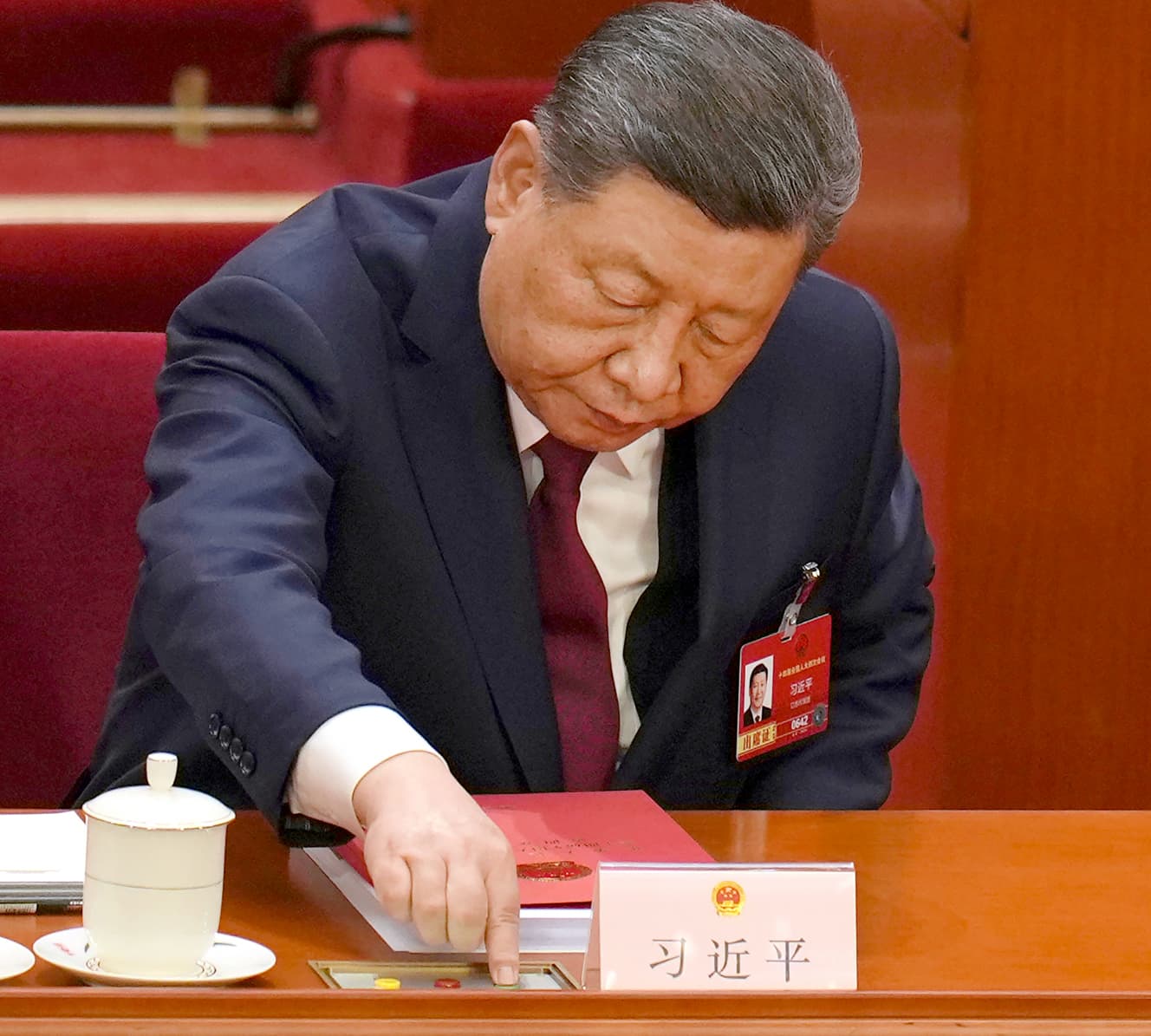
Behind this lies the dilemma of the one-man dominance of General Secretary Xi Jinping. Having abolished the presidential term limit of two terms, 10 years in March 2018, Xi has become an absolute authority.
Growth targets are, in practice, orders from Xi. When a person with immense power says do it, those around him have no choice but to comply. In particular, Xi has been pushing an anti-corruption campaign. If someone disobeys orders, they may be labeled as corrupt and purged. China’s economic stagnation is, in my view, a consequence of Xi’s ultra-centralized system.
The “Five-Year Plan” adopted at the National People’s Congress lists investment in new businesses such as AI, robotics, and quantum technology as one of its goals (see table for main points). On March 6, the Chinese government announced that it aims to expand the AI-related industry to a scale of 229 trillion yen by the end of 2030.
Advances in AI and robotics are a double-edged sword for China’s economy, as they may take away human jobs. The Five-Year Plan states that it will create employment for migrant workers and young people from regions where unemployment is worsening, and increase income to boost consumption capacity. Many of them work in manufacturing. However, jobs that were previously done by humans in manufacturing are now being taken over by AI and robots. The Chinese government reports that youth unemployment (ages 16–24) is around 16–18%, but some estimates suggest it exceeds 50% in rural areas.
On the other hand, China has announced a monitoring list that tightens export screening of dual-use goods under the pretext of involvement in strengthening Japan’s military capabilities. The list includes 40 Japanese companies and organizations subject to export bans or monitoring (see table). Recently, “Japan-bashing” has been accelerating, but this is counterproductive for China’s economy. Many Japanese companies have factories in China and employ local workers. Some have been rooted in local communities for decades and provide technical training to workers. Strengthening sanctions against Japan will further reduce employment, leading to the self-destruction of the Chinese economy.
The Five-Year Plan also sets a long-term goal of doubling GDP per capita by 2035 compared to 2020 levels.
The Chinese government is offering subsidies ranging from just over 10,000 yen up to around 440,000 yen for replacing cars and home appliances, likely in an attempt to stimulate weak domestic demand. However, it is hard to imagine that many people will frequently replace cars. In other words, this reflects a lack of effective ideas. Without fundamental measures, the goal of doubling GDP by 2035 compared to 2020 will not be achieved.
China is constrained by a planned economy led by the Communist Party and tends to set long-term targets. But with conflicts such as the outbreak of clashes between the U.S. and Iran at the end of February, who can really predict the future? China’s economic downturn is the inevitable consequence of the ultra-centralized system under Xi Jinping.


From “FRIDAY”, April 10, 2026 issue.
PHOTO: AP/Afro CFoto/Afro