I want it as a tattoo! Abrazemi in neon! The true nature of the “fluorescent creature” that glows with black light.


Shocking discovery of beautiful “fluorescent creatures
The “green sea anemone” glows blue and orange, the “octopus jellyfish” has a pop polka dot pattern, and the “abrazemi” floats like a neon sign. ……
A photo collection titled “Creatures of Light and Darkness: Beautiful Life Forms Glowing in Black Light” (KADOKAWA), which captures the unknown appearance of “fluorescent organisms” that react to ultraviolet (UV) light and emit a cyber-like light, has been attracting attention. The author is Gan Yu, a wildlife photographer based in Matsue City, Shimane Prefecture.
He began taking UV photographs in 2006, using a black light or strobe to irradiate ultraviolet rays onto a subject and capture its luminescence. Since then, he has been taking UV photos of aquatic organisms, insects, birds, and plants, posting his fantastic photos on social networking services, and has received many admiring comments such as “too mysterious” and “too fresh. This book contains more than 70 photos of glowing creatures, including those that have been the subject of much buzz.
Most of my photos of fluorescent creatures are probably the first of their kind in the world, ” he said. However, an Italian photographer specializing in flowers has already published a book of photos of glowing flowers, so I missed out on a world first for a photo book.
Gan Yu is disappointed, but there is no doubt that she is a leading photographer of fluorescent organisms.
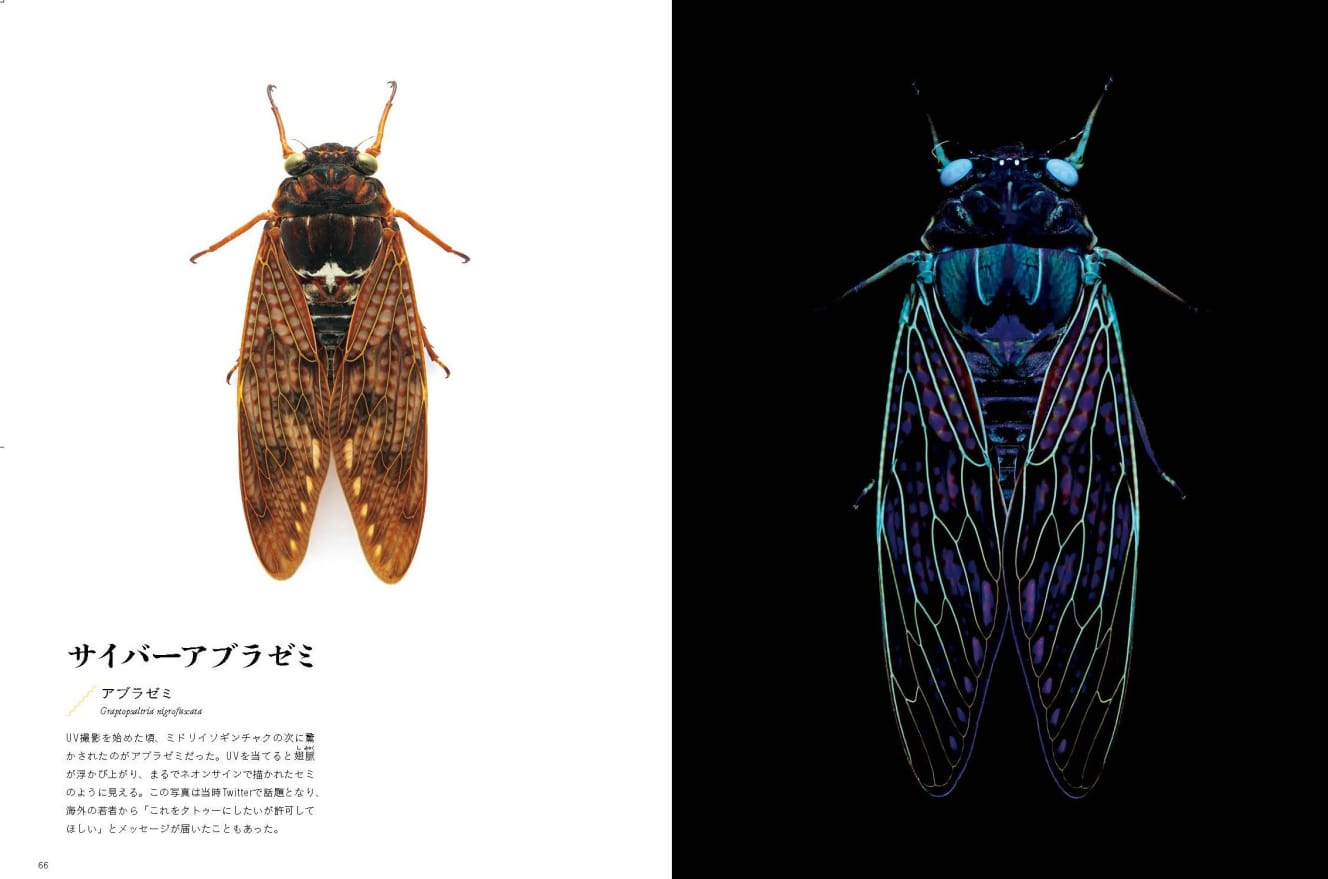
When I posted a photo on Twitter (now X) of an “Abrazemi glowing,” I was surprised by insect researchers.
If I could shine ultraviolet light on the creature in front of me and photograph its fluorescence, it could be the world’s first photograph. It ‘s fun to think that there are an infinite number of unphotographed subjects around me.
To begin with, “fluorescence” refers to the phenomenon in which a substance absorbs light energy such as ultraviolet light and emits visible light that can be seen by the human eye. What was it that led Ganyu to focus on the “fluorescence of living organisms”?
I had been taking photographs specializing in minerals for about four years, so I knew that stones glow.” When I found a brightly colored green anemone in the ocean in 2006, I had the same feeling I get from glowing minerals, and it hit me: ‘This is fluorescence. I think it was just the sunlight shining on it, but it really was the color of a fluorescent marker.
I took it home and shined a black light on it, and my intuition was right. The anemone emitted red and yellow fluorescence. I was so pleased with my discovery.
The three green anemones shown in the book are blue, red, and green, and while one would think that a single anemone would change color depending on the intensity and angle of the ultraviolet rays, this is not the case.
Each anemone has a different fluorescent coloration. Each anemone has its own personality, its own character. There are anemones, beryl anemones, and other anemones in the sea, but they are not diverse at all. Only the green anemone is colorful, perhaps because of its strong individuality.”

Tattoo Aspiration! Glowing Abrazemi.
The octopus jellyfish, with its blue and red body covered in lime green polka dots, is another impressive beauty.
Octopus jellyfish have a type of photosynthetic algae called zooxanthellae living symbiotically inside their bodies. The lime green polka-dot pattern is the fluorescence emitted by the octopus jellyfish, but the red glow comes from the zooxanthellae. The red glow is caused by the reaction of chlorophyll, which emits red fluorescence.
The first half of the book is devoted to underwater life, while the second half is devoted to insects and arthropods. The most eye-catching of all the insects is the abrazemi, which appears to be painted with blue, green, and purple lines against a black background.
I had a feeling from the beginning that the aburazemi would also glow fluorescently, and in fact it was the aburazemi that I photographed next to the green anemone. When I photographed it, it glowed beautifully. It got quite a buzz on X, and I got a message from a young man overseas saying, “It’s such a cool picture, can I use it for a tattoo?
If I hadn’t taken pictures of anemones and blue jellies, I might not have gotten into photographing fluorescent creatures as much as I did. I think it was because I felt that there was nothing more interesting in the world than these two species that I decided to pursue it further.
You don’t know whether or not your subject will light up until you expose it to ultraviolet light. When his intuition is right and the creature glows with fluorescent light, “I am extremely happy,” says Ganyu.
A hairy dandelion is one such subject.
I tried to bring home a dandelion in a downy state, but the moment I plucked it, it scattered. After several attempts, I gave up and took home a dandelion that was still in flower, and waited for it to turn into cotton wool while I cultivated it.
Although I had thought it would glow in shape before I took the picture, I did not expect it to glow so beautifully. It looked even better than I expected, and I couldn’t help but say, ‘Yes!

Secret Techniques Revealed! UV Photography and Medical Dreams
Mr. Ganyu says that he established his method of UV photography about a year after starting to use it. In this book, he generously shares his techniques.
I am the type of person who, once I get hooked on something, I just go for it, ” he says, ” so I bought all kinds of equipment and experimented around a lot until I found the style that I knew was right. I have been shooting in that style ever since.
I use a Canon mirrorless single-lens reflex camera, a modified original UV strobe, and UV protective glasses. Ultraviolet rays are electromagnetic waves with wavelengths ranging from 10 to 380 nanometers, which are shorter than visible light, but I shoot with 365 nanometer ultraviolet rays. I shoot with 365-nanometer UV light because it produces the most beautiful photographic results.”
At this point, the world of UV photography must be dominated by Ganyu-san. Is it okay for him to simply teach his techniques?
I have been asked several times by photographers how to shoot in a roundabout way, ” he said. I didn’t want to give up the blue ocean (a new market with no competition) that I had discovered, so I kept it a secret for a long time.
But I guess the publication of my photo book has made me enter a phase in my life where I want to expand the scene of UV photography. I hope that more and more children will enjoy UV photography and that it will become a standard part of their free research.
He also has this dream.
I secretly hope that the fluorescent organisms I have discovered may be useful to mankind. Take, for example, the Itoyoridai, which I have included in my photo collection. The fish has a metallic pink body, and when exposed to ultraviolet light, it glows blue and a yellow line emerges. Moreover, the yellow line did not lose its fluorescence even when it was boiled.
The fluorescent protein of a glowing jellyfish called owan jellyfish is being used in cancer research. Itoyoridai, which glows without denaturing when heated, may also harbor components useful in medicine. I would be very happy if some researcher sees my photographs and starts studying them.
Imagining that his work might be useful to mankind seems to motivate him even more. What is Mr. Ganyu’s next target for UV photography?
The blue-spotted mantis, which lives in the mud. They are a species of crab, and they have very colorful shells and scabs. I am hoping to photograph them in Malaysia next month.”
GANYU GANYU, real name Takuya Moriku, is a wildlife photographer. Born in Hiroshima Prefecture in 1979. He became interested in fishing when he was in high school and started photographing the fish he caught at the same time. Admiring Hideto Konishi, the editor of an illustrated book on fish, he began taking photographs of fish specimens. After graduating from university, he photographed brackish water creatures, Canadian nature, minerals, etc., and started UV photography in ’18. He is also a member of the Japan Society of Natural Science Photography.


First Public Appearance! Fascinating Glowing Creatures


Interview and text by: Sayuri Saito PHOTO: GANYU GANYU