Inside Japan US Military Drills Massive Iron Fist 26 Exercise in Okinawa Captured Up Close
The latest amphibious vehicle ACV and MV-22B Osprey appeared, and thousands of personnel participated in total... What the tense scene means


Combat training against a simulated enemy
Under cloudy skies with light rain, a deep, roaring bass echoed across Maenohama Seaside Park in Tanegashima. Parents walking with children and elderly people walking dogs looked up in surprise as the massive U.S. Marine Corps MV-22B Osprey appeared among the trees.
Upon landing in the park, the rear hatch opened, and U.S. Marines carrying rifles and mortars disembarked. They crossed the field and proceeded along the walkway while remaining alert.
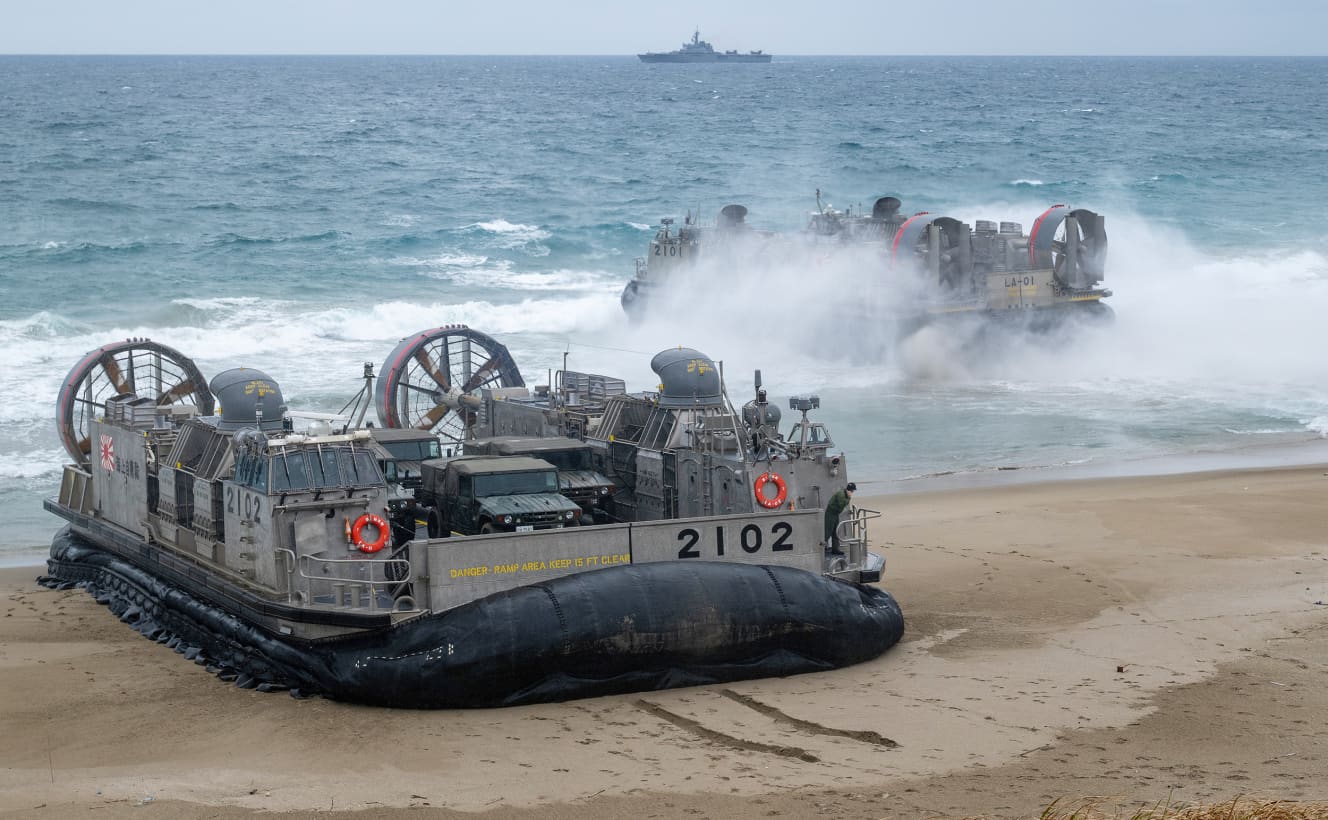
From there, about 30 km northeast, at Nakayama Coast in the center of the island, the Japan Maritime Self-Defense Force’s hovercraft-type landing craft LCAC landed, delivering high-mobility vehicles and other equipment.
Two days later, military vehicles began landing on the coast of Hisashi, Nago City, Okinawa. The U.S. Marines’ new ACV, equipped with wheels, ran up the sandy beach and onto public roads—
This was part of the U.S.-Japan joint exercise “Iron Fist 26,” conducted from February 11 to March 9 by Japan’s Amphibious Rapid Deployment Brigade, the Japanese version of the Marine Corps, and the U.S. 3rd Marine Expeditionary Force stationed in Okinawa. The U.S. also deployed major carriers such as the Abraham Lincoln and Gerald R. Ford to the Middle East and carried out intense airstrikes against Iran, while conducting the largest-ever island defense exercise involving around 4,900 personnel from both countries.
Various exercises are held between Japan and the U.S. throughout the year, but “Iron Fist” is slightly different in character. This joint exercise, held annually since 2006, explicitly assumes a confrontation with a simulated enemy—China.
In the 2000s, Chinese demonstrations of naval and air power intensified around Japan’s southwestern islands. The Japanese Ground Self-Defense Force, long focused on defending northern regions, had to change tactics, but lacked know-how in island defense. Thus, the joint training “Iron Fist,” modeled on the U.S. Marine Corps, was launched.
Starting with basics such as combat swimming in full gear used in the U.S., then training with amphibious vehicles, the Amphibious Rapid Deployment Brigade was newly formed in 2018. From 2023, the exercises finally moved to Japan, using actual islands as sites for island defense training.
“Training outside designated ranges is called live-ground training. It uses actual terrain and is indispensable for improving tactical skills. Even Air Self-Defense Force fighter jets train for dispersed operations at civilian airports in case their bases are destroyed,” said a Ground Self-Defense Force official.
On March 6, combat training with enemy forces landing on the island was conducted. The rifles carried by Japanese and U.S. personnel had radar transmitters, and their bodies had radar receivers. When hit by the enemy’s laser, an alarm sounded from the receiver, and in the worst case, they were judged killed in action. Amid the loud blank-fire gunshots, Japanese and U.S. personnel advanced steadily.
The U.S. Department of Defense is wary of a potential Chinese invasion of Taiwan in 2027, the 100th anniversary of the PLA. For Japan, the China-Taiwan issue is not a distant problem. This shared sense of crisis created tension on the ground. One can only hope that today’s tragedies in Iran do not occur in East Asia.


From the March 27/April 3, 2026 issue of “FRIDAY”
Photography and text by: Masayuki Kikuchi (military photojournalist)