“Rent’s Too High! Fix It!”—50s Man Facing Job Loss Shares Harsh Life Struggles in Shinjuku Protest


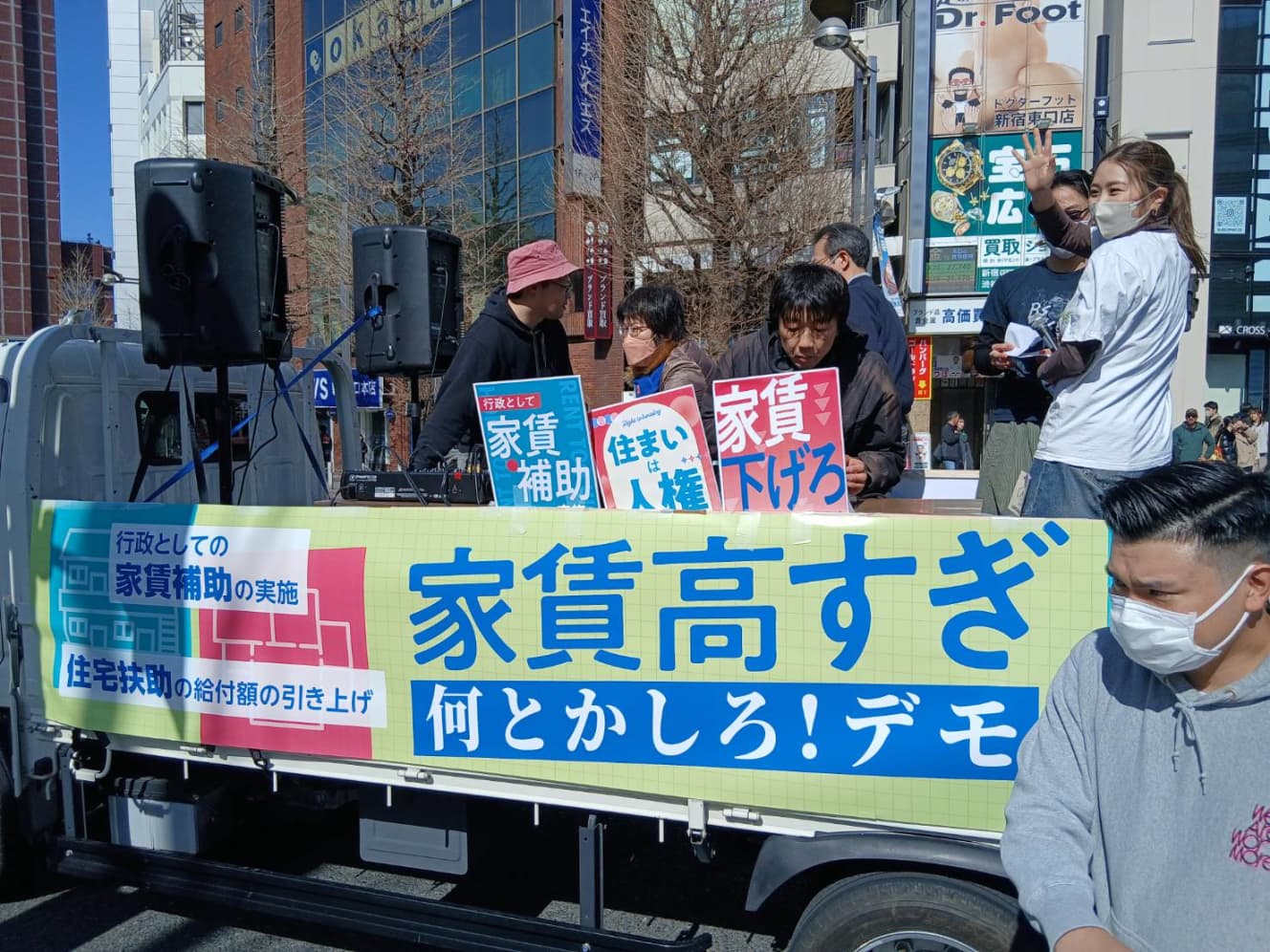
Voices of people crying out against rising rents
When melodies played from a DJ booth set up on the back of the truck, young men and women holding microphones spoke one after another:
“If rent went down, we could travel.”
“Rent’s so high we can’t go out and have fun.”
“Where can we find cheap, decent housing?”
“Lower the rent!”
On March 14, the “Rent’s Too High! Do Something About It! Demo” was held at Shinjuku Station East Exit. It was organized by the Housing Poverty Network and the Metropolitan Youth Union.
In Tokyo’s 23 wards, one-room apartments have surged to 100,000 yen, couple-sized apartments to 200,000 yen, and family-sized apartments to 250,000 yen. Landlords are setting aggressive prices, and cases where they demand more than a 10% increase at renewal are on the rise. Rent levels are expected to continue climbing.
“I survive by hopping between several supermarkets to buy sale items.”
Mr. A, a man in his 50s who worked at a call center in Koto Ward for over ten years but was laid off last summer, spoke about his situation.
His monthly income of about 300,000 yen dropped to around 180,000 yen in unemployment benefits. Unfortunately, the timing of his layoff coincided with the renewal period of his rental property, and his landlord notified him of a rent increase. His 19-square-meter 1DK apartment with separate bath and toilet rose from 87,000 yen to 88,000 yen. He expressed his frustration:
“Just 1,000 yen, but with unemployment benefits, it’s a significant amount. I was informed at move-in that there would be cockroaches, but I also have to deal with drafts and noise—the living environment is poor. I want to move somewhere cheaper, but in Shinjuku Ward, only more expensive places are available.
After paying rent from my 180,000 yen unemployment benefit, I have less than 100,000 yen left, and with rising prices, I can’t make ends meet on unemployment alone. Rent takes up the largest portion of my expenses, and surviving on supermarket sales has its limits. I wish there were reliable support systems to help.”
Rising condominium prices are impacting renters
In Tokyo’s 23 wards, the average price of newly built condominiums reached 138.13 million yen (2025), about 18 times the average annual income, making them unaffordable for ordinary people. Associate Professor Kazuhiro Sato of Takasaki City University of Economics points out that as prices for new condominiums rise, the burden is also falling on those who cannot afford to buy, and explains:
“Compared to 2010, condominium prices have roughly doubled. Housing prices have risen too much, and with mortgage interest rates also increasing, households that would have normally purchased homes are giving up and instead living in rentals, which may be pushing rent levels higher.”
Condominium prices in Tokyo’s 23 wards have surpassed even those during the bubble era, creating a situation where ordinary workers cannot afford to buy. Overall, rents are also rising, and it is becoming a situation where people with regular jobs cannot own homes—or even afford to live—in Tokyo.
“If people buy homes, they tend to purchase new furniture and appliances, which stimulates the economy. That is why government housing policy is biased toward promoting homeownership. Japan’s policy, which prioritizes owning homes, should be fundamentally reconsidered,” says Professor Sato.
In the 2026 tax reform outline, mortgage tax deductions have been extended in duration and expanded to include secondhand and smaller properties. However, there is no support such as rent subsidies for those living in rental housing.
Even in Tokyo, where rents are high, no new public housing has been built since the Ishihara administration—only rebuilds of existing units. Under the Koike administration, affordable housing targeting middle-income groups has been promoted using private development and fund mechanisms, but Professor Sato notes that the target is limited mainly to households with children, and supply is small, making the impact minimal.
The burden of housing costs has continued to worsen over the past 30 years, and it is not uncommon for low-income renters to spend more than 40% of their disposable income on rent. Even among the middle class, more people are likely cutting back on living expenses due to rent.
“In Germany, citizen-led demonstrations led to the enactment of the rent brake law in 2014, which prohibits raising rents for new contracts by more than 10% above the local average. Japan has no legal framework that sets an upper limit on rent. It is necessary to establish standard rent guidelines based on factors such as building age and location, and to create a system that allows local governments to limit rent increases,” says Professor Sato.
Interview, text, and photos: Daisuke Iwasaki