Behind the High Court’s Order to Dissolve the Former Unification Church Reporter Witnesses Tragedy of Japanese Wives at Mass Weddings


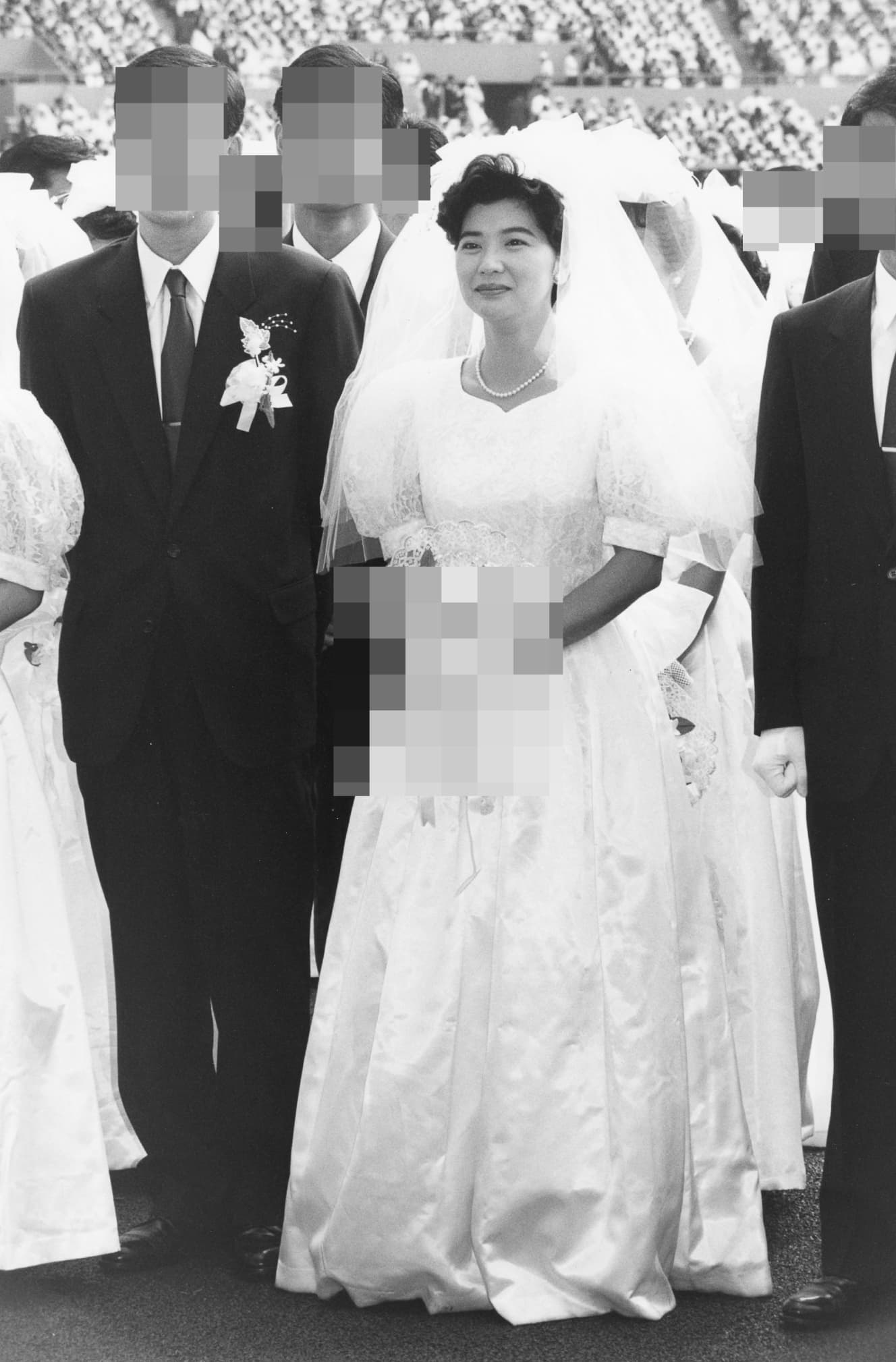
30,000 couples filled the stadium
On March 4, the Tokyo High Court issued a dissolution order against the former Unification Church (now the Family Federation for World Peace and Unification) under the Religious Corporations Act. The church filed a special appeal with the Supreme Court on March 9, objecting to the high court’s decision.
My coverage of the former Unification Church began back in 1992, after Junko Sakurada held a press conference announcing she would attend the mass wedding in Korea that August.
Following Sakurada, several other celebrities announced their participation in the mass wedding. Across Japan, not just the entertainment world, people were asking:
“What is the Unification Church?”
It became a huge topic of discussion, appearing daily not only on wide shows but also on news programs.
At that time, as a reporter for “Time 3” (Fuji TV), I also went to cover the mass wedding that Sakurada attended at Seoul’s Olympic Stadium in August 1992. About 60 Japanese reporters from TV, newspapers, and magazines were on site.
The stadium was filled with brides in wedding dresses and grooms in morning suits. Around 30,000 couples packed the venue, creating a truly bizarre spectacle.
Behind the scenes of Sakurada’s coverage, my crew and I tried to contact and interview a Japanese wife who had already married and moved to a rural village in northeastern Korea through the mass wedding.
With the cooperation of the “Association to Recover Believers,” we were able to conduct the interview, though it was a tense five-minute session because she had a strict curfew.
The woman, whom we call Yoko (pseudonym), was in her early 30s according to her, but with no makeup, rough skin, and dry hair, she appeared to me to be in her mid-to-late 40s. She had grown up in a family of public servants in the Kanto region and led a comfortable life after graduating from junior college. She had one younger brother.
She joined the Unification Church six years earlier, having been invited by a junior college friend. She became a believer because she sympathized with its teachings and world peace ideals.
Her passport was taken away
No one, including her parents, approved of her participation in the mass wedding. Yet she said she was driven by an unfounded confidence:
“I can do this.”
She first met her spouse at the Seoul Olympic Stadium during the mass wedding. He was the second son of a farming family and seemed unreliable.
After the mass wedding, hell began immediately.
Her married life in her husband’s family home in northeastern Korea was a living hell.
There was no room for the second son in the family home, so Yoko had to live in a building like a pigsty.
Yoko could speak broken English, but her husband was uneducated and spoke only Korean. They had no conversations, no family gatherings. Occasionally, her husband would visit, take care of his business, and leave.
Her days consisted solely of labor. On top of that, she was forced to deliver newspapers for cash income.
Despite such harsh conditions, she said the only thing she could rely on was:
“Reading the Unification Church’s scriptures.”
She was allowed to go outside and contact a support organization. Through this organization, Yoko learned her husband’s true intentions regarding joining the church.
About 30 years ago, very few people married into second sons of Korean farming families. She was told by Unification Church officials:
“If you join the church, you can marry a highly educated Japanese woman.”
This led her husband to join the church.
When asked why she didn’t escape, Yoko said:
“My passport was taken, I had no cash, and I had no sense of the area, so I didn’t know where I was.”
After returning to Japan, I tried everything to find Yoko, but her whereabouts remain unknown. Yet, despite her difficult life, there was a sense of determination; from her expression, speech, and faith, there was strangely no sense of regret.
Yoko had encountered the former Unification Church and chose to live by its teachings. We can only hope for her safety. But we must not forget that many women around the world have been swept up and manipulated by such religious organizations.
On YouTube, FRIDAY Digital’s Entertainment Reporter Channel, reporter Mitsutoshi Abe, who covered the mass wedding and the Japanese wives in Korea, provides testimony about the inside story of the former Unification Church. Under the title “The Tragedy of Japanese Wives Seen by Reporters in the Former Unification Church [Entertainment Reporter Explains #16]”, Abe explains in depth the dark side experienced by these Japanese wives.
Interview and text by: Mitsutoshi Abe (former TV reporter)