Why Gen Z and Alpha Are Rediscovering the Second Button Tradition Once Popular Among Teens


Second Button Recognized by Eight out of Ten Young People
It’s currently peak graduation season. When thinking of graduation ceremonies, many people might picture the tradition of the second button. While it’s a standard custom for older generations, do today’s teenagers even know about it?
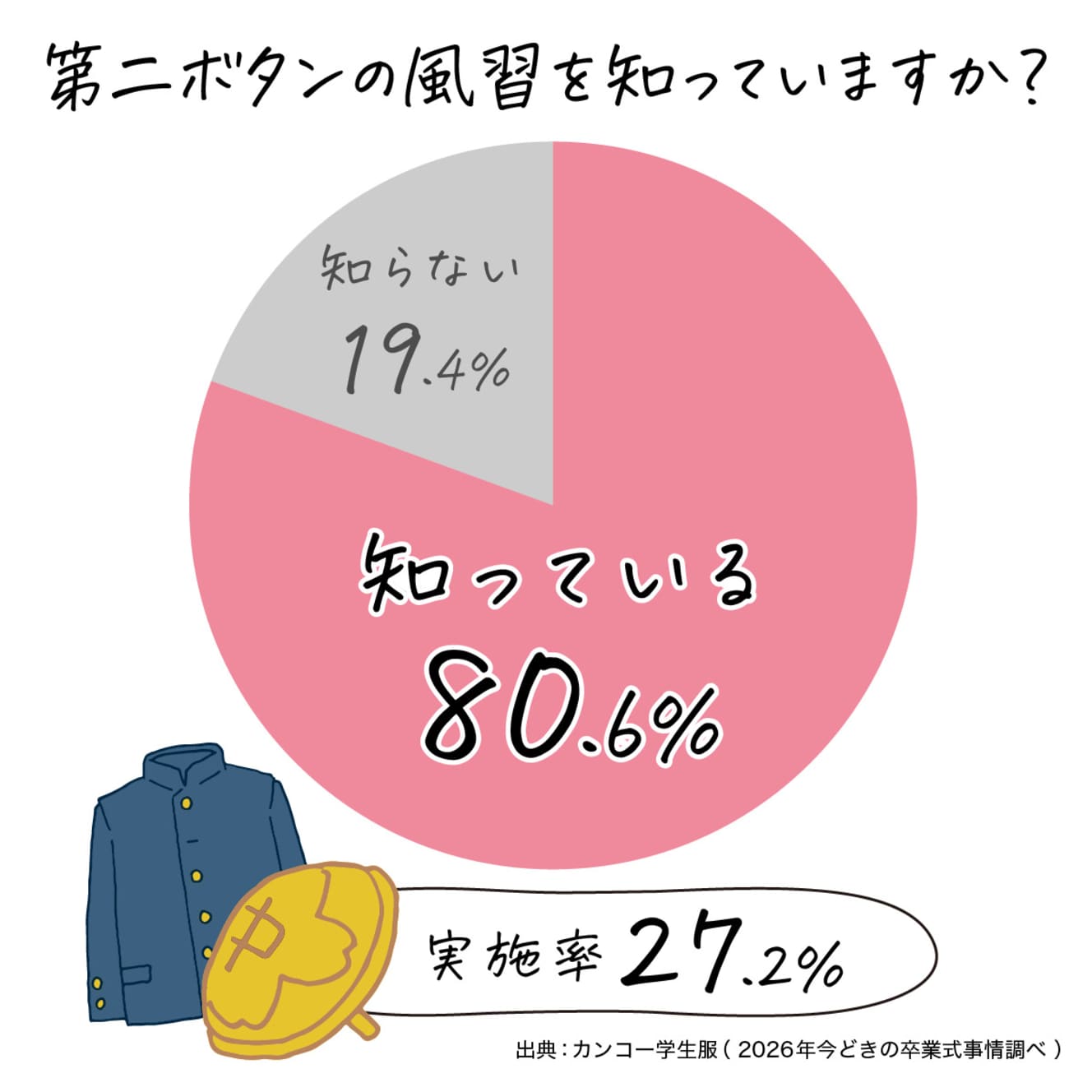
That question was answered by Kanko Gakuseifuku, a major school uniform manufacturer, which conducted a survey of 1,200 middle and high school students titled [2026 Latest] Graduation Ceremony Trend Survey: Is the Second Button Already Outdated?
According to the survey, 80.6% of respondents said they knew about the second button tradition. Furthermore, about one in four—27.2%—have actually given or received a second button, rising to 30.8% when considering only middle school students.
Young People Re-editing Showa-Era Culture
In the Reiwa era, even digitally native middle and high school students, known as Gen Z and Alpha Generation, still keep the second button tradition alive. Atsushi Kogoma, Professor of Business Administration at the University of Industrial Technology and a researcher on Gen Z and Alpha Generation, offered his insights. He is also the author of Creating New Consumption with the Alpha Generation: “Meta-Cognition” Thinking with Answers in Mind (Nikkei BP).
“Looking at the survey results, I’m surprised the recognition rate is higher than I expected. When I asked my university seminar students, about 90% knew of the tradition, but only around 10% had actually given or received a second button. Most said they learned about it through manga or anime, and I imagine the middle and high school students surveyed followed a similar path,” said Kogoma.
Through manga, anime, and other entertainment content such as dramas or movies, the second button tradition seems to have been passed down across generations.
Even though they know the tradition, why do Gen Z and Alpha students, who experience much of their life digitally through SNS, still practice a custom that involves physically giving a button from a school uniform?
“For their generation, SNS is a tool for the present moment. Separately, they tend to value things that remain as memories. For example, they often develop photos deliberately or exchange letters.
Another characteristic of this generation is that they don’t automatically consider something old as uncool. They dig up old content and add a personal touch to increase its value. You can often see them enjoying and re-editing long-standing customs and content.”
Gen Z and Alpha students don’t view the second button tradition as old-fashioned or outdated. Instead, they incorporate it according to their own values, often adding their own sense of creativity and fun. In fact, their approach to physical objects may even be more updated than that of older generations.
Ties, Name Tags? Graduation Ceremonies in the Reiwa Era
From the perspective of teachers guiding students, how have these traditions changed?
A teacher at a public junior high school in Tokyo said, “Our school uses blazers, so I’ve never heard of the second button. Instead, it seems boys give or receive ties, and girls give or receive ribbons.” This shows that besides the second button, other items are also exchanged as keepsakes or mementos.
Professor Atsushi Kogoma added, “When I ask my current seminar students, it’s not just second buttons—sometimes they exchange name tags or gym uniforms as well.” In other words, the practice of giving and receiving physical items remains alive.
On the other hand, a teacher at a different public junior high school noted, “Because we sometimes use recycled uniforms, we instruct students not to remove buttons. Some schools and PTAs manage recycled uniforms, so in some places, exchanging buttons may not be possible.” This shows that in some cases, the tradition of passing along buttons is restricted.
As for recycled uniforms, Sakuraya, a store handling them, confirmed: “Our store’s purpose is for students of the same school to wear reused uniforms, so we’ve almost never had a uniform brought in with missing buttons.” From the perspective of recycled uniforms, the second button tradition exists in a slightly different context—a topic that could be explored further another time.

Around 30% Have Experienced It, Both Then and Now?
Finally, Professor Kogoma reflected on his own junior and senior high school days, offering a surprising insight:
“I was born in 1960, graduated junior high in 1976 and high school in 1979. At the time, I remember thinking the second button tradition was outdated.
As I recall, the custom started around a 1960 movie (according to Kanko Gakuseifuku’s website, it may have been the film Yokaren Monogatari: Konpeki no Sora Tooku). By the time I graduated, the trend had already gone full circle.
Even in my generation, although most people knew about the second button, only about 30% actually gave or received one. So, the percentage of people who give or receive second buttons hasn’t really changed between my generation and today’s students.”
The author of this piece was born in 1980 and also recalls that, during junior high graduation ceremonies, fewer than half of students participated in exchanging buttons—likely around 30%.
In other words, even as times change, the tradition persists, and the actual rate of participation has stayed roughly the same.
The second button tradition began in the 1960s, became slightly outdated after its initial trend cycle, yet was preserved through the influence of manga and anime. Now, a new generation enjoys re-editing old customs and adding new value, creating a transitional period where fresh perspectives emerge.
As for the author, he recalls giving a button to a younger female student in junior high when asked. This memorable experience remains one of his life’s greatest successes, and he hopes the tradition of the second button continues, cherished and perhaps even proudly shared with younger generations.
Interview and text: Diceke Takahashi