YouTube is in turmoil! The “mass-production” regulations have caused many users to stop monetizing… What is the “secret technique” to restore earnings?


In January ’26, there was a tremor in the YouTube world. A number of channels had their monetization stopped. When monetization is suspended, no matter how many videos are viewed, revenue cannot be earned from advertisements. Naturally, YouTube users who were told that monetization would be suspended were in turmoil. The reason is that in July ’25, the criteria for videos that qualify for monetization were changed, and in ’26, they began to be strictly enforced.
Particularly targeted was “mass-produced content.” Even if a channel is healthy and beneficial, if it is judged to be “mass-produced,” its monetization will be suspended without question. So what exactly is mass-produced content? How can we avoid suspension? And is there any way to revive a suspended channel? We asked experts about the future of YouTube.
The Real Purpose of the “Mass Production” Regulation
The incident began in July 2013 with changes to the “Monetization Policy” of the “YouTube Partner Program (YPP),” which aims to provide video creators with profit-earning opportunities. The biggest change is that the “Monetization Policy” has been changed to “Regulations.
The biggest change is that the “target” of the regulation has been changed from “repetitive content” to “mass-produced content” (see image). To the untrained eye, however, the difference between the two is not clear. IT journalist Shuji Shinohara points out that “the change has a clear aim.
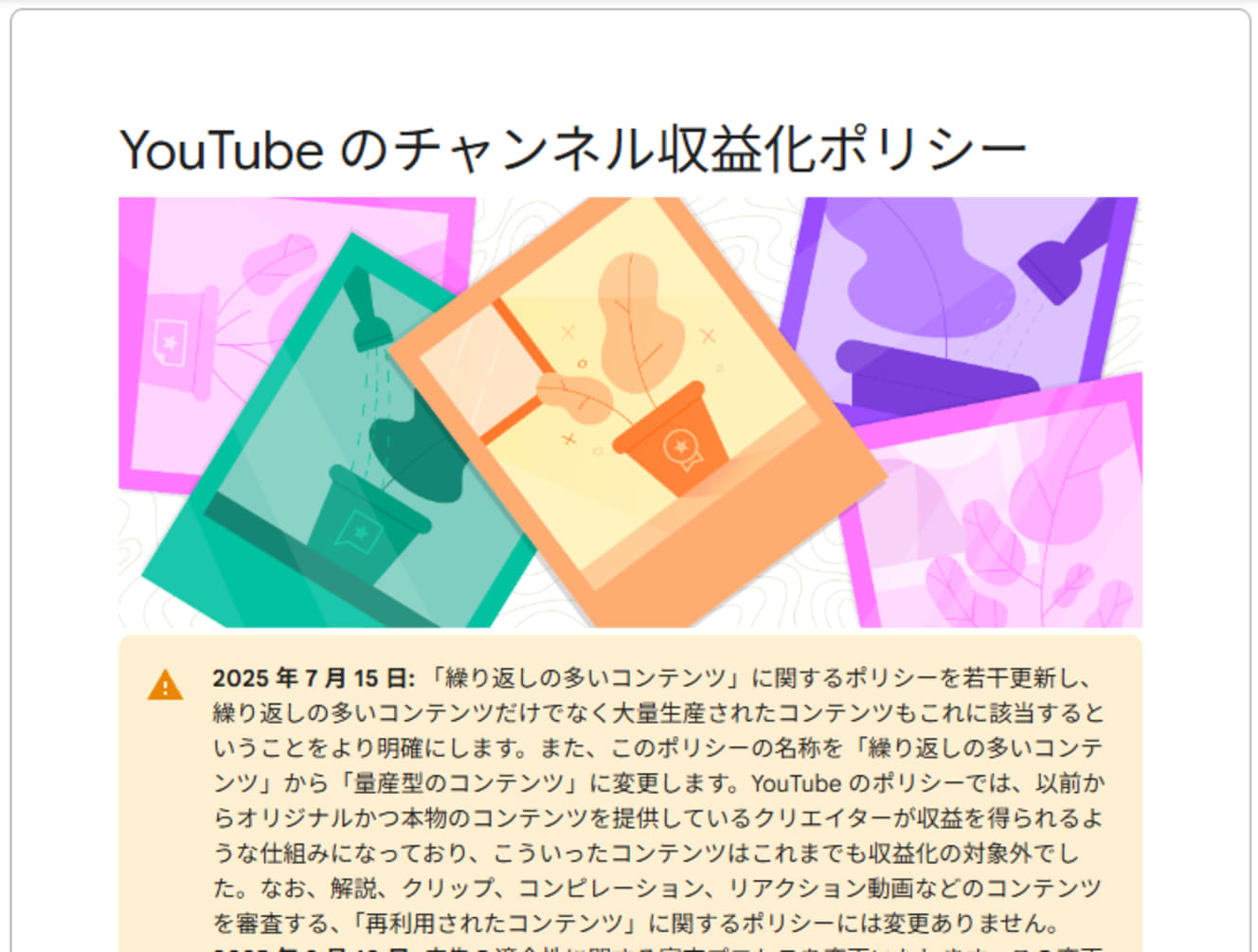
The term “repetition” was difficult to regulate because even if a video is made with the same structure, it does not constitute “repetition” if the content is different. However, when it comes to “mass-produced” videos, the same structure alone could be judged to be mass-produced and mechanically produced, and the videos could be out of bounds.
The scope of regulation will widen considerably. What is even more important is that they have made it clear that content that is mass-produced using AI will not be subject to monetization.
Why did the “shutdown festival” occur in January?
YouTube’s intention was more clearly shown in its annual letter to the video creator community published in January 2014, in which YouTube CEO Neil Mohan announced that the company would “strengthen its response to low-quality AI-generated content” (see image). (see image).

We believe that YouTube has been concerned about “low-quality AI-generated content” for some time. Low-quality AI-generated content is known as “AI slop,” and it has been occurring in large numbers with the proliferation of generative AI.
Around 2013, a number of video-generating AIs appeared on the market, allowing users to create videos easily and free of charge, not only on their computers but also on their smartphones. As a result, “re-purposed content,” such as videos cut and pasted from existing videos, has been created in a crude manner, filling up the short videos.
One out of every five videos is a “trash video” in the dark
A survey clearly illustrates this situation. According to a report released in November 2013 by Kapwing, a US video editing platform, 21 of the 100 short videos viewed by new accounts on YouTube fell into the category of AI slop.
In short, one out of every five videos was an AI slop, meaning that the content was low quality, trashy content. If this situation is left unchecked, user satisfaction will decline, and eventually users will leave the market.
The word “slop” originally referred to leftover food and muddy water fed to livestock. The word “slop” originally meant leftover food and muddy water fed to livestock. Incidentally, “slop” was selected as “Word of the Year” in 2013 by Merriam-Webster, a famous English dictionary, and AI slop has already become a social concern in the United States.
In Japan, a series of YouTube video monetization stops began in late January ’26. It is believed that regulations were tightened immediately after the aforementioned annual letter was released. In other words, after a grace period of about six months following the change in monetization policy, the “roundup” of mass-produced content began with an official statement by the CEO.
Popular “slow commentary” also targeted
While we understand the background of the regulation and the intentions of the operators, we cannot overlook the fact that videos that were profitable until yesterday are now labeled as “low-quality mass-produced content” and stripped of their profit-making rights overnight. (In fact, a video that I used to watch often, showing the market price of PC parts in Akihabara, was very useful, but I had to take emergency refuge in my blog because of the suspension of monetization.)
) “It’s almost an automatic system that determines if you’re a mass-producer or not. It judges by the external form, not the content, such as scant screen movement or the lack of a live face. For this reason, there have been a number of cases where “slow commentary” using voice synthesizing software such as Voiceloid has been judged as mass-produced and monetization has been suspended, even if the content has been elaborately created with a lot of time and effort.
Backstage Tips to Revive Monetization from Despair
In the YouTube Partner Program, creators can file an objection with YouTube in the event that monetization is suspended or the channel itself is suspended. After that, they will undergo a re-examination, and if they pass the re-examination, monetization can be restored.
In order to prove that the content is in line with the monetization policy, the creator may have to make videos that are likely to be judged as mass-produced private, or add new videos that use the creator’s own voice or “face” to the video. However, it is difficult to take such measures.
However, there are also creators who find it difficult to take such measures and wish to avoid exposure as much as possible. In such cases, the following measures can be considered.
Instead of requesting a review via the “YouTube Help” site, you can “make a fuss” on X (formerly known as Twitter). Direct your protest to X’s “TeamYouTube” account (@TeamYouTube).
Since this account is supposedly run by a human, you can show that the channel is run by a live person, without an automated system. It will be more effective if fans of the channel are also complicit. Some channels have actually revived monetization with this.”
The evolution of video-generating AI has brought about mass-produced content, which is now being exposed by AI. It is a match-pumping structure, but the fact that it is humans who end up resolving problems between AIs is also a sign of the future AI society… It seems to imply the future of AI society….
Conditions for “earning money” on YouTube in the future
The YouTube side claims that the series of restrictions are, in essence, a request to create contents with proper value.
Whether or not AI is used in video production is not the issue. It only means that we want you to stop using AI to mass-produce garbage videos.
I believe that more and more videos will be produced with a human touch, where the scripts and plans are made by AI, but only human beings appear on the screen. In any case, an automated system will continue to determine whether a video is mass-produced or not. We expect that each creator will create his or her own AI character in the future.
The latest financial results of Alphabet, Google’s holding company, show that YouTube as a business is doing extremely well. Not only its mainstay advertising business, but also its subscription (subscription-based billing) sales have reached a record high. In the advertising business alone, sales for the October-December period of 2013 were approximately $11.4 billion, an increase of 8.7% over the previous year. Because of its strong performance, the company may be aiming to eliminate content that may damage the value of its brand as soon as possible.
However, “AI slop” is not the only challenge for YouTube and other video platforms; fraudulent ads continue to be a common occurrence on social networking sites, including X and Facebook. Rather, the damage caused by fraudulent ads and fraudulent content is increasing every year. We hope that drastic measures will be taken to stop such damage by making full use of advanced AI.
Shuji Shinohara is an IT freelance writer. He specializes in commentary on flame wars that occur on the Internet (SNS), fact-checking of false rumors, topics on smartphones and gadgets, and generative AI.
Interview and text by: Kenji Matsuoka
After working as a money writer, financial planner, and market analyst for a securities company, Matsuoka became independent in 1996. He writes articles on finance and asset management mainly for business and economic magazines. Author of "A Textbook for the First Year of Robo-Advisor Investing" and "Understanding with Rich Illustrations! The book is entitled "Cashless Payments: How to Benefit from Cashless Payments". X (former Twitter)→@1847mattsuu
PHOTO: Afro