Over 300 Highway Fake Orbis Cameras Installed Reveal True Purpose Amid Buzz Over High-Performance New Model


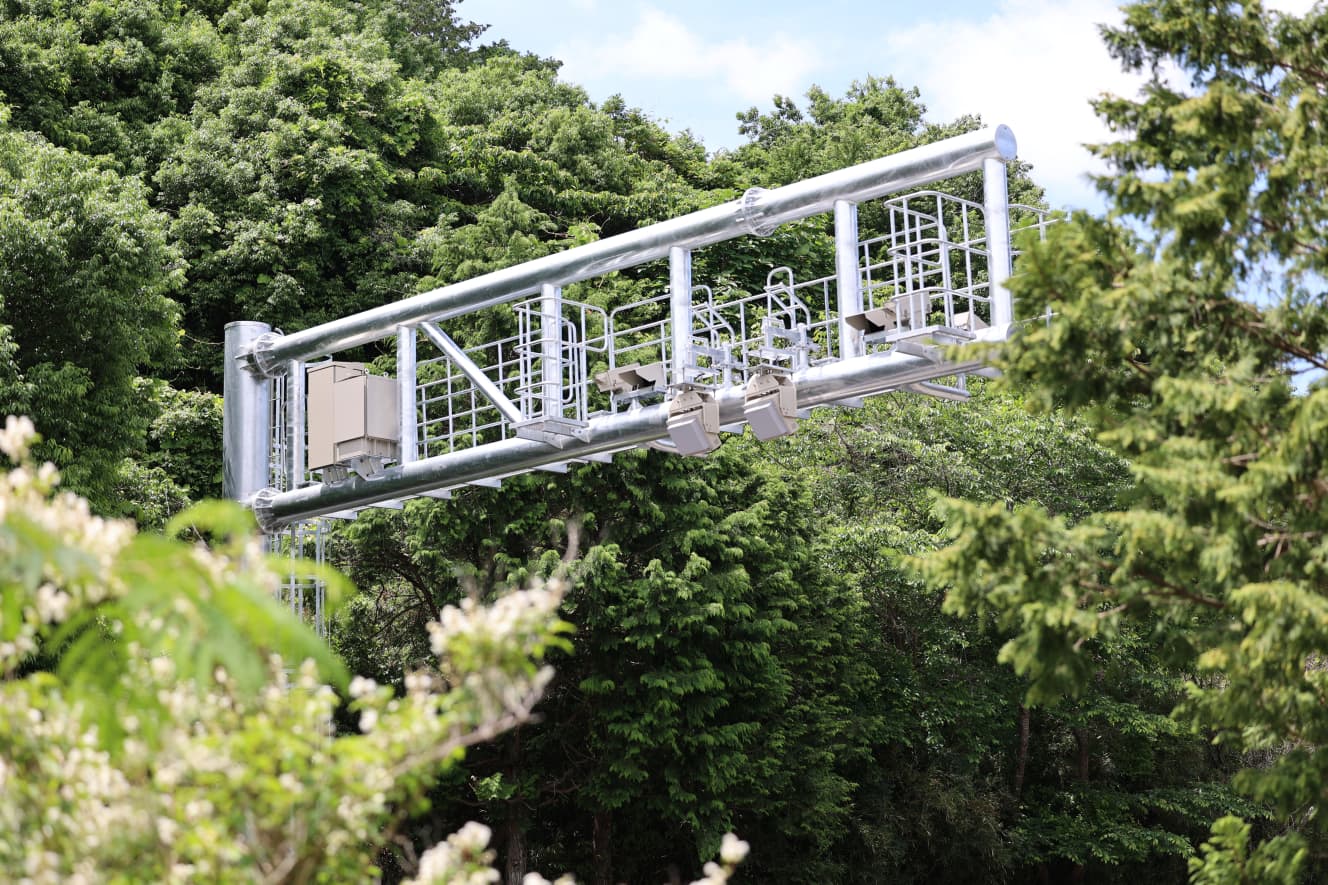
The number of “Orbis-like” vehicles is increasing rapidly
Have you ever felt a chill when a creepy monitoring device suddenly appeared overhead while driving on a highway late at night? Square antennas jut from the support poles, a camera glares at the road, and a black box—resembling an infrared strobe—adds to the eerie feeling. Even stranger, sometimes the device briefly flashes red while you’re driving.
“Wait, was there an Orbis (automatic speed enforcement camera) here?”
Instinctively, you press the brake and check your speed, but there’s no familiar blue warning sign reading “Automatic Speed Enforcement Ahead,” which should be installed before any Orbis.
These mysterious devices are now appearing on highways across Japan. Drivers speculate: “Is this a new model of Orbis?” or “No, it must be a new N-System (automatic license plate reader).” The truth, according to Katsumi Osuga of Orbis Guide, who has studied traffic enforcement nationwide for years, is different:
“These are not Orbis cameras. They are antenna sets installed to support the new ETC late-night discount system.”
Osuga notes that sightings have surged since around 2024.
“Their appearance closely resembles the fixed Orbis units known as ‘LH Systems.’ The overhead poles have communication antennas, cameras for capturing vehicles, and what looks like night-time lighting equipment, so it’s easy to see why someone unfamiliar could mistake them for speed enforcement devices. The clear differences are that LH Systems have red warning lights on the poles and white lane markers on the road—features that the ETC antenna sets lack.”
These antenna sets are typically installed on sections of highway between junctions and the next interchange, often a few kilometers before the interchange itself.

Installation has been completed across all sites
This device is a communication system designed to support the new late-night toll system for highways, scheduled to begin in fiscal 2026. Specifically, it records passing vehicles’ license plates and timestamps, allowing authorities to determine “when” and “which route” a vehicle traveled. Previously, late-night discounts were calculated only based on “entry and exit times,” but the new system requires precise tracking of the actual sections traveled. To achieve this, these antenna sets have been installed at various points across highways nationwide.
So how many have actually been installed? NEXCO East Japan was asked.
“All 114 installation sites within our jurisdiction (the East Japan area) have been completed. Including NEXCO Central Japan and West Japan, the total across the three companies is approximately 309 locations.”
The antenna installation work was completed by all three NEXCO companies by the end of fiscal 2024. However, actual operation of the system has been significantly delayed compared to the original schedule. Despite the equipment being installed, the start date has yet to be determined. This delay is due to both the extreme complexity of the new system and recurring “serious problems” with the existing ETC system.
Originally, the new system was scheduled to start around March 2025, but after two postponements, no concrete start date has been set. A decisive factor was a widespread ETC system failure on April 6 last year in the NEXCO Central Japan area. ETC services became unusable across 17 routes and 106 locations in one metropolitan area and seven prefectures, taking approximately 38 hours for full restoration. Since the failure affected components related to the new late-night discount system, system development had to be temporarily suspended.
Regarding the ongoing uncertainty over the start date, NEXCO East Japan explained to FRIDAY Digital:
“The new toll system is being developed in parts by multiple manufacturers. As a result, coordinating system development has taken longer than expected. In addition, following the system failure in April last year, it became necessary to conduct more careful verification of system development, the overall operating environment, and whether the system would function properly.”
Although the hardware installation is complete, software adjustments involving complex processing are still not fully operational. As a result, these visually convincing devices have proliferated without the new system being active—fueling speculation that they might be a new model Orbis.
So why has system development been so difficult? The new toll calculation system is far more complex than anticipated. Determining passage time, calculating average speed, adjusting for speed limits, and deducting rest periods—the new system cross-references all of these variables for millions of vehicles traveling nationwide to calculate the discount amount. The processing is so massive and complicated that accurate calculations cannot be completed the moment a car passes the exit.
As a result, the toll display at exit booths does not show the discounted rate. Previously, the 30% discount was applied immediately upon passing the tollgate, but under the new system, payment is initially processed at the regular rate. Later, the driving data collected by the nationwide fake Orbis antennas is aggregated on servers, and the discount is refunded in points or similar methods the following month. To receive the discount, prior registration with the “ETC Mileage Service” or an “ETC Corporate Card” is required. Without registration, no refunds are applied regardless of how much driving occurs at night.
NEXCO’s Goal in Promoting the New System
The complexity of the new system doesn’t just slow down calculations—it also creates “distortions” in the discount rules themselves. Under the new system, the vehicle’s average speed is calculated from the time it passes between ETC antennas across the country, and the distance traveled is determined from that. For ordinary cars, however, the calculation caps the speed at a uniform “105 km/h.”
NEXCO East Japan explains the reason for this uniform limit:
“It is technically difficult for the system to track every section’s speed limit or temporary restrictions due to weather in real time and set individual maximum speeds. Therefore, a uniform speed cap was adopted.”
This means that even if a driver travels at the speed limit of 120 km/h on sections like the Shin-Tomei Expressway, the discount calculation treats it as if the vehicle traveled at 105 km/h. For example, driving 120 km in one hour counts as only 105 km toward the discount; the remaining 15 km, even during late-night hours, is excluded.
Another factor affecting long-distance drivers is how rest periods are handled. For trips exceeding four hours, 30 minutes (0.5 hours) of travel distance is automatically excluded from the discount for safety reasons, regardless of whether the driver actually took a break. Combining the “105 km/h cap” and the “forced 30-minute deduction” sets a physical upper limit on discounted distance: 105 km/h × 6.5 hours = 682.5 km, no matter how efficiently one drives at night.
The new toll system has faced criticism from drivers as a de facto price increase or deterioration of the discount. Yet NEXCO’s intent is clear:
“The revision of the late-night discount aims primarily to eliminate congestion and dangerous stops near toll booths caused by drivers waiting until midnight. The current system gives a 30% discount on the entire route even if the vehicle travels only a small distance between midnight and 4 a.m. The new system applies the discount only to the actual distance traveled at night, which is the original intent. Because the newly installed antennas calculate distances after the fact, immediate discounts at exits are not possible; refunds are processed later. This is to ensure safety and reduce congestion, and we ask for understanding.”
The fake Orbis antennas quietly await the time when the new system goes live.
PHOTO: Orbis Guide