[Investment Scam Report – Part 1] Three Days of Battle with Singaporean Runners Over Investment Offers


Day 1: “We’ll double your money in a month.”
One day, a suspicious call came in from overseas. It marked the beginning of a three-day battle. The author continued interactions with foreign runners to investigate the methods of an investment scam. This is the record of the first part.
Suddenly, the smartphone rang. The number displayed started with “+65,” indicating an international call from Singapore, though the author had no reason to expect calls from abroad. Being in a profession that exchanges contacts with many people, the author thought it might be someone reaching out with an interesting opportunity and answered the call.
“My name is Reika Matsuda. Are you interested in investing?” (hereafter “Reika Matsuda”)
The caller immediately introduced herself in fluent Japanese and recommended an investment. Her Japanese was very good, only slightly broken, but perfectly understandable.
Could this be an investment scam call? It was a typical scheme that uses false claims of massive returns to swindle money. While the author had encountered malicious real estate investment calls before, nothing had seemed this blatantly suspicious.
According to the Metropolitan Police Department’s Organized Crime Division, in 2025, there were 27,758 recognized cases of special fraud, with total damages of about 141.4 billion yen. Of these, 200 cases involved financial product fraud, resulting in about 2.1 billion yen in damages—an increase of 122 cases and 1.5 billion yen from the previous year.
Reika Matsuda recommended various financial products handled by her company: “Forex, crypto, real estate, and stocks.” She claimed that investing in any of them would guarantee profits and even offered a principal guarantee. While seemingly generous, anyone with even basic financial knowledge would know such claims were impossible.
“The packages we offer are $300, $500, and $1,000. Returns vary depending on the investment, but there’s no risk. Some people even double their money in a month.”
Judging from her voice, Reika Matsuda seemed to be in her 40s. She said that after selecting the investment and depositing the corresponding amount, asset management would begin immediately. A foreigner with a Japanese name speaking broken Japanese, offering impossible financial products—this was remarkably sloppy for a scam.
Still, even knowing it was likely a scam, the author’s curiosity was piqued—if it were true, one could make a profit and even deposit their entire fortune. To investigate, the author first asked about her company.
“Understood. I’ll send you an email.”
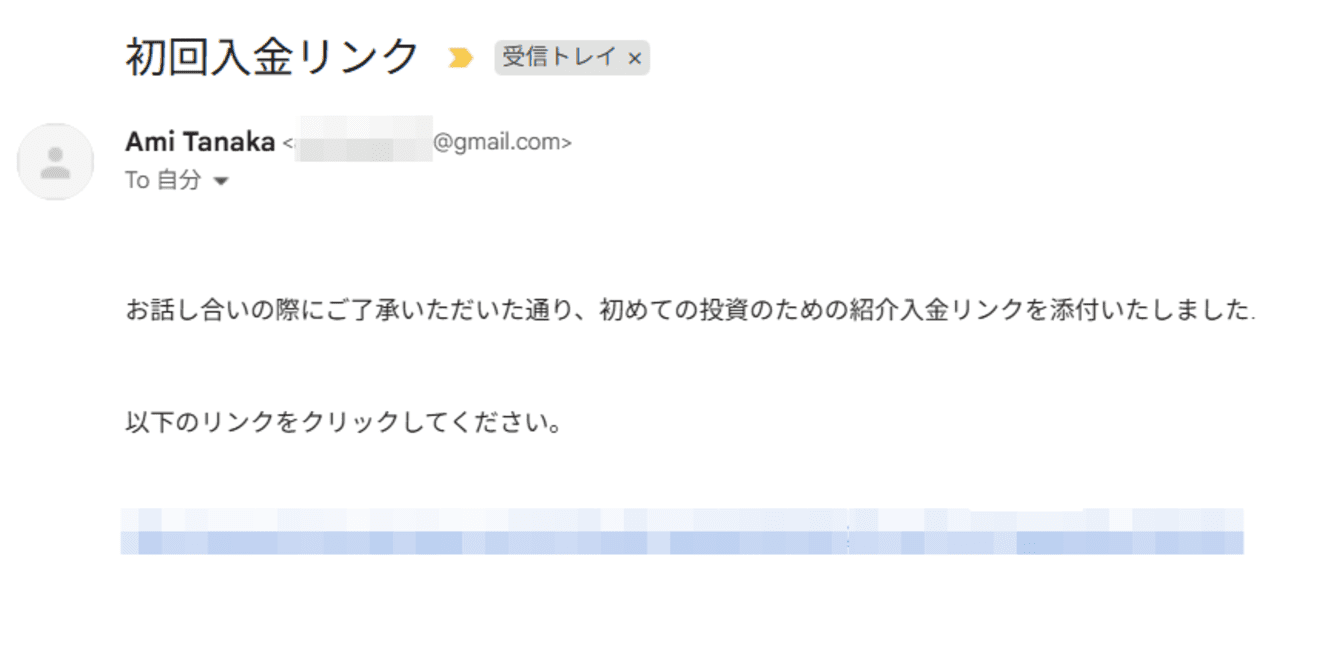
Even though the author never provided an email address, a message arrived immediately from someone named Ami Tanaka—not Reika Matsuda. The email contained the line:
“As agreed during our discussion, we have attached the introductory deposit link for your first investment. Please click the link below.”
The author had agreed to nothing, and the company name was absent. Sending a deposit link out of the blue, using a Gmail address, and writing in awkward Japanese—all of it was far too careless.
Everything is suspicious from start to finish
However, considering that they already knew the author’s name, phone number, and email address, it was possible that the scammers had complete access to personal information. They may have purchased a contact list from a company that trades in personal data, but there was no way to verify this.
The author was tempted to continue the call full of suspicious points with Reika Matsuda, but had another engagement that day. When requesting to pause, she readily agreed, saying, “That’s fine. Let’s continue another day,” and added, “I’ll send a LINE link, so you can also contact us that way.”
Shortly after, another email arrived from Ami Tanaka. By opening the attached link and registering on LINE, a contact named “Manager Sales” sent a sticker, and a follow-up conversation was scheduled, ending the call with Reika Matsuda.
When asked about the company name via LINE, a link was sent to an investment platform called “BONMOT INVEST,” which sounded French. The website looked well-made at first glance but had several suspicious points.
First, the top-level domain is “.pro,” a relatively uncommon domain. This domain originates from “professional,” intended for doctors, lawyers, and other specialists. While available for general use, it feels unusual compared to “.com” or “.jp.” It was likely purchased to convey the idea of a “professional investment group.”
Additionally, the BONMOT site listed addresses in London and Luxembourg, yet the calls came from Singapore. Searching these addresses on Google Maps confirmed buildings exist, but it was unclear whether BONMOT actually occupied them. Moreover, the company does not appear anywhere on the official list of licensed or registered financial service providers published by the Japanese Financial Services Agency (FSA).
While it is technically possible to trade via overseas high-leverage FX brokers without FSA registration, the key point is whether the company is registered and licensed in another country. BONMOT provided no information about any international licenses or regulatory approvals.
From beginning to end, everything about this setup was suspicious. Given these inconsistencies, it is reasonable to conclude that this was a scam.
Day 2: ¥46,000 into ¥10,000,000!?
The next day at 2:00 p.m., another international call came from Singapore.
“Hello, are you interested in investing?”
It was the same woman as yesterday, Mazda Reika. She began with the same polite investment pitch as before—likely following a call script. Knowing this was clearly an investment scam, I wanted to draw out as much information as possible for the report. I started by asking about the investment itself.
“You can choose from stocks, forex, real estate, or crypto. After you deposit the money, it will be transferred from your account to ours. Then a financial analyst will call you. They will manage your funds based on optimal information to grow your money.”
I asked how much people had been able to increase their funds in past cases.
“Many people have made a lot. Some increased 300 dollars to 10 million yen. By the way, how much are your assets? How much can you invest? Do you know how to make the deposit?”
Three hundred dollars (at 154 yen per dollar) is roughly 46,000 yen. It was odd that the currency suddenly switched from dollars to yen, but the claim that a financial analyst could turn 46,000 yen into 10 million yen was astonishing.
As we continued the conversation with some small talk, Mazda Reika kept urging me to make the deposit. Was she really that busy? I decided to probe a little deeper.
Mazda Reika urging for the deposit
“At the earliest, it will increase about 8% in a week. You can withdraw anytime. The analyst service is only for people who have invested, so they cannot contact you immediately. However, we also have an AI analyst, so even while working, AI can automatically grow your money.”
It’s unfortunate that you can’t speak to a human analyst without depositing money. Another new term appears: the “AI analyst” supposedly grows your money automatically. But an analyst’s job should be analyzing investment information, not trading automatically. Perhaps Mazda Reika herself doesn’t fully understand the distinction. Trying a few technical terms revealed her confusion.
“‘Saiken’?… ‘Kinri’?… We handle various products, so I think the best option will be found. You seem very knowledgeable, so surely something suitable will be found. We take a small management fee from that, but since profits are high, it’s not a problem.”
Mazda Reika clearly didn’t understand. Flustered and sidetracked, she forced the conversation back to her script. The fee is apparently 5% of profits—so a $100 gain would result in a $5 fee.
After about an hour on the phone, she grew impatient and kept pushing for the deposit, cutting off any questions: “How will you deposit…?” “Do you have a credit card?” The international call from Singapore to Japan must be expensive, so this long call likely cost them money already.
As the user had to go out, the conversation ended for the day. Mazda Reika got even more anxious, urging a deposit rapidly. When refused, she offered a $100 bonus to entice action, but there simply wasn’t time. They agreed to follow up later.
In the next part, Mazda Reika’s manager appears, and when confronted about whether this is a scam, he begins to reveal unexpected truths.
Part 2: “I didn’t have a job,” a Singaporean who had given up on his job finally tells his story.

Interview and text: Shirakami Midori