Singaporean Runner Finally Shares Her Story After Investment Scam: “I Had No Work”


Day 3: “It’s not a lie, it’s all true.”
One day, the author suddenly received an investment solicitation call from Singapore on their smartphone. The woman spoke fluent Japanese, but her story was clearly suspicious. Convinced it was an investment scam, the author decided to investigate their methods and continued exchanges for three days. This is the record of the battle with the runner [Part 2].
Part 1: “Are you interested in investing?” Three Days of “Fighting” with Singaporean Kakeko
On the third day, Reika Mazda called again. She seemed to understand that this was a continuation from the previous day, so her first words were not, “Are you interested in investing?”
“Then please open the link from the email and complete the payment process. You can use either a credit card or debit card. VISA and Mastercard are accepted.”
No matter what was said, she kept pressuring for payment, making a proper conversation impossible. It was time to get to the main point: Was she really running a scam, and who exactly was Reika Mazda? The author confronted her with the inconsistencies so far.
“This is not a scam. I’m not special at all, so my salary is low. The company is in Luxembourg, and we support everyone. I sent you our website, right? Did you read it? Couldn’t read it? Everything is true.”
Her tone grew rough, perhaps out of panic. Gradually, she kept repeating, “It’s not a lie. Everything is true. It’s not a scam,” making conversation nearly impossible. The author asked to speak with her supervisor. She didn’t understand what “supervisor” meant, so when clarified as “Manager or Boss,” she reluctantly handed the call over.
A man with a Japanese name who is good at talking
“I’ve taken over the call. I’m Junichi Sugawara, the manager,” (hereafter, “Junichi Sugawara”).
A man claiming to be Japanese appeared, speaking even smoother Japanese than Reika Mazda. Sugawara continued:
“What you’re concerned about is not wanting to pay because you don’t fully understand the investment, right? That’s not a problem; all investments are introduced by our company’s analysts. After your credit card is approved and the deposit is confirmed, we’ll guide you by phone immediately.”
Sugawara insisted he also lives in Singapore and explained how investing would generate profits. When asked about recommended investment products, he said futures.
“My recommendation is ‘futures,’ particularly natural gas. When it gets cold, people use stoves. That increases demand for gas, so if you sell quickly, you can make a profit. The timing is now. Even as it gets warmer, prices won’t drop immediately.”
Checking natural gas charts, it did appear to be rising, but there was no guarantee it would continue. More convincing evidence was needed.
“Stocks are the easiest way to make a profit. I recommend Coca-Cola stock. This company hasn’t gone bankrupt in 139 years, so it’s very reliable. Compared to futures, returns are slower, but over time, the stock price rises and can generate huge profits.”
Upon checking, Coca-Cola was founded in 1892, making it 133 years old—a minor discrepancy within a tolerable margin. If these investments were truly guaranteed to make money, Sugawara himself would presumably be investing…
“I’ve tried crypto. An AI handled it automatically. I started with about 50,000 yen and added more for a total of around 200,000 yen. In about six months, it grew to roughly 1.2 million yen. With crypto, it can triple in a month. Prices fluctuate, but overall, they go up.”
While it’s theoretically possible for cryptocurrency to triple in a month, he seemed unaware that cryptocurrencies have been generally declining since Bitcoin’s peak in October.
“By the way, how old are you? Around your 30s?”
This was the first time in three days that the scammer initiated casual conversation. Believing he already knew the author’s personal details, the author slightly fibbed and said he was 32. Sugawara then began sharing his personal story.
“You’re young. I just turned 40 recently. Being 32, you’re the same age as my youngest brother. I also suggest investments to him, but he doesn’t have enough capital to get started. Even a small investment could turn into 3 million yen in six months, but he won’t invest, so he can’t earn. He’s useless.”
Living in Singapore must be tough. One might think he could just lend money to his brother, but the author refrained from asking.
“You are lucky. We are registered with the Financial Services Agency, so you can invest safely. Financial products require licenses, and we have obtained them from Japan’s FSA, so there’s no problem. Our company operates worldwide, registering licenses in each country. We are a globally recognized company.”
Sugawara revealed the inside story of the scam!
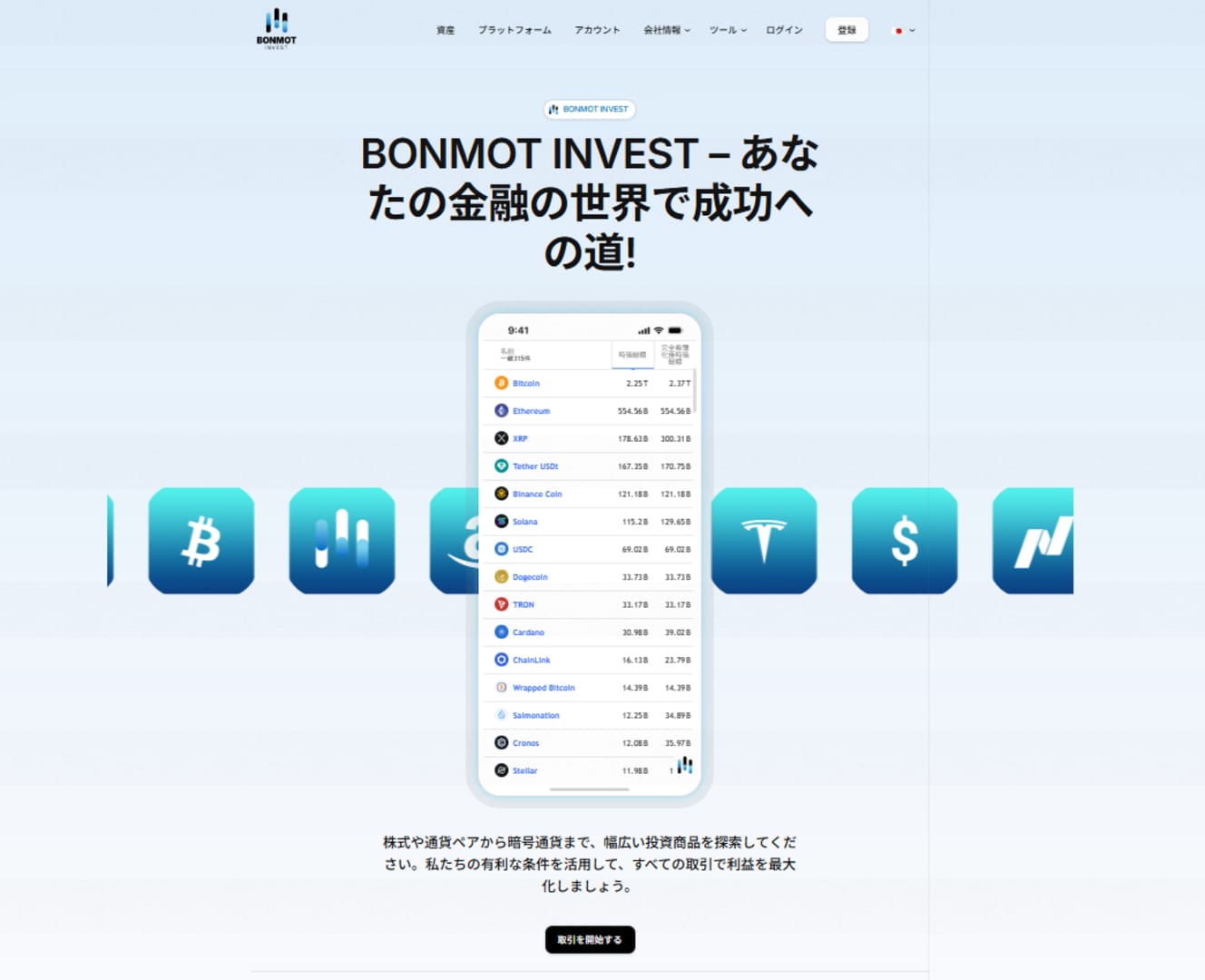
There was no license registration displayed for BONMOT, and the company was not listed as a registered operator on the Financial Services Agency—a fact the author had already confirmed on the first day. Such behavior is far too sloppy for a so-called global company. Determined to investigate whether this was a Ponzi scheme or outright fraud, the author pressed further.
Sugawara Junichi maintained a calm voice but spoke rapidly, repeatedly denying it was a scam, insisting it was “safe.” When the author went through the inconsistencies one by one, Sugawara paused for a few seconds—and then, inexplicably, began sharing his personal story.
“I lived in Ageo City, Saitama, for 20 years. Are you in Tokyo? Rent must be high there. I learned Japanese while working in Saitama. I returned to Singapore three years ago, but I had no work.”
It seems his claim of being Japanese was false. Summarizing his long story, it became clear that this was indeed an investment scam. Having no job and speaking Japanese made him a candidate for recruitment into the scam group.
He said he had found the opportunity through an online scam job listing, similar to a temp agency in Japan. About five people gather in a room and systematically go through contact lists as instructed.
“If you succeed in getting a deposit, you get 5%. The company’s fees and what we explained are our salary. For $300, that’s $15; for $1,000, that’s $50. On top of that, there’s a daily salary of about 15,000 yen. My supervisor told me, ‘Even if you scam Japanese people, the Singapore police won’t arrest you. If it’s a $300 scam, the police won’t come.’”
He received both a base salary and performance-based pay. The organization was surprisingly structured for a scam group, suggesting it might be quite large.
“You’re not going to deposit anymore, right? Sorry, this is the end.”
The call was cut off. His final words sounded either regretful or sad—whether because the scam failed or from a pang of conscience was unclear.
As a postscript, international calls from Singapore still arrive. Each time, they start with, “Are you interested in investing?” and the author immediately hangs up. Sometimes the caller even spoofs the incoming name as “KDDI.”
This case was remarkably sloppy, but investment scams have become increasingly sophisticated. They often bombard victims with incomprehensible jargon and pressure them to deposit money, claiming guaranteed profits. In reality, there is no such thing as a guaranteed profit in any field.

Interview and text by: Green Blank Paper