Mana Sakura Says She Would Never Have Become a Novelist Without Her AV Career in a Candid Long Interview
A ″double talent″ -- her 10th book "Ano no Kawari" is published!


As the sex that gives birth
“AV actresses are easily exposed to the gaze of people with ill intent, but by being subjected to all kinds of words, I’m able to observe the kinds of thinking people have. Being able to convey reality through novels might be, for me, a kind of life-support measure that allows me to continue being an AV actress.”
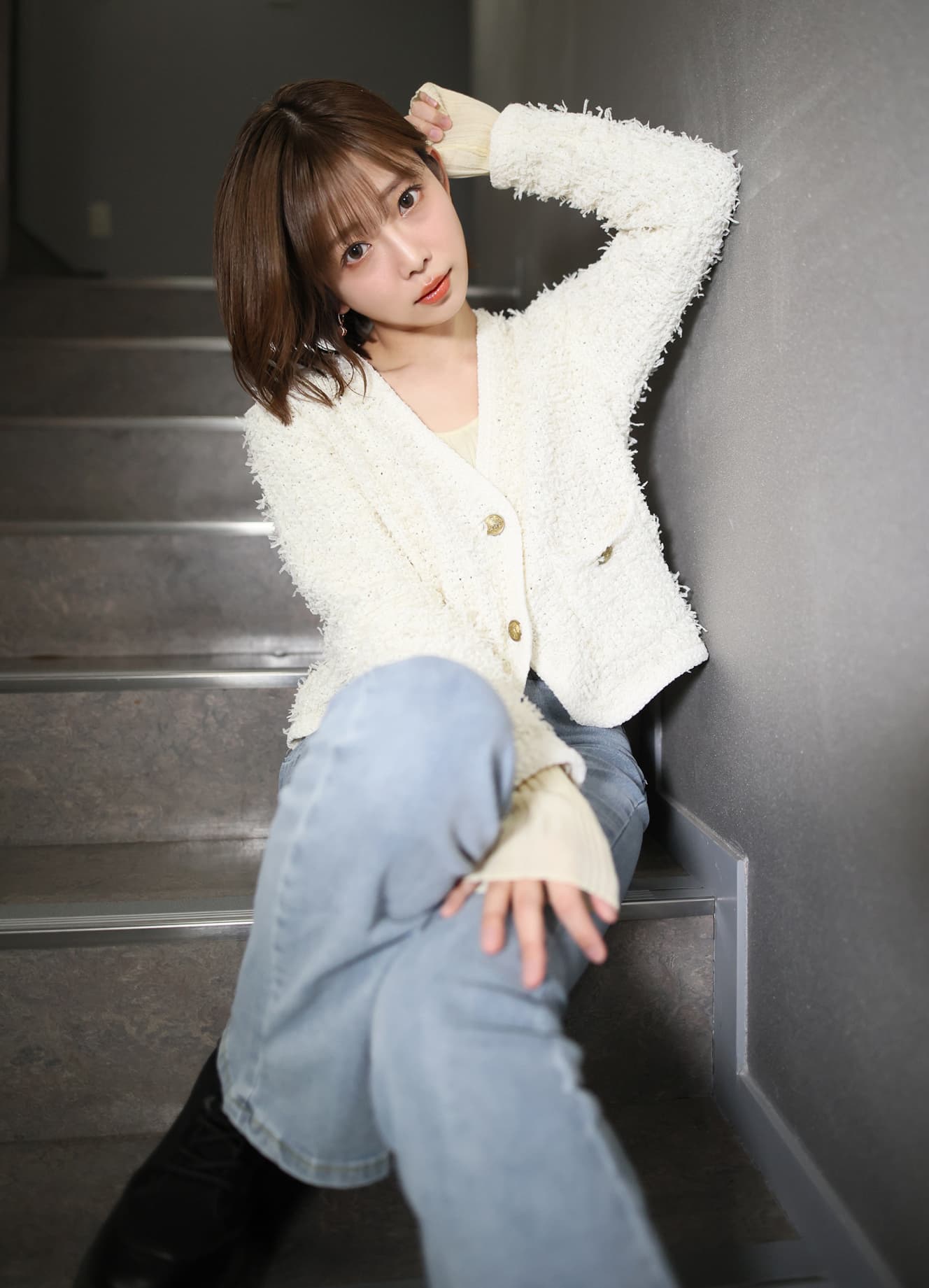
An AV actress and a novelist—Mana Sakura (32), a one-of-a-kind dual-career writer, smiled bewitchingly. She began her gravure activities in 2011 and made her AV debut the following year. At the SOD Awards 2012, she won six awards, including Best Actress—the first in history—rising to become a popular star.
Calling herself an “ero-ya” (erotic worker), she has appeared in over 200 works to date. Then in 2016, when she released her first novel Sai.tei., it quickly sold out at bookstores. Having been nominated twice for the Noma Literary Newcomer Award, Sakura blossomed as a novelist, and on February 12 she published her 10th book, Ano Ko no Kawari (Kawade Shobo Shinsha).
What she depicts is pregnancy and childbirth. The story follows Yura, a makeup artist, who becomes overwhelmed by inexplicable, almost frenzied emotions triggered by her close friend Arina’s pregnancy.
“Working in AV, people often ask out of curiosity—both good and bad—about marriage and children. Questions like ‘Isn’t it hard for an AV actress to give birth?’ are difficult to answer. Experiences like that made me start thinking about it whether I wanted to or not, even in my 20s.
In my 30s, as those around me entered a baby boom phase, friends would say, ‘If you plan to have kids, sooner is better,’ making me even more aware of the countdown to fertility.
Four years ago, I adopted a rescue dog, and through this kind of pseudo-parenting, I began to think more realistically about how difficult it is to raise a life. Of course, I understand that humans and animals are different.
Still, the theme of pregnancy and childbirth has always been with me in some form, and it became an opportunity to rethink how I want to live going forward. That’s why I tried to reflect my own inner conflicts as fully as possible in the protagonist. Though I’m not as wildly unhinged as Yura (laughs).”
She entered the industry as a teenager and will turn 33 next month. She has now reached a stage where she is conscious of pregnancy and childbirth herself…
“Having options actually makes it harder to decide. If I say this, I might get criticized as being privileged, but while I feel free, I also sense a kind of old-fashioned pressure. Still, I think I probably won’t choose to have children, regardless of my profession.
In this era where people talk about living to 100, the idea of bringing another human into the world—someone who might also live for 100 years—feels overwhelming. Like Yura, who is already struggling just to handle her own life, I feel like it would exceed my capacity.”
Among the characters in the story, Sakura paid particular attention to the protagonist’s husband. He consistently brings Yura—who tends to spiral—back to reality with his unique phrase, “Let’s keep it pop.” In fact, Sakura says this pop husband was created out of her desire for men to see the issue as something that concerns them too.
“When you read it, you might think, ‘What is this guy?’ but their relationship is actually my ideal. I have a bit of that same tendency, so having a partner like him—someone who can ground a person who tends to spiral into obsessive thoughts like Yura—would be reassuring. In a way, I depicted them as my ideal couple.
Pregnancy and childbirth certainly place a heavier burden on women, but precisely because of that, I didn’t want to push the idea of respect our feelings while at the same time dismissing men with you wouldn’t understand anyway.
Among women, even close friendships can suddenly drift apart due to pregnancy or childbirth, only to reconnect once the children are grown. Emotions and relationships can fluctuate that much. It might seem strange from a male perspective, but I want people to understand that this is what it means to be part of the sex that gives birth.”
Reason for continuing as an active performer
Her career as an AV actress has now entered its 15th year. She has also reached her 10th anniversary as a novelist, establishing a strong presence as a uniquely talented dual-career figure. Despite already achieving success as an AV actress, the reason she began writing novels was something quite small.
“I originally liked writing and would casually keep diaries and columns as a way to unwind. An editor I met during an interview once asked me, ‘Don’t you write novels?’—that’s how it started. Looking back now, the quality was embarrassingly low (laughs), and I never imagined I’d continue writing as a profession.”
She says this modestly, but her work has been nominated twice for prestigious literary awards in the pure literature category. Her delicate emotional expression and vivid descriptive ability are widely recognized.
“I think my early writing had a kind of forced, overly chosen language. But as I kept producing works, I stopped worrying about how others perceived me, and gradually my writing became more natural and unadorned.”
At the same time, she says that writing a single novel is no easy task. Why does someone often called the number-one AV actress continue to write despite the difficulty?
“What I realized after entering this profession is that being an AV actress means being constantly exposed to people’s gaze. Others freely judge and label your value and nature. Through that experience, I began to reflect on myself more. That process may be similar to exploring and verbalizing a character’s inner world when writing a novel.”
In other words, being an AV actress is the front, while writing is the back. The two professions are inseparable.
“Personally, I think the job isn’t just the time spent filming, but also the time spent processing both malice and goodwill directed at me by society. Even compliments can carry a hint of condescension, so it’s essential to organize myself through my own words.
That’s why I think if I weren’t an AV actress, I wouldn’t be writing novels. Unlike essays where you directly present your thoughts, novels allow me to project my feelings onto other characters without showing myself. In a world where others tend to define your image, novels let me express myself freely. I feel saved by that.”
Writing is something she cannot do without in order to continue being an AV actress. For her, it is an irreplaceable activity.
“My main profession is still being an AV actress, but this year marks 10 years since I started writing novels. More people now say, ‘Both are your main professions, right?’ Even so, I love my identity as an AV actress and see it as my absolute main career. My desire to continue for a long time hasn’t changed since my debut.”
There was a strong sense of determination in her straightforward gaze.
She also revealed that while managing work across different fields, she clearly separates her schedule.
“For the past 14 years, I’ve limited AV releases to one per month, so filming is only one or two days a month. I also appear at related events, variety shows, and as a commentator. Recently, I’m often invited in a role that combines being an AV actress and a writer. Even so, I try to write every day.
Since it’s not a regular job, the amount I write varies daily. But when I once spoke with Akutagawa Prize-winning author Shin’ya Tanaka (53), he said, ‘It’s important to write even just one sentence or one word every day.’ That really stayed with me, and since then I try not to skip writing—even if it’s just on my phone.”
“To keep being an AV actress, I keep writing”—she said this with a refreshing expression as she spoke about her motivation for her 11th work.
“Every time I write, it feels like I’m carving something out of myself, and I think, ‘There’s nothing left to write. This will probably be my last novel.’ But once I finish, new ideas surprisingly start to emerge right away. Being an AV actress means facing criticism, and the more I’m criticized, the more interested I become in people—and in myself.
Of course, I read the harsh comments online with a bitter smile, but at some point I even start thinking, ‘This is almost fascinating,’ and want to explore the psychology behind those people. Without irony, everyone is making me write novels.”
Without conforming to the times or conventional norms, she continues to move forward according to her own beliefs.

From the March 6, 2026 issue of “FRIDAY”
PHOTO: Takehiko Kohiyama