Leaks show Xi Jinping’s secret plan for reunifying Taiwan has already begun


Urgent Warning Report
There is a possibility that U.S. President Trump might not interfere but could even give tacit approval
The Taiwan contingency is no longer a question of whether it will happen or not. It has already begun.
This warning comes from Kenji Minemura, a leading expert in international affairs and Senior Researcher at Canon Institute for Global Studies, as well as Director of the China Research Center.
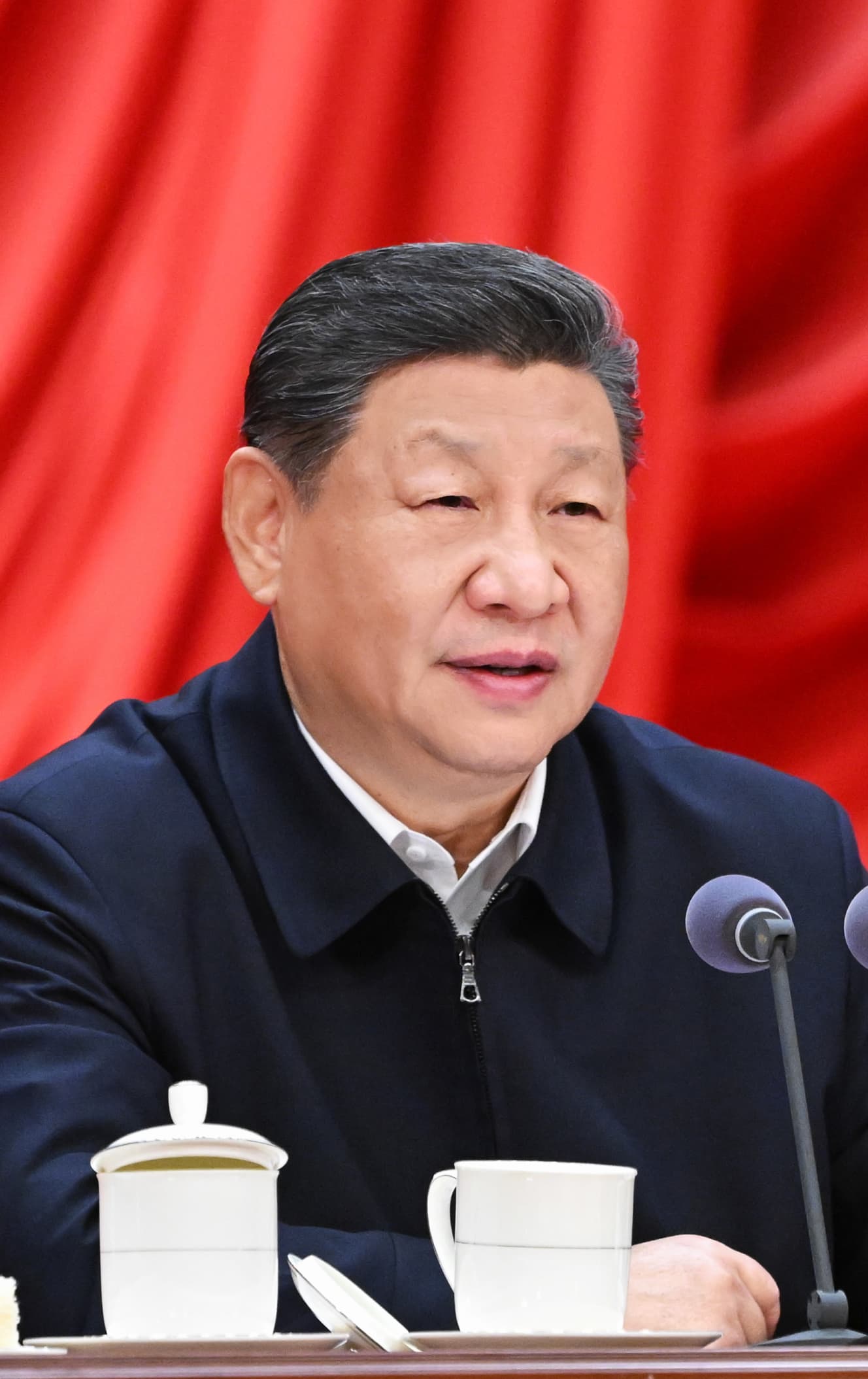
For Chinese President Xi Jinping (72), annexing Taiwan is a long-cherished goal. At the five-yearly Communist Party Congress, he declared to domestic and international audiences that the complete reunification of the motherland must be achieved (October 2022). Last December, the People’s Liberation Army conducted military exercises around Taiwan. Minemura continues:
The likelihood that China will annex Taiwan via a large-scale amphibious operation that provokes the international community is low. Instead, Beijing is likely to proceed step by step through a gray-zone approach—a new type of unification war—achieving Taiwan’s annexation without direct military conflict.
The diagram below was created from Chinese internal documents to illustrate these steps. It shows how Xi is steadily advancing toward national reunification. Accelerating Xi’s new unification war are the surprising actions of U.S. President Trump since the start of this year.
On January 3, the U.S. military attacked military facilities in Venezuela and detained President Maduro and his wife. The following day, President Trump expressed interest in claiming the Danish autonomous territory of Greenland. His goal is to secure U.S. interests in the Western Hemisphere.
For Trump, the Americas and Greenland are within the U.S. sphere of influence. Venezuela, part of his backyard, is an oil-rich country, 85% of whose exports go to China. For Trump, reclaiming this stolen oil is absolutely imperative.
China’s Sphere of Influence and the Eastern Hemisphere Recognized by President Trump
This could become a deal with China: the U.S. would gain Venezuela’s oil in exchange for recognizing Taiwan, Japan, and other parts of the “Eastern Hemisphere” as within China’s sphere of influence, agreeing not to interfere.
Trump emphasizes U.S. rights over the “Western Hemisphere” because of this. At the upcoming U.S.-China summit in April, this deal might be executed. In other words, the U.S. could effectively give its approval to China’s annexation of Taiwan.
Just as the U.S. acted against the Venezuelan president, Chinese special forces could potentially carry out a decapitation operation to detain Taiwan’s President Lai Ching-te. In fact, a full-scale mock-up of Taiwan’s presidential office has been confirmed in the Inner Mongolian desert, and repeated training for such an incursion has taken place—a rehearsal for a possible decapitation operation.
Beyond a decapitation operation, what else might happen to achieve Taiwan’s annexation? Looking back at the diagram, military exercises and a degree of diplomatic pressure on Taiwan are already underway.
For China, the most effective strategy is maritime blockades, including inspections by surveillance vessels and the use of mines. Taiwan’s liquefied natural gas reserves, which provide about 30% of its electricity, would last only 11 days, and its food self-sufficiency is around 30%. A blockade would rapidly plunge Taiwan’s population into hardship.
Cyberattacks would also intensify, disrupting smartphones and computers via electromagnetic waves. False information—such as “President Lai has abandoned the people and fled abroad”—would likely be spread. Xi’s goal is to unify the motherland intact, avoiding destruction of society or property, while breaking the morale of the Taiwanese people to force them into negotiations favorable to China.
Japan is not exempt. If the “Eastern Hemisphere” envisioned by U.S. and Chinese leaders is left to China, American support cannot be expected. Without U.S. backing, Taiwan would find it difficult to resist China alone. In that case, how far would Japan’s Self-Defense Forces be involved? If Japan aligns with the U.S. and lets Taiwan fend for itself, it would face severe international criticism. Conversely, if the Self-Defense Forces intervene, the potential damage would be immense. Japan faces an extremely serious dilemma.
The economic impact would also be significant. About 90% of Japan’s maritime logistics pass through the Bashi Channel. A maritime blockade of Taiwan would have incalculable consequences for Japan.
Taiwan and Japan are being pulled along by the strategic calculations of the two major powers, the U.S. and China. The severity of a potential crisis grows day by day.
—From “FRIDAY”, February 20–27, 2026 combined issue
Caption: U.S. President Trump shows strong interest in asserting control over the “Western Hemisphere,” while some view that he has effectively recognized the “Eastern Hemisphere” as China’s sphere of influence.
Diagram caption: Stages of Taiwan’s gray-zone annexation by China
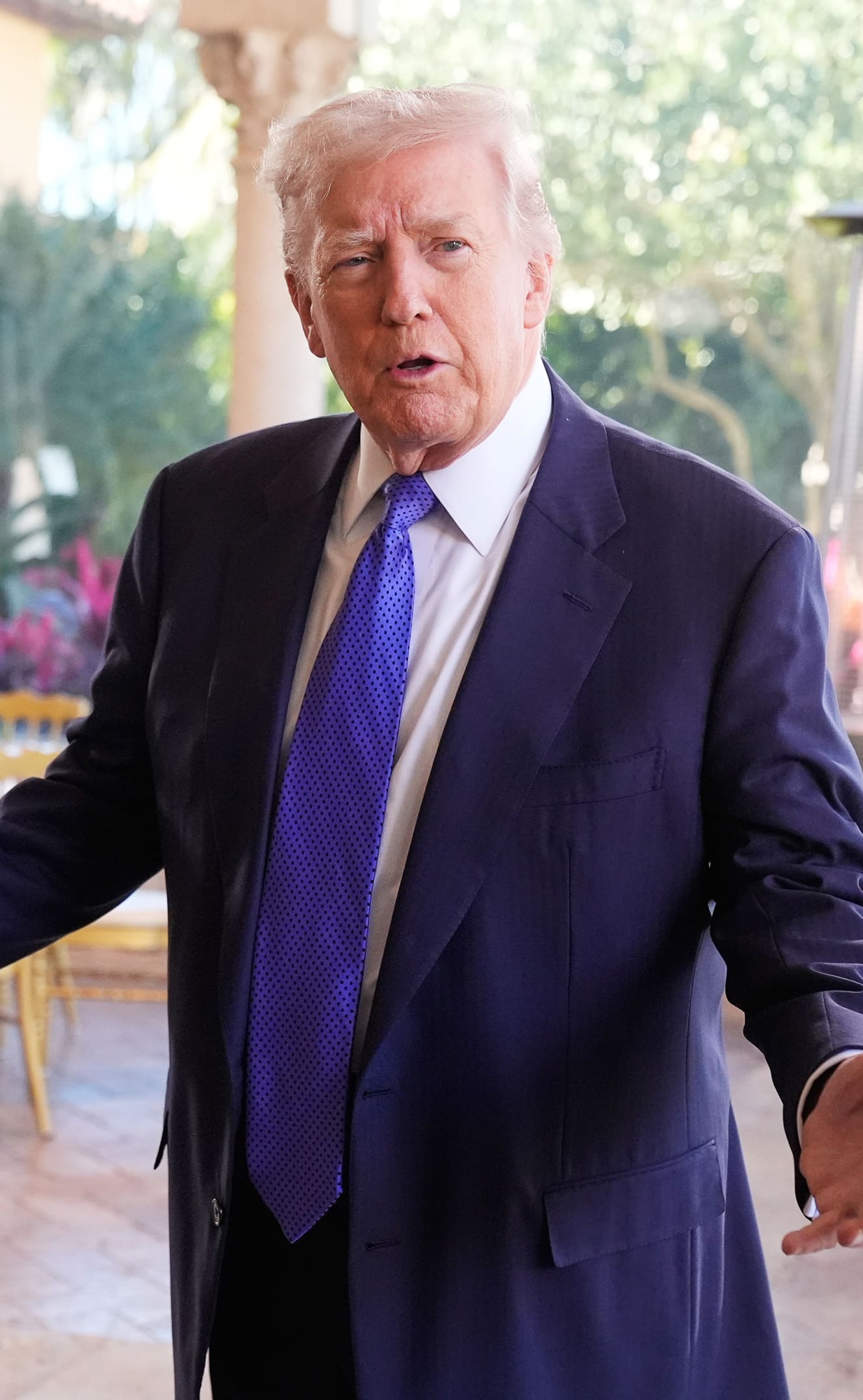
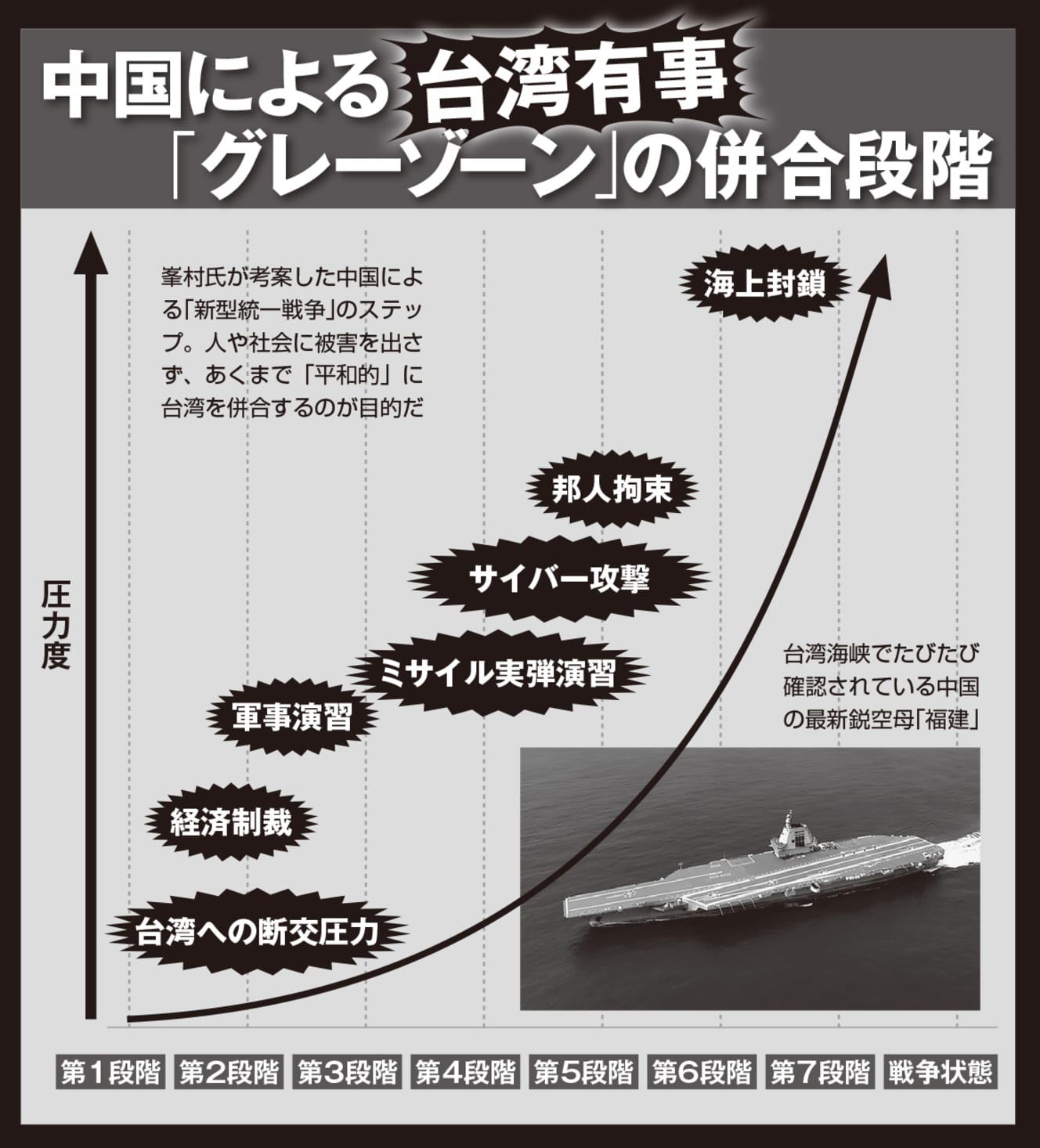
PHOTO: AP/Afro Xinhua/Afro Kyodo News Reporting by: Kenji Minemura (Senior Fellow, Canon Institute for Global Studies)