Centrist reform coalition faces internal rift amid Komeito’s gains, CDP’s collapse


Former Komeito exceeds previous House election with 28 seats
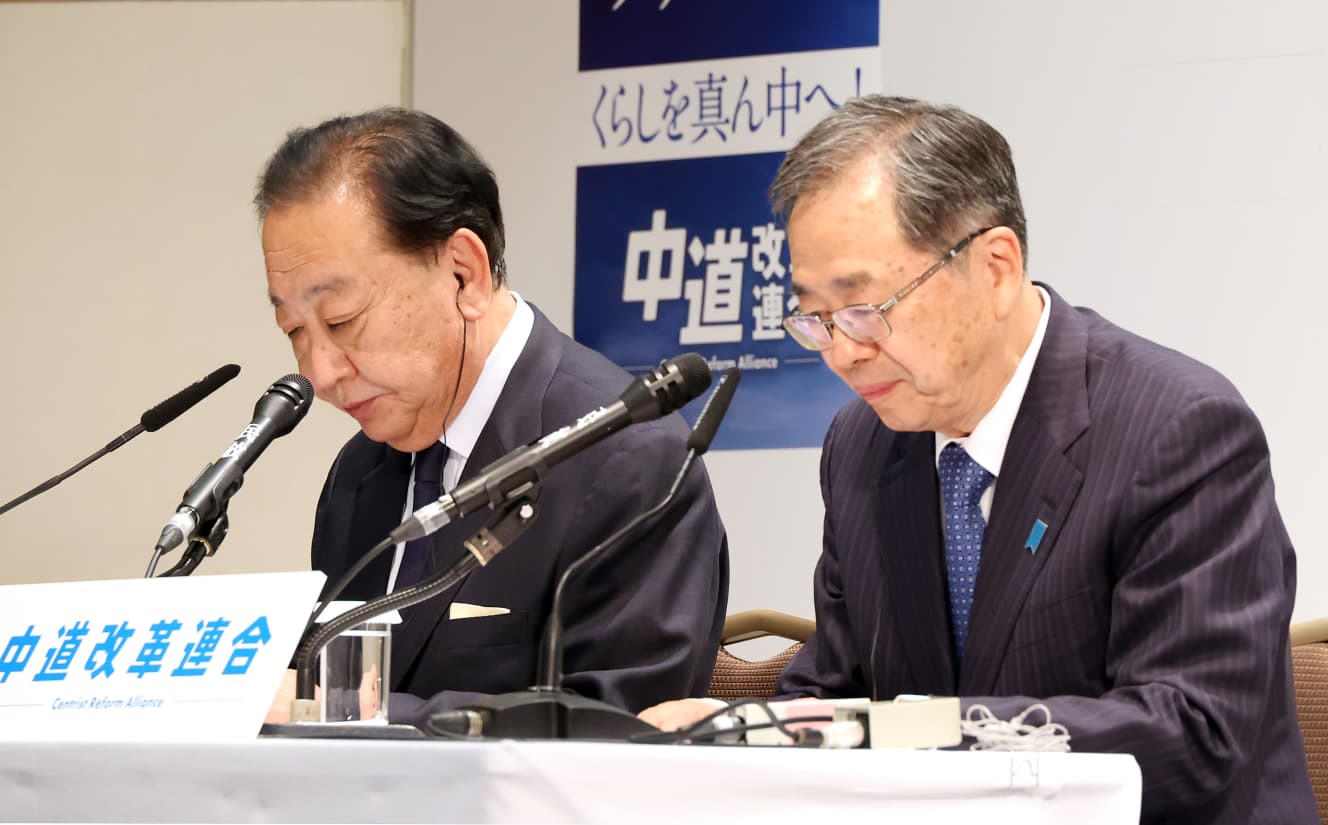
“I bear a responsibility worthy of death,”
said Yoshihiko Noda, former co-leader (68) of the Centrist Reform Alliance, weakly.
In the House of Representatives election held on February 8, the Centrist Reform Alliance, formed by the Constitutional Democratic Party and Komeito, suffered a catastrophic defeat, dropping from 167 seats before the official announcement to just 49—less than a third. A national newspaper political reporter covering the count center testified:
“It was completely like a wake. Even the customary ceremony of placing flowers on the winners was canceled. What stayed with me was Noda’s vacant eyes.”
Meanwhile, an election to choose new leadership to replace Noda and Tetsuo Saito (74), who resigned on the 9th taking responsibility for the defeat, is scheduled for the 13th. It will be a head-to-head contest between Junya Ogawa (54) and Takeshi Kai (59), both of whom survived in single-member districts and are former members of the Constitutional Democratic Party.
That said, for the former Constitutional Democratic Party, the situation can only be described as a total collapse.
Founding member Yukio Edano (61), co-secretary-general Jun Azumi (64) who led the formation of the Centrist Alliance, co-election committee chairman Sumio Mabuchi (65), and former Democratic Party leader Ichiro Ozawa (83) all lost in their districts and could not be revived via proportional representation.
Others, including former Foreign Minister Katsuya Okada (72), former House Vice Speaker Banri Kaieda (76), and former House Vice Speaker Koichiro Genba (61), also exited the Diet. Perhaps most shocking was the loss in a single-member district of Akira Nagatsuma (65), the “Mr. Pension.”
“Nagatsuma’s candidacy in Tokyo’s 27th district was supposed to be ironclad. When news of his loss arrived, Centrist Alliance members were blinking in disbelief, saying, ‘How could this happen? Unbelievable.’ He later won a seat via proportional representation, but the headwind against the Centrist Alliance was hurricane-level,” said the same national reporter.
The party’s internal resentment has not only remained but grown, especially after Komeito candidates were favored on proportional representation lists, winning 28 seats, surpassing their 2024 results. A Constitutional Democratic Party insider expressed anger in an interview with our site:
“We were completely outmaneuvered. The responsibility lies heavily on Noda, Azumi, Mabuchi, and the executive team who pushed for the Centrist Alliance. If you liken it to the Battle of Sekigahara, former Komeito legislators watched from a high vantage point while former Constitutional Democratic legislators were cut down one after another on the battlefield. The sudden dissolution forced Noda and the executive team to give too many concessions in order to secure Komeito’s organizational votes, I think.”
Caught between a rock and a hard place
Mr. Noda, during the Democratic Party administration in 2012, also suddenly called for a dissolution in a party leader debate with the late Prime Minister Shinzo Abe, and subsequently suffered a historic defeat in the election that followed. Based on that, he is mocked on social media as the man who crushed the Democratic Party twice.
A Constitutional Democratic Party insider who knows Mr. Noda said:
“He’s normally gentle and straightforward. When he walks through his local shopping district, people call out, ‘Mr. Noda!’—he’s well-liked. Privately, he’s a pro wrestling fan, especially of the late Jumbo Tsuruta. Once he starts talking about wrestling, he doesn’t stop. Honestly, this time the result may have been that Mr. Noda’s good nature was taken advantage of.”
The Centrist Reform Alliance had considered the security legislation constitutional and allowed the restart of nuclear reactors, while the CDP opposed them. Entering the election without correcting this created confusion and disillusionment among supporters on both sides.
“Honestly, the organizational votes from Komeito that the CDP had hoped for weren’t that significant. From Komeito’s perspective, if you wrote ‘Centrist’ on the proportional ballot, your job was done. Some didn’t support the CDP candidates running in single-member districts and instead voted for the LDP. From the start, Centrist was not a united front,” said the same CDP insider.
What will happen to the Centrist party going forward? The party has adopted a separation of national and local approach; in the House of Representatives, the former CDP and former Komeito were united, but in the House of Councillors and local assemblies, they remain as the CDP and Komeito respectively. Former co-leader Saito said at a press conference:
“The direction is for the Centrist party to gather together locally and in the House of Councillors from now on.”
However, the path ahead is undoubtedly difficult.
“This is truly a case of caught between a rock and a hard place,” political commentator Harumi Arima told this site.
“Within the party, there are, of course, voices saying that they should start over separately as a true CDP, apart from Komeito, while others argue that if they break up now, they’ll be criticized as a mutual aid society for elections, so they should stay together. Still, all the legislators, including those who lost, have strong opinions. The seeds of division are smoldering.”
If you win, you’re the government; if you lose, you’re the rebels—an oppressive atmosphere spreads within the Centrist party.
PHOTO: Yoshio Tsunoda/Afro (1st), Takeshi Kinugawa (2nd)