New 30 km/h residential limit highlights the power of mobile speed cameras


“The era when cyclists could get away with violations is over.” — With the revised Road Traffic Act coming into effect on April 1, the bicycle blue ticket system has been widely reported. However, what drivers should really watch out for is the reduction of speed limits on residential streets, which will be enforced from September 1.
Until now, the default speed limit on general roads without signs was 60 km/h. After the revision, on so-called residential streets without center lines, the limit will uniformly be 30 km/h, even if no signs are posted. Alongside this new regulation, what poses a concern is the powerful enforcement by mobile speed cameras on residential roads.
Detection rates increase sixfold
A key point of this revision is how roads without speed limit signs are handled. According to the National Police Agency, roads where the 60 km/h limit will continue are limited to those with center lines, lane markings, or median strips.
Familiar shortcuts in residential areas or quiet rural roads during trips — if drivers assume no sign means okay and accelerate, they could immediately face heavy violations (equivalent to a red ticket) for exceeding 30 km/h. The strict 30 km/h regulation reflects the police’s strong intent to reduce traffic accident risks on residential roads.
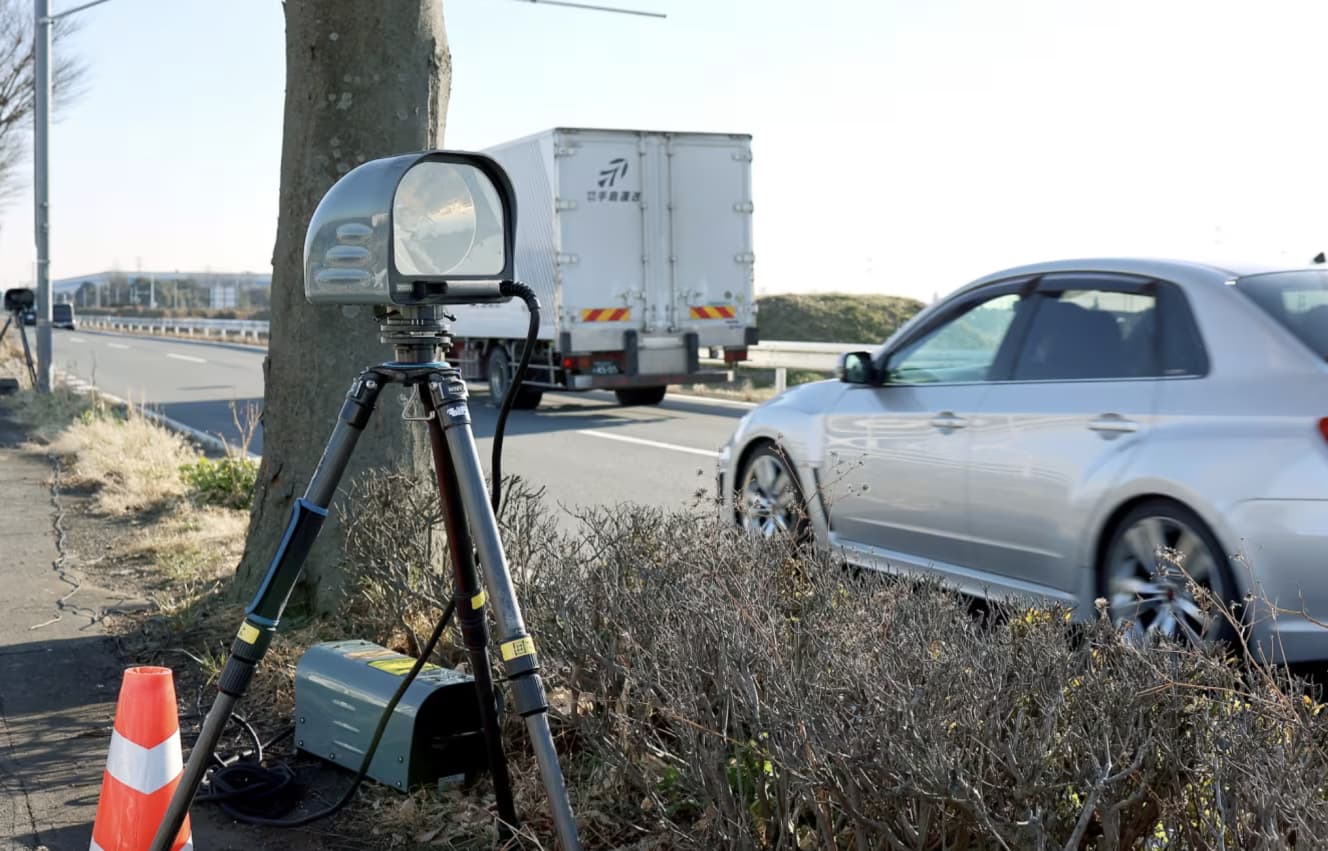
Mobile speed cameras, which are stealthily deployed, are a focal point of concern. These are portable devices that automatically measure speed, capture violations, and record evidence. Unlike traditional speed traps, where officers measure speed and stop vehicles on the spot, mobile cameras automatically photograph violating vehicles for later processing.
“Mobile speed cameras are small devices designed for use on school routes and residential streets. Traditional speed traps require space for a ticketing area, which is difficult in residential roads. Mobile cameras, however, can be set up in an area roughly the size of two tatami mats.”
This is according to Katsumi Osuga, who runs Orbis Guide, a website sharing speed camera installation information. The mobile cameras consist of a simple setup with a camera and sensor mounted on a tripod about 1 meter high. Portable by a person, they can be installed with only about 1 meter of roadside width. There is no need for officers to rush out and stop vehicles. Passing violators are automatically photographed, including their license plates and faces, and are summoned to the police station later. This makes it possible to operate even on narrow residential streets where stopping vehicles would be difficult. With the new law, it is expected that enforcement with mobile cameras may be strengthened.
“The decision to enforce is up to the police, so it cannot be stated definitively, but it is likely that checks will be stricter than before,” says Osuga.
The power of mobile cameras is remarkable. According to Yomiuri Shimbun, when Chiba Prefectural Police began full-scale use of mobile cameras in 2021 with only three units, the number of violations recorded from January to April jumped to 1,440 — about 6.6 times higher than the same period the previous year.
By the time you notice it, it’s already too late
Fixed speed cameras, commonly seen on highways and main roads, have traditionally been known to activate only at significant speed violations. However, mobile speed cameras can have their enforcement speeds set arbitrarily, so the situation on residential streets is different.
“The speed limit on residential streets will be 30 km/h. Driving with conventional expectations can be dangerous. If you drive at 50 km/h on a 30 km/h road, that’s 20 km/h over. At that speed, you’ll probably get photographed,” Osuga explains.
So, when and where are these devices typically deployed? According to Osuga, the times to be most cautious are during the morning and afternoon school commute periods.
“Mobile cameras on residential streets are mainly used during the day, especially during school commuting times. Around schools, many requests come from PTAs and neighborhood associations asking the police to crack down on speeding because it’s dangerous. Often, cameras are installed in response to these requests.”
He also notes enforcement can catch drivers off guard.
“For example, in Chiba Prefecture, even narrow, pitch-dark residential streets are subject to mobile camera enforcement at night. In Chiba, enforcement is focused more on narrow residential streets than on main roads. At night, mobile cameras are hard to see. Plus, in residential areas with many obstacles, even the latest radar detectors may respond too late, and by the time you notice, it’s already too late. Needless to say, on residential streets and around schools, driving slowly is the basic rule regardless of whether there’s a camera. On top of that, drivers must be even more careful about speed.”
On the other hand, enforcement isn’t always about issuing tickets — visible enforcement is also used. Signs are placed in school zones to make drivers aware of enforcement. Osuga reveals, “Sometimes not only real cameras but also dummy devices are used.”
“Police stations may even make fake cameras from tin cans or wood to resemble speed cameras. Mobile cameras are very expensive, so each prefectural police department can only have a limited number. But if the goal is to make drivers aware of there’s a camera here and slow down, it doesn’t have to be a real camera. You can really feel the police’s determination to prevent accidents by any means necessary.”
From September onward, residential streets will have a uniform 30 km/h limit. Unless signs indicate otherwise, driving at 60 km/h like before will result in a ticket. Ignorance will no longer be an excuse. High-performance cameras or dummies may be waiting right in your neighborhood. Drivers will need to exercise greater caution than ever on residential streets.
PHOTO: Orbis Guide