Back Where He Belongs — Toshiki Sakurai’s Fight for Another Chance on the Mound
--Toshitaka Sakurai, a former Giant Draft pick, is now struggling to win a championship at the Tokyo Dome!


Many Turning Points
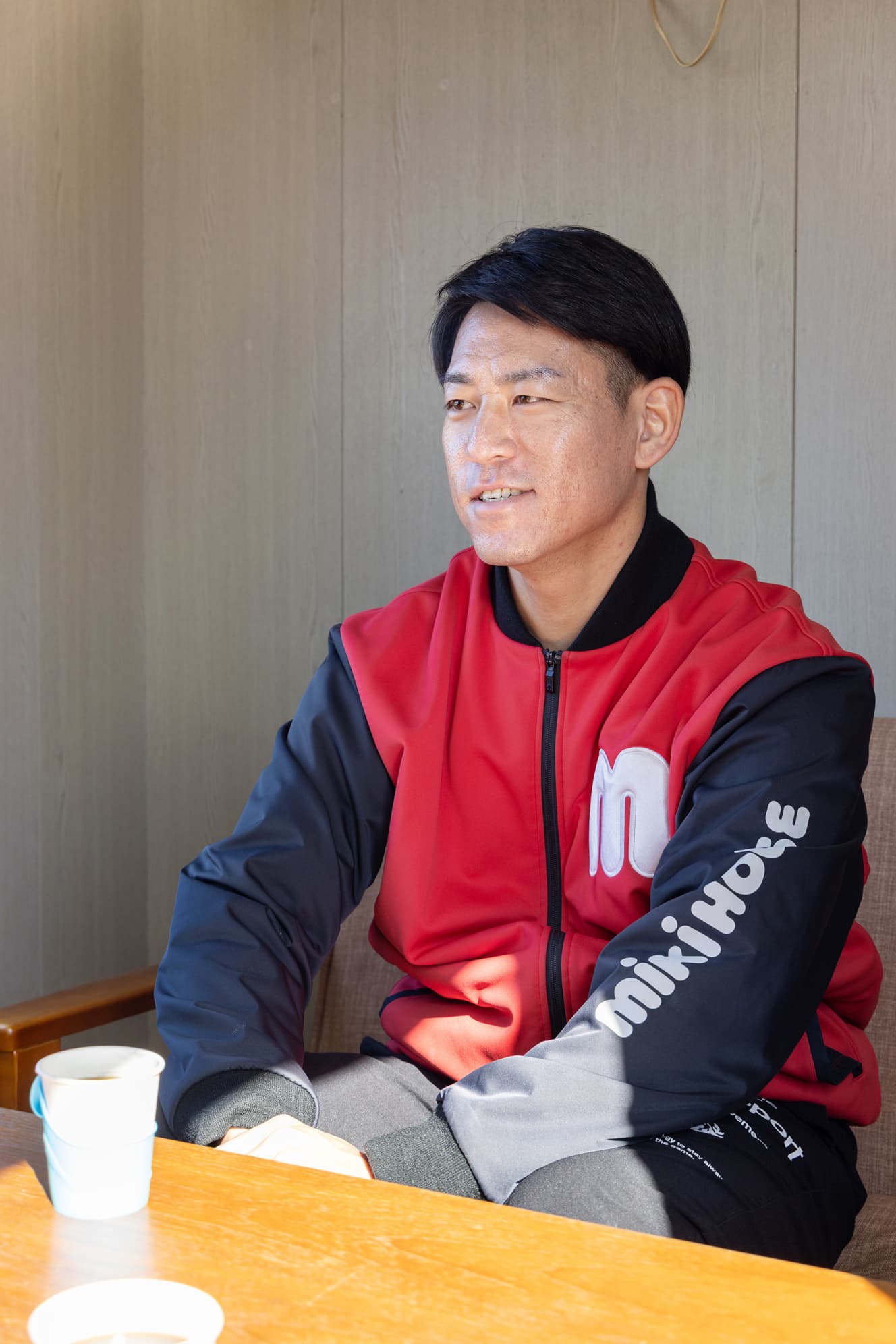
On the coldest wave of this winter, beneath a frigid sky where a wintry wind was blowing, the former Giants’ first-round draft pick—wearing a bright red outer jacket—greeted us with a smile at a ground in Iga City (Mie Prefecture).
“Those clouds you can see over there are snow clouds. It looks like it’s about to snow.”
So says Toshiki Sakurai (32), whose tightly built physique is almost unchanged from his days with the Giants. The man who once stood on the mound at Tokyo Dome to roaring cheers has, for the past two years, belonged to the corporate team MIKI HOUSE and is now performing as their ace.
“When the Giants selected me in the first round of the draft, I felt like my life had changed.”
After graduating from Ritsumeikan University, Sakurai joined the Giants in 2016. It was from his third year onward that he began to feel he could make it. He clawed his way back from an injury in his first season, and in his fourth year recorded eight wins as part of the starting rotation. The right-hander was expected to become an ace candidate, but the professional world is ruthless when results don’t come. In 2022 he received a notice of non-renewal and decided to retire from active play, switching to a scouting role for the Giants.
“I had a family, so because of the financial burden the independent leagues weren’t an option. Thinking realistically, I decided it was better to move on to a new path.”
He suddenly went from player to scout, and his life changed completely. Sakurai was in charge of the Kansai region as well as Shimane and Tottori in the San’in area. He moved from Tokyo to Kyoto, and his life as a scout began.
“The hardest part was travel and putting together the schedule. When I was a player, the manager arranged things like tickets, but as a scout I had to do everything myself. I built my schedule like a puzzle, combining the games I wanted to watch while taking travel time into account.”
However, this scouting experience also became an opportunity to broaden Sakurai’s view of baseball. By observing hitters’ movements from behind the backstop, he came to understand their approach at the plate. Ironically, by taking off the uniform he gained the ‘field of vision’ necessary as a pitcher.
Furthermore, a small coincidence also pushed him toward returning to active play. In June 2023, a high school game in Kyoto that he was scheduled to scout was rained out, and it was switched to a practice at the training ground of his alma mater, Ritsumeikan University.
“By chance, the president of the baseball club’s alumni association was there, and in the course of small talk I casually told him, ‘I’d like to play baseball a little longer,’ and he said, ‘That’s also a possible path, isn’t it?’”
From that day on, the feelings for the mound that had been smoldering inside him gradually began to burn again. The alumni association president, Shigeki Fujioka, had once managed MIKI HOUSE during its club-team era, and as the off-season began, the path to an active comeback started to become a reality.
“Even so, the draft was approaching, so my only thought was to finish my scouting job to the very end. I didn’t have the time to train for a comeback.”
After the draft, he conveyed his intention to return to active play to scouting director Yujin Mizuno (60) and then-manager Tatsunori Hara (67). He says he received words of encouragement from both.
Back to the mound at Tokyo Dome
With the new year, Sakurai resumed his activities with MIKI HOUSE after a one-year blank. In corporate baseball, unlike in professional baseball, the main battleground is single-elimination tournaments where a loss means the end.
“In pro baseball there are 143 games a year, but in the corporate leagues it’s over in just one game. The intensity from the qualifying rounds is incredible, and the company employees all come together to cheer for us. You really feel the weight of it as a company sport.”
After his return, the moment that left the biggest impression came in June 2024, his first year with the team, in the second round of the Intercity Tournament Kinki qualifiers against Nippon Steel Setouchi. He got the call in the eighth inning of a game they absolutely could not lose.
“To be honest, from around the sixth inning I was thinking, ‘I really don’t want to pitch’ (laughs). Images of getting hit started running through my head.”
During his time with the Giants, he would repeatedly review video of opposing hitters and work out countermeasures. As his turn in the rotation approached, he sometimes overthought things so much that he felt like he might throw up from the nerves.
“I’m negative until I get on the mound. But once I’m there, I just lock in, and it’s like a lie—I’m released from the tension. In the end, I walked the first batter, but then struck out three straight. I closed out the ninth with a zero as well.”
The team won and earned a place in the main tournament, and Sakurai—wearing the red uniform—made his return to Tokyo Dome.
That same year, in the final Kinki qualifying round for the Japan Championship, he faced Nippon Steel again. Starting the game, Sakurai battled with persistence, allowing two runs through eight innings, leading MIKI HOUSE to its first Japan Championship appearance in 19 tournaments.
In 2025, another former Giants first-round pick, left-hander Yuki Takahashi (28), joined MIKI HOUSE. Sakurai himself invited his former teammate, and together they are aiming to be the best in Japan.
“In the pros, if you put it one way, the individual aspect is very strong. In corporate baseball, the company comes first—it exists because of the company. You can feel that from your teammates too. I know Takahashi’s personality well, and I thought he’d be a good fit for corporate baseball, so I asked him to join.”
By the time the interview ended and practice began, light snow had started to fall on the ground. Carrying the hopes of his company and his teammates, Sakurai continues to take the mound again this year.



From the February 13, 2026 issue of “FRIDAY”
Photography and text: Kei Kato