Doctors and Pharmacists Slam Viral Post Misrepresenting Emergency Contraception



A lack of understanding toward cases where consent to contraception is not obtained
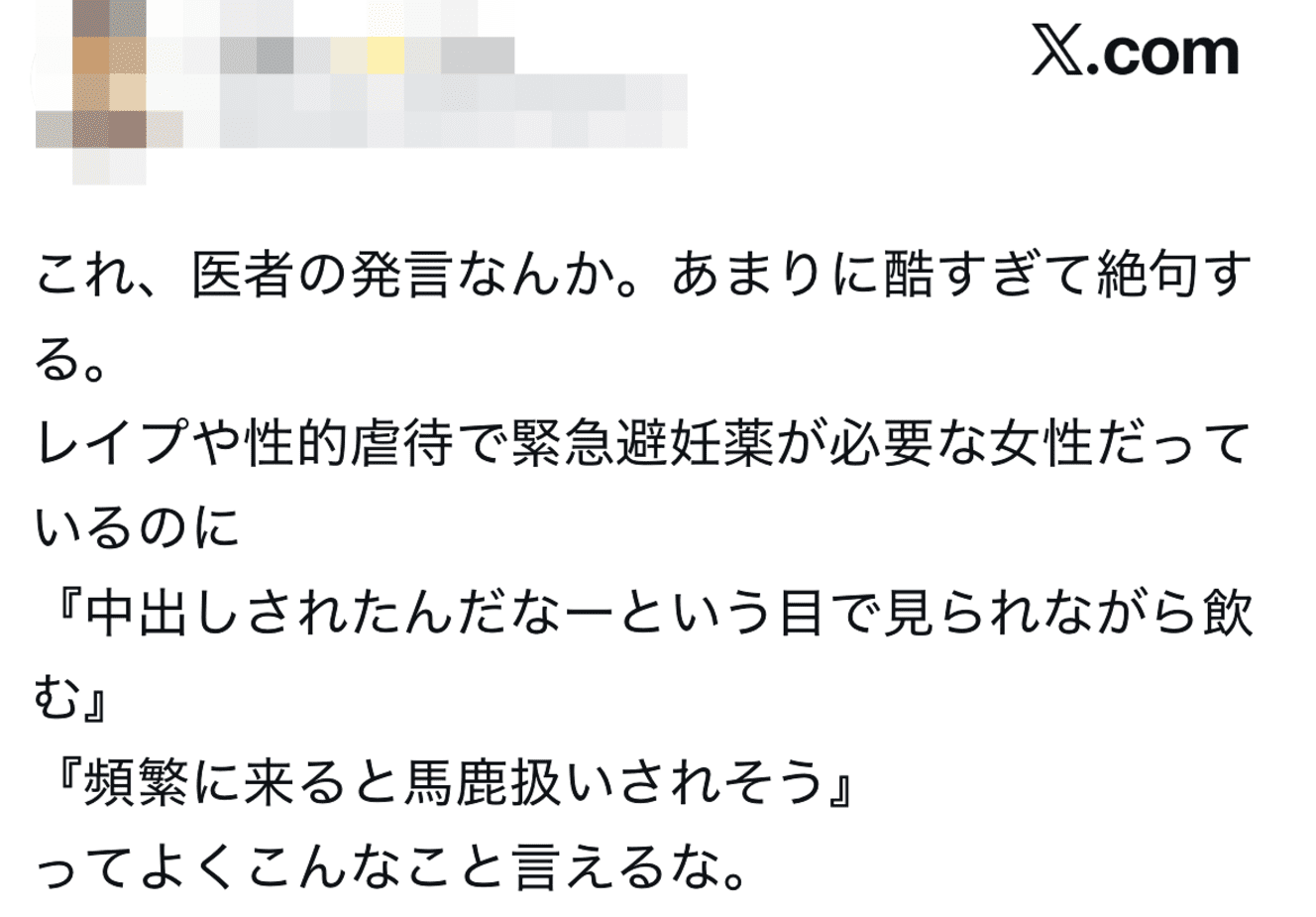
“Having to take it while being looked at like, ‘So you got creampied, huh,’ is pretty tough.”
“If you come too often, they might treat you like an idiot… Well, I guess you can just go to a different store. Take care of your body.”
Expressions that seem to condemn women as careless or personally responsible, without considering their circumstances or background. A social media post directed at women seeking emergency contraception caused a major backlash online (the post was later deleted). Because the author was a physician, voices of anger and disappointment have emerged from within the medical field.
On February 2, 2026, the emergency contraceptive “NorLevo” began over-the-counter sales at pharmacies. What is the true significance of this policy change? We spoke with Dr. Kenichiro Sakaguchi, director of Sangenjaya Art Clinic, and a female managing pharmacist working at a dispensing pharmacy in Tokyo.
—The kind of comment mentioned at the beginning spread widely on social media. As healthcare professionals on the front lines, how do you view it?
Dr. Sakaguchi: “I don’t believe physicians working in clinical settings think that way. Patients who need emergency contraception include not only those who experienced contraceptive failure, but also cases where consent to contraception was not obtained, or where there was sexual assault—situations beyond the individual’s control. However, unless patients choose to tell us, we cannot probe deeply. In consultations, we focus on what is physically and psychologically safest for the patient at that moment.”
Pharmacist: “It’s the same at pharmacies. Many people come to us feeling anxious, rushed, or confused. What we consider is simply:
• Whether the person meets the conditions for taking the medication
• Whether they can use it correctly without misunderstanding
• Whether we can connect them to further medical care if necessary
That’s it.”
—How do you view the shift to OTC (over-the-counter) availability of emergency contraception?
Dr. Sakaguchi: “The purpose of the system is very simple: to deliver a time-sensitive medication to those who need it in time. Emergency contraception has a clear time limit—within 72 hours after intercourse. In reality, some people lose their options because hospitals are closed, they cannot make time for a visit, or it is psychologically difficult to seek medical care. Making it available at pharmacies means expanding their options.”
—What is the process for purchasing it at a pharmacy?
Pharmacist: “If a pharmacist who has completed the required training is present, it can be purchased even at a drugstore. A prescription is not required, but before dispensing, we confirm details such as the timing of intercourse and the person’s health condition. If it is determined they can take it, they do so in front of the pharmacist. There is no age restriction; even minors can purchase and take it based on their own decision. However, depending on the situation, we are expected to connect them with medical institutions or counseling services.”
—With OTC availability, privacy concerns have also come to light. Are pharmacies taking any measures?
Pharmacist: “Pharmacies are spaces where unspecified numbers of people come and go. When someone consults about emergency contraception in that environment, we must be mindful of voices, glances, and waiting times—everything. Even if there is a private room, during busy hours, some people may give up while waiting for it to become available. Consideration must extend to time, space, and even movement flow within the store. I believe responses vary depending on the pharmacy.”
“I can’t ask what’s going on.”
—Could you explain the difference between emergency contraception and abortion pills such as Mefeego Pack?
Dr. Sakaguchi: “Emergency contraceptives are not medications that terminate a pregnancy. They work by delaying ovulation or creating conditions that make fertilization or implantation less likely. They do not have the effect of ending an already established pregnancy.”
Pharmacist: “Some people may mistakenly believe they are the same as abortion pills, so we feel it’s important to clearly explain the distinction. In our training, we always learn the difference between emergency contraception and abortion medication. Emergency contraceptives are used to prevent pregnancy and have no effect if someone is already pregnant.
In contrast, abortion pills are used after a pregnancy has been established, and their purpose and mechanism are completely different. If these are confused, it can lead to the misunderstanding that this system ‘treats life lightly.’ Preventing that misunderstanding is also an important role for pharmacists.”
—In some cases, sexual assault may be suspected in the background of someone seeking emergency contraception. How is that handled?
Dr. Sakaguchi: “It’s an extremely sensitive issue. Even as physicians, we cannot determine whether it was sexual assault unless the person chooses to tell us. Forcing them to speak can actually push them further into distress. That’s why it’s important to create an environment where they are respected whether they speak about it or not.”
Pharmacist: “We can connect someone to medical institutions or support services, but we do not press them for details. Some people considering emergency contraception may worry that they’ll be interrogated at the pharmacy. What we pharmacists confirm is only what is necessary to determine whether they can safely take the medication.”
—The doctor’s comment suggesting that someone who comes frequently might be treated like an idiot was shocking. If someone needs emergency contraception repeatedly, how do medical professionals view that?
Dr. Sakaguchi: “If someone is using it frequently, that’s not something to blame—it’s a sign they should be connected to the next stage of care. Emergency contraception is an option for emergencies. If it’s needed repeatedly, we should discuss more stable contraceptive methods, such as low-dose oral contraceptives. In that sense, I think discussions about making regular contraceptive pills available at pharmacies should have accompanied the move to OTC emergency contraception.”
—If pregnancy does occur after taking emergency contraception, is there any impact on the fetus?
Dr. Sakaguchi: “There is no adverse effect on fetal development. If pregnancy has already been established, taking emergency contraception will not stop it, and the pregnancy will continue. That’s why it’s important to confirm whether pregnancy has occurred about three weeks after taking the medication.”
—If pregnancy is confirmed and the person decides not to give birth?
Dr. Sakaguchi: “In that case, a surgical abortion would be necessary.”
—Some people are anxious about abortion procedures themselves.
Dr. Sakaguchi: “Today, instruments and techniques have improved significantly, and safety has greatly increased. The risk of affecting future pregnancies is considered extremely low.”
—If pregnancy is established, it’s important not only for the individual but also to consult with trusted people and think carefully. There is also a time limit for abortion, correct?
Dr. Sakaguchi: “Under Japan’s Maternal Protection Act, abortion is permitted up to 21 weeks and 6 days of pregnancy (before 22 weeks). Considering fetal development and the burden on the mother’s body, early-stage abortion between 6 and 9 weeks is regarded as the safest period.”
—If someone delays, thinking ‘I’ll decide later,’ the weeks can pass and options may narrow. Early consultation seems essential. With emergency contraception now available over the counter, pharmacies may increasingly become the first point of contact.
Pharmacist: “I believe so. Pharmacies are psychologically more accessible than medical institutions. That’s why we try to ensure it doesn’t ‘end here.’
We calmly explain:
• The possibility of pregnancy
• When confirmation is necessary
• The need to connect with a medical institution
It’s not just about handing over the medication and finishing. We want to be a place where we think about the next step together.”
The circumstances behind seeking emergency contraception differ greatly from person to person. That is precisely why prejudice or careless words must not narrow women’s options or harm their health. It is something society needs to recognize and share.