Yamanashi Wildfire Burns Area Equal to 84 Tokyo Domes; Low Rainfall Raises Risk Through May
The cause of the wildfire, which took 17 days to extinguish and burned 84 Tokyo Domes, is "global warming.


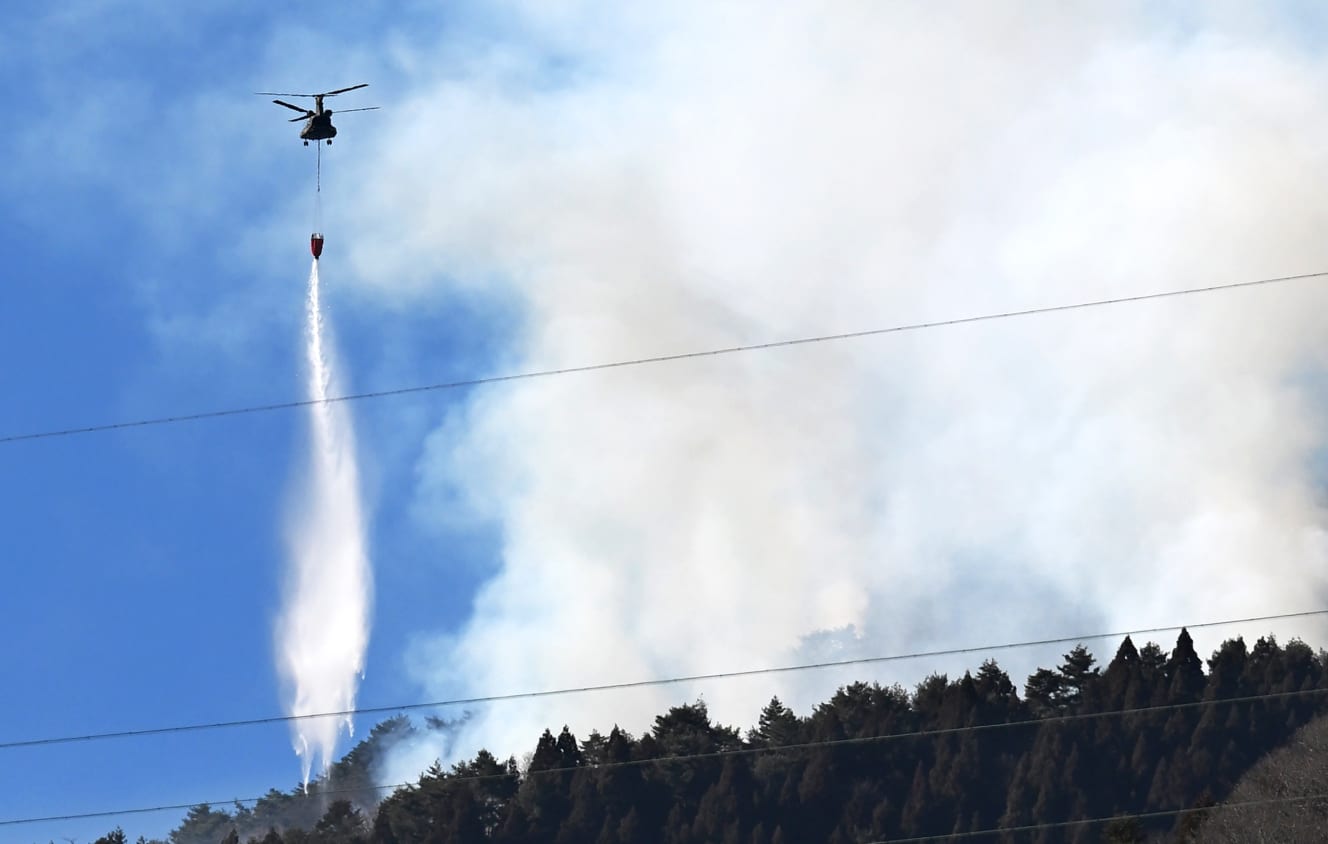
The white smoke of the great fire engulfed the entire mountain

Take a look at the photo above. The white haze spreading across and covering the entire mountain is smoke from a massive wildfire. The location is Mt. Ogi (1,138 meters above sea level), which straddles Uenohara City and Otsuki City in Yamanashi Prefecture. A man in his 70s who lives nearby recounts:
“I was shocked to see smoke rising from the mountain right behind my house—the one I’ve climbed so many times. Embers and ash were flying through the air, and I was terrified the fire might spread to my home. I’ve lived here for 72 years, and this is the first time I’ve seen a wildfire of this scale.”
He continued:
“Since last December, it has hardly rained at all. It’s been so dry that frost columns haven’t even formed in the fields. That’s extremely unusual.”
The fire broke out on January 8. It took 17 days to bring it under control, burning through 396 hectares—an area equivalent to about 84 Tokyo Domes. At one point, the flames came within 30 meters of homes at the foot of the mountain. Fortunately, no houses were damaged, but evacuation orders were issued to 215 households, affecting 297 residents.
The exact cause of the fire remains unknown, but as the resident suggested, this winter’s extreme dryness undoubtedly played a role.
“The average precipitation over the four weeks since late December has reached ‘once-in-30-years’ low levels in the Tokai, Kinki, Shikoku, and southern Kyushu regions. In Maebashi City in Gunma Prefecture, Kofu City in Yamanashi Prefecture, and Nagoya in Aichi Prefecture, recorded rainfall has been 0 millimeters,” said a reporter from a national newspaper’s social affairs desk.
Yamanashi is not the only place experiencing large-scale wildfires. Since January, fires have also broken out in Kiryu City in Gunma Prefecture and Fujieda City in Shizuoka Prefecture. According to the Forestry Agency, an average of about 1,200 wildfires occur annually over the past six years, with each incident causing approximately 210 million yen in damages. A notable trend is the increasing scale of these fires. A wildfire that broke out last February in Ofunato City, Iwate Prefecture, burned for about 40 days, scorching 3,370 hectares—roughly the equivalent of 720 Tokyo Domes. So-called mega wildfires are erupting with alarming frequency.
The growing scale of wildfires is said to be linked to global warming. Yoshihiro Tachibana, professor at the Graduate School of Bioresources at Mie University, explains:
“As Arctic sea ice melts, cold air masses are more likely to flow over Japan. When cold air from the north collides with warm air from the south, strong winds develop. Combined with ground that has been dried out by extreme summer heat, once a fire starts, strong winds can cause it to spread rapidly. Due to global warming, conditions that favor dryness and strong winds are becoming more common throughout the year. It would not be surprising if large-scale wildfires were to occur anywhere at any time.”
The Japan Meteorological Agency is warning that particular caution is needed through May, when precipitation levels are expected to remain low.
Interview, text, and photography: Masayoshi Katayama (Journalist) PHOTO: Jiji Press (2nd photo)