Ex-Luffy Gang Executive Kojima Exposes the Lies of Fearsome Commander Seiya Fujita


Exclusive Scoop! Prison Memoirs
A notorious crime syndicate that swindled 6 billion yen through special fraud faces internal conflicts in court
“As for the fraud, that’s correct. But regarding robbery resulting in injury, I did not instruct anyone to carry weapons or to threaten or assault anyone,”
the man told the court, acknowledging involvement in the charges while contesting part of them.
On January 26, the trial of Seiya Fujita (41), who was charged with robbery resulting in death and other crimes for acting as a coordinator in the nationwide “Luffy Group” robberies between ’22 and ’23, began. Fujita had also appeared as a witness in the trial of Tomonobu Kojima (48), another executive of the same organization.
Since last July, when Kojima received a 20-year prison sentence (later appealed), the author has been meeting Kojima almost weekly at Tokyo Detention Center. Within the fraud group, Kojima and Fujita had stood side by side as top executives. However, at the detention center, Kojima often displayed strong hostility toward Fujita. Their falling out stemmed from verbal attacks during Kojima’s own trial.
During Kojima’s trial, Fujita testified that Kojima controlled the organization’s money and personnel and that Kojima has killed people. Kojima denied these statements and elaborated on the contact unit led by Fujita.
Kojima explained that the contact unit was formed to prevent runners from embezzling money, revealing that members of the unit imposed cruel punishments on the runners who tried to escape with proceeds: stapling their bodies, making them brush their teeth with a toothbrush inserted into their anus, and forcing homosexual acts among men.
Before Fujita’s trial, Kojima told the author about the actual robberies:
“Imamura Kiyoto (41), who called himself ‘Luffy,’ planned and carried out the robberies, which were strictly robberies. However, once Fujita joined as a coordinator and manipulated the perpetrators, they escalated to robbery causing injury.
In fact, in the December ’22 incident in Nogata, Nakano Ward, Tokyo, Fujita instructed the perpetrators: ‘If you don’t beat them, you won’t get paid.’ Using a Telegram account under the name ‘Kim,’ Fujita also directed the perpetrators to use violence. His involvement made the crimes more vicious.”
Kojima described Fujita as a workaholic. While other executives indulged in nightlife and casinos, Fujita focused relentlessly on recruiting for special fraud.
“Fujita used polite language even with younger colleagues if they were business partners. He was devoted to his Filipino girlfriend and refrained from womanizing. But his thoroughness was terrifying. He praised successes excessively and immediately purged failures. His subordinates feared him, calling him ‘Frieza.’”

Will Fujita’s viciousness be revealed in court?
In this trial, Fujita faces charges for seven robbery incidents: six referred to by their locations—Ibaraki (Tokyo), Iwakuni (Yamaguchi), Nogata, Hiroshima, Chiba, and Adachi (Tokyo)—plus the robbery resulting in death of a 90-year-old woman in Komae (Tokyo) at the time.
The group’s executives issued robbery instructions remotely from a detention facility in the Philippines. According to Kojima, Imamura planned the robberies and directed the perpetrators, Yuki Watanabe (41) managed and transferred the stolen funds, and Fujita secured and instructed the perpetrators. Kojima added details about the relationships among the executives:
“In court, Fujita will likely claim he followed Imamura and Watanabe’s orders. But as far as I know, Imamura was actually manipulated by Fujita. Fujita and Watanabe planned to kill Imamura, who was wealthy in the detention center, and take his share.
Even with Watanabe, the group’s boss, Fujita was able to speak casually, as he was a long-time friend. From the statements of the perpetrators, I believe Fujita was the true mastermind behind the robberies.”
Kojima emphasized that in the Luffy Group’s wide-area robberies, Fujita played a larger role than Imamura. Just before Fujita’s trial, Kojima also stated:
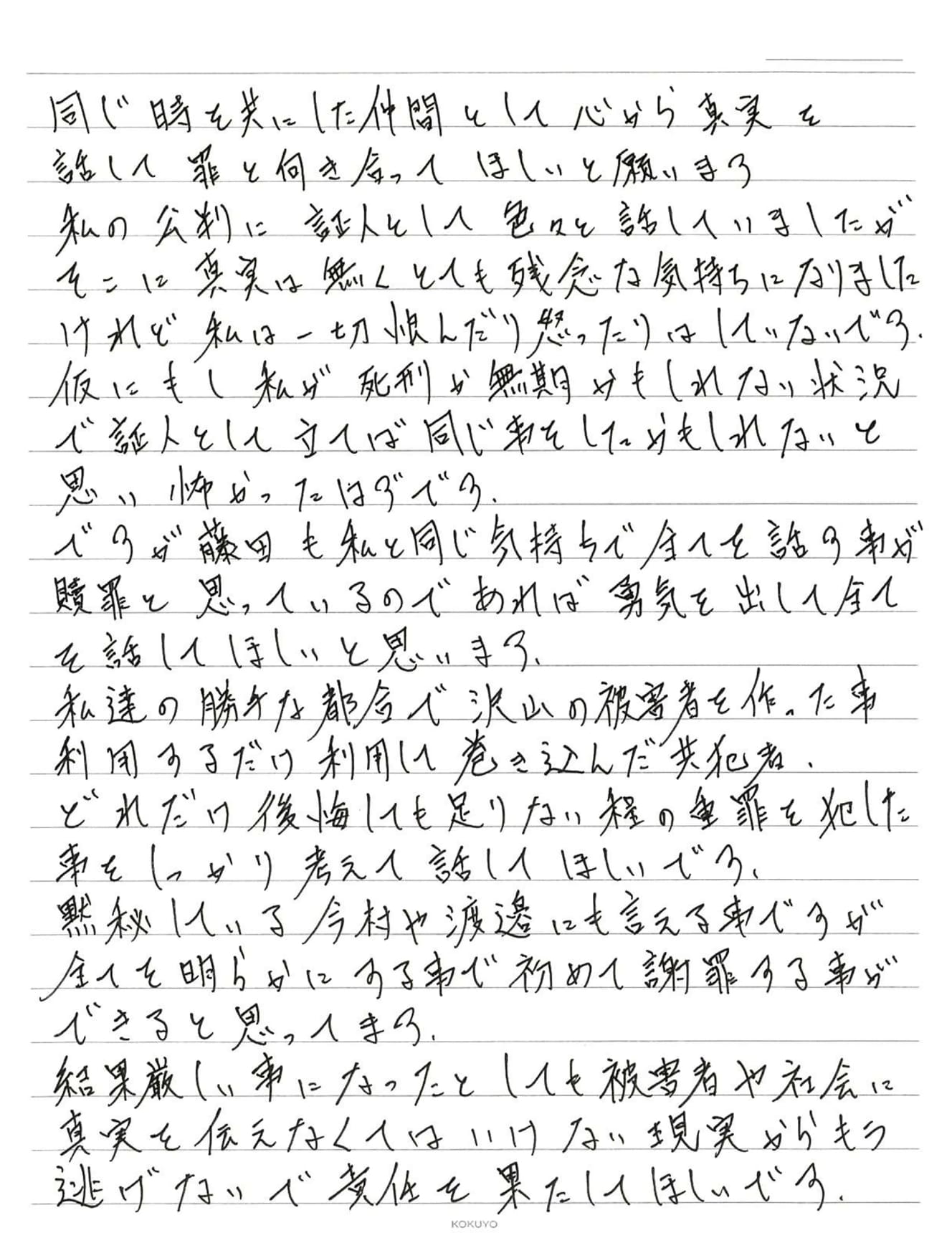
“Fujita manipulated the perpetrators from behind the scenes, involving them in crimes and discarding them afterward. Most of the perpetrators involved in the Komae case received life sentences. He bears responsibility for ruining their lives. I want Fujita to speak the truth without fear of the death penalty. That is the only atonement we can offer the victims.”
During defendant questioning, the defense referred to Fujita’s position in the detention center: “Every day was a life-threatening situation, and Fujita needed to belong to the Japanese group to protect himself. He was not in a position to oppose the robbery plans devised by the executives,” stating that his role was not as a co-principal but limited to aiding.
Imamura and Watanabe are reportedly still remaining silent. If so, Fujita’s testimony could be extremely important regarding this series of robberies. Initially, Fujita had remained silent during questioning but began giving statements after being persuaded by his father. What he will reveal remains to be seen.
The court’s verdict is scheduled for February 16.
Around 2019, defendant Kojima. After rising through the ranks of the group, he indulged in every luxury, driving multiple high-end cars.
From “FRIDAY”, February 13, 2026 issue
Interview and text by: Shimei Kurita (nonfiction writer) PHOTO: Afro (1st photo)