Inside the Urisen Industry Former Top Earner Discusses Affluent Clients and Emotional Demand


“I had no qualms about selling my body.”
For a long time, women known as “tachinbo,” who stand on the street for the purpose of prostitution, have been a social problem.
Not far from Okubo Park (Shinjuku, Tokyo)—where many tachinbo based in Shinjuku wait for clients—there was once a similar scene in a park in Shinjuku Ni-chome. The difference was simply whether it was women or men standing on the street looking for someone to sell sex to.
That park is now closed off at night thanks to the efforts of the Shinjuku Ward Office and the police.
The men who sell sex in Shinjuku Ni-chome are known as “Urisen.” Up until about ten years ago, it was common to see male prostitutes standing at nearly 400 bar establishments, looking for clients for the day. Today, however, such bars have drastically decreased, with only a handful remaining. Places for matching people’s desires have shifted to matching apps and storefront adult entertainment businesses.
Koji, in his first year as a working adult, and Naoya, a fourth-year university student (both pseudonyms), previously worked in Shinjuku Ni-chome as Urisen. During his two years on the job, Koji consistently ranked among the top earners. Naoya, despite working only six months, rose all the way to become the shop’s number one. Both were extremely popular.
Even in the Urisen world—where rates are lower than adult entertainment establishments where women work—their highest monthly income reached 750,000 yen. Among roughly 50 cast members at their shop, the two stood out for their numbers. Both say they entered the industry to earn money for tuition and entertainment expenses. Their entry point was also the same: “I applied after seeing a job listing in a gay-focused recruitment magazine.” However, their approaches and the way they thought about their own sexuality were completely different.
As Shinjuku Ni-chome becomes more open to foreigners and female visitors, long-time residents unanimously say it is entering a period of transition. Through their stories, let’s take a glimpse into part of this world of male prostitution.
“Basically, good-looking young guys sell the easiest. That’s the same as adult entertainment for women,” Koji states firmly.
At the shop where he worked, the rate was about 13,000 yen for 60 minutes. Even when he was called for an overnight stay, it was around 40,000 yen. About 60% of that went to the worker.
“The longer the time, the lower the percentage of the cut that goes back to the cast. So the key to earning money was how many 60-minute sessions you could do.”
Koji said this while drinking alcohol cheerfully.
Naoya realized in elementary school that he liked men, and he had been open about being gay to people around him since his student days. By being upfront, he was treated as special by those around him, and it made him feel more at ease.
Koji, on the other hand, couldn’t come out as gay and spent his student years feeling pent up. With striking facial features, Koji was popular with women. He had dated women before, but it was during that time that he realized, “I like men.”
If he went to bars in Ni-chome or used matching apps, it was easy to find someone to spend the day with. But of course, that didn’t bring in money. Koji, who had been sickly since birth and lacked physical stamina, had limited job options for earning.
Saying he “didn’t feel resistance to selling his body,” Koji continued a delivery-style life—being sent out to wherever he was called—for two years. He says his monthly income averaged around 500,000 yen.
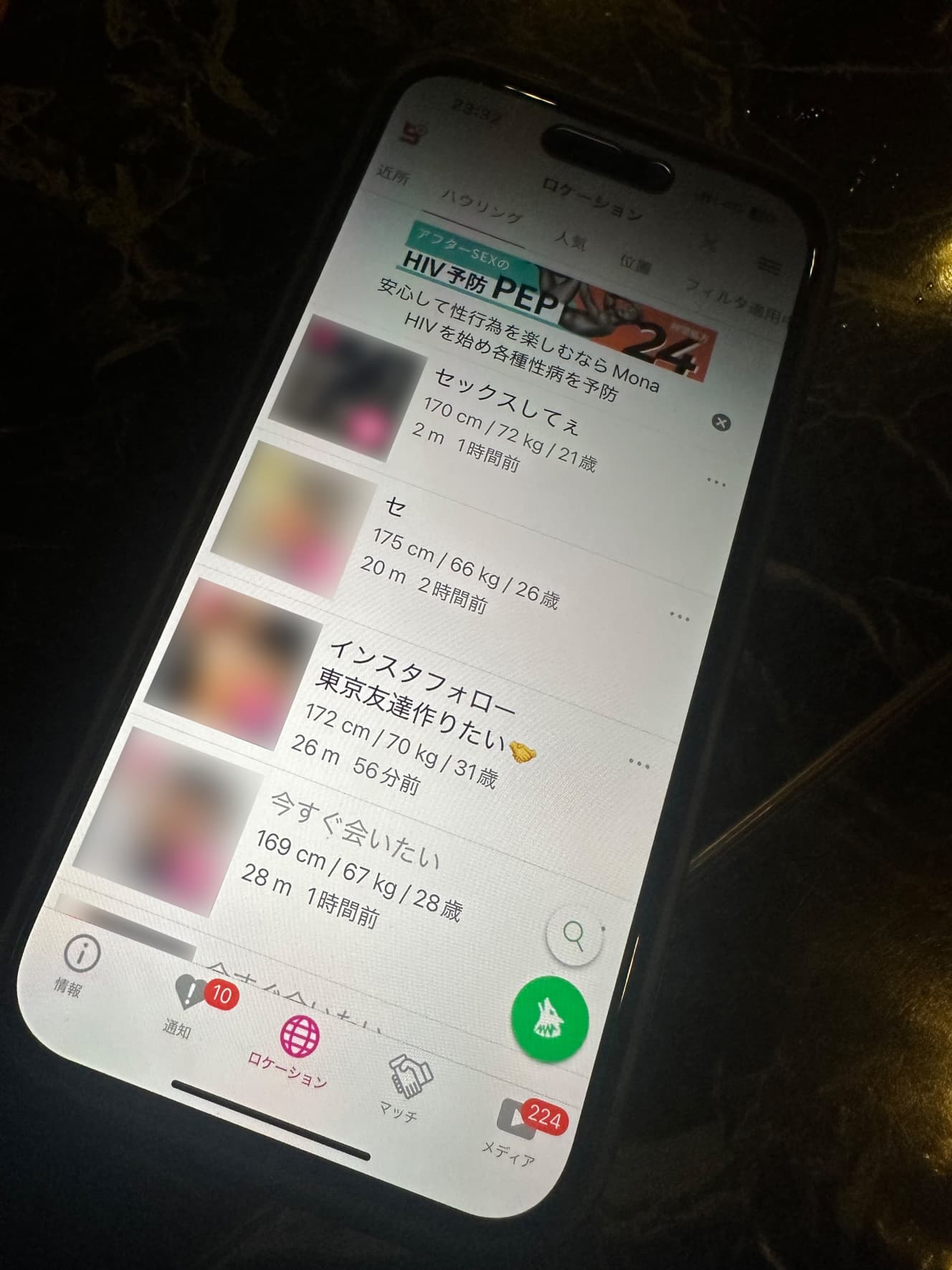
Some of the customers are executives of large companies
“I’d wanted to quit the whole time. But as I kept dragging it out, I started getting popular, and before I knew it, two years had passed.” (Koji)
After he began working in Ni-chome, Koji says his personality became much brighter. In the past, he had kept being gay completely hidden and was overly concerned about how others saw him. But that changed after meeting many different clients in Ni-chome. “It started to feel ridiculous that I’d kept hiding being gay,” Koji said in an especially upbeat tone.
“I realized that people aren’t as interested in me as I thought. And I also realized that by hiding the fact that I was gay, I was actually discriminating against gay people in a subconscious way. There were so many people in this town who could accept their sexuality as part of who they are and act openly and cheerfully. I only understood that truth after I started working as Urisen.”
In front of clients, he always acted like the best boyfriend possible. The two had been told that “the overwhelming majority of clients in this scene lean toward masochistic preferences.” However, Koji says that in his experience, that ratio has been changing.
“Whether someone was a top or a bottom, if they wanted it, I could do either. I’m personally more of a bottom, but since I was being paid, I wanted to do anything I could as a professional.” (Koji)
Naoya’s approach was the complete opposite. Popular with clients who had masochistic tendencies, Naoya was skilled at push-and-pull—deliberately acting distant or cold. He also set strict boundaries for what he would do, such as “no kissing” and “no anal sex.” In other words, it was oral-only (sex without penetration). Even so, how did Naoya manage to become the number one?
“Many of the clients have a past of suffering from serious prejudice. That’s why, fundamentally, they’re kind. If I told them I didn’t like something, they would honestly apologize, and they valued emotional connection more than physical connection. Maybe because they were lonely, I was often asked for advice, like ‘I want you to understand me.’ My style was to take the role of the listener.” (Naoya)
The clientele also had distinctive characteristics. Many of the clients who requested Naoya were financially well-off, and he was often called to luxury hotels. Some were executives at major companies, or well-known business owners. He was fortunate enough to form connections he never would have had otherwise, and says he was able to learn how top-class businessmen think.
“The higher someone’s social status, the more they wanted to be understood. Older people had suffered because their sexual orientation wasn’t easily accepted. Society wasn’t as understanding as it is now. And yet, when I deliberately acted cold, some of them would even enjoy it—so honestly, I don’t really get it (laughs).” (Naoya)
Now that the two have graduated from Urisen, they say they only come to Ni-chome occasionally for drinks. Times have changed, and gay bars have expanded beyond the gay district. When it comes to finding a partner, apps are now the main way. Even so, the two agreed that there are still plenty of people who can live as themselves because Ni-chome exists.
Interview and text by: Shimei Kurita (Nonfiction writer) PHOTO: Takayuki Ogawauchi