A “Mysterious Phenomenon” Cheaper than a Round-Trip Ticket to Europe and the United States… Why “Round-the-World Airline Ticket” with a Total Price of 500,000 yen is Ridiculously Selling in Japan


Around the World at 300,000 yen!
When you hear the words “round-the-world,” you probably think that if you like traveling, you would like to do it at least once in your life. In fact, round-the-world airline tickets are more popular in Japan than in other countries, and although fuel surcharges and other expenses are not included, they are still significantly cheaper than regular round-trip airline tickets.
oneworld, the airline alliance to which Japan Airlines (JAL) and other airlines belong, recently announced that Japan topped the list of departure destinations (number of passengers) for Round the World (RTW) tickets in 2013. The cost of an economy class ticket was in the 300,000 yen range (excluding taxes and other fees).
Why is that airfare so inexpensive for a round-the-world trip? In addition, we looked into the structure and detailed price of round-the-world airline tickets.
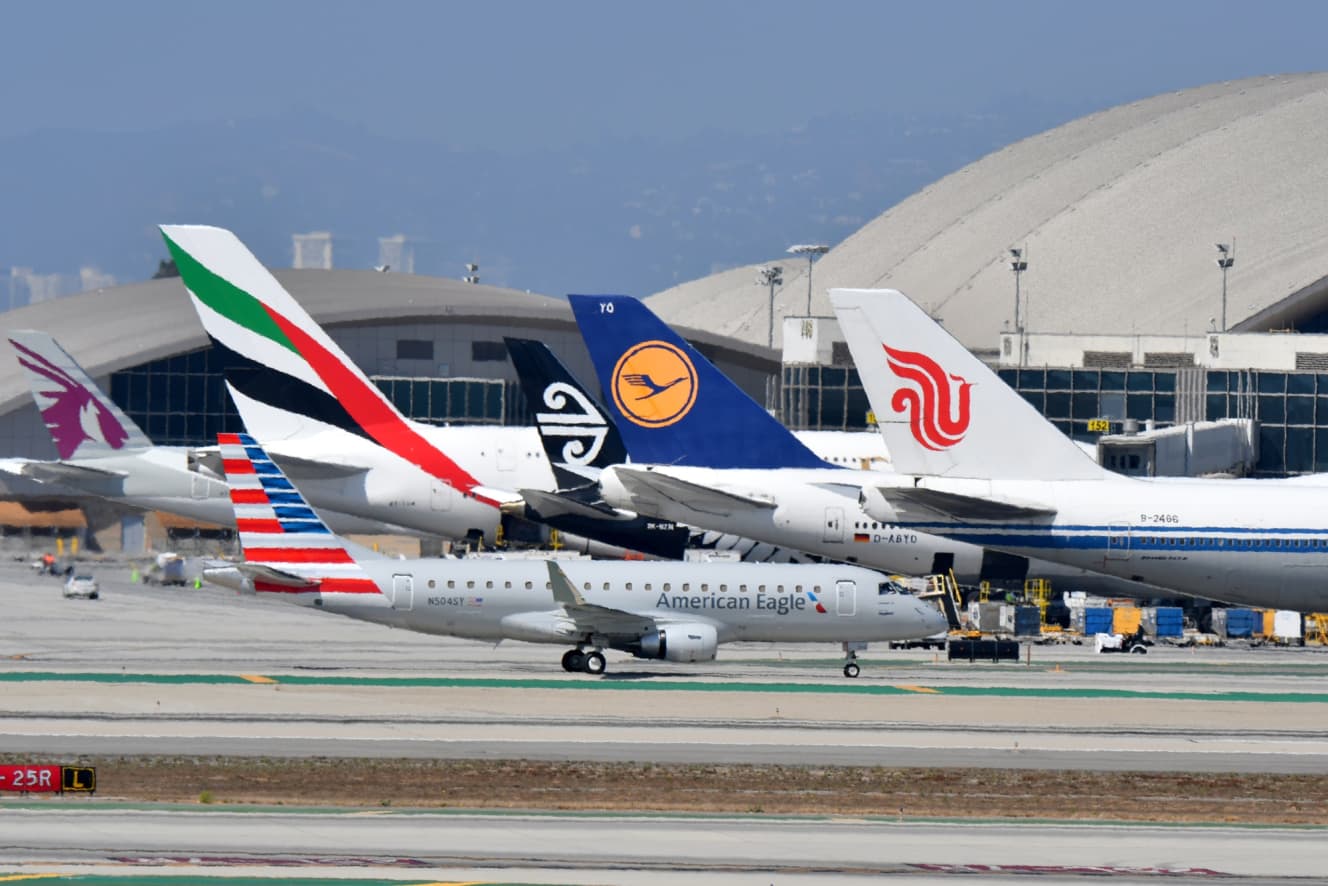
Difference between “oneworld” and “Star Alla
A round-the-world ticket is a ticket that circles the globe in either an eastbound or westbound direction and returns to the point of departure. In the case of a round-the-world ticket departing from Japan, an eastbound ticket crosses the Pacific Ocean and travels to the Americas, Europe, and Asia, while a westbound ticket passes through Asia and returns to Japan via Europe and the United States, respectively.
The following two round-the-world tickets are currently on sale.
- oneworld Round the World ticket
- Star Alliance Round the World Ticket
JAL is a member of oneworld and All Nippon Airways (ANA) is a member of Star Alliance. SkyTeam, an airline alliance in which no Japanese carriers are members, has suspended round-the-world ticket sales since 2011.
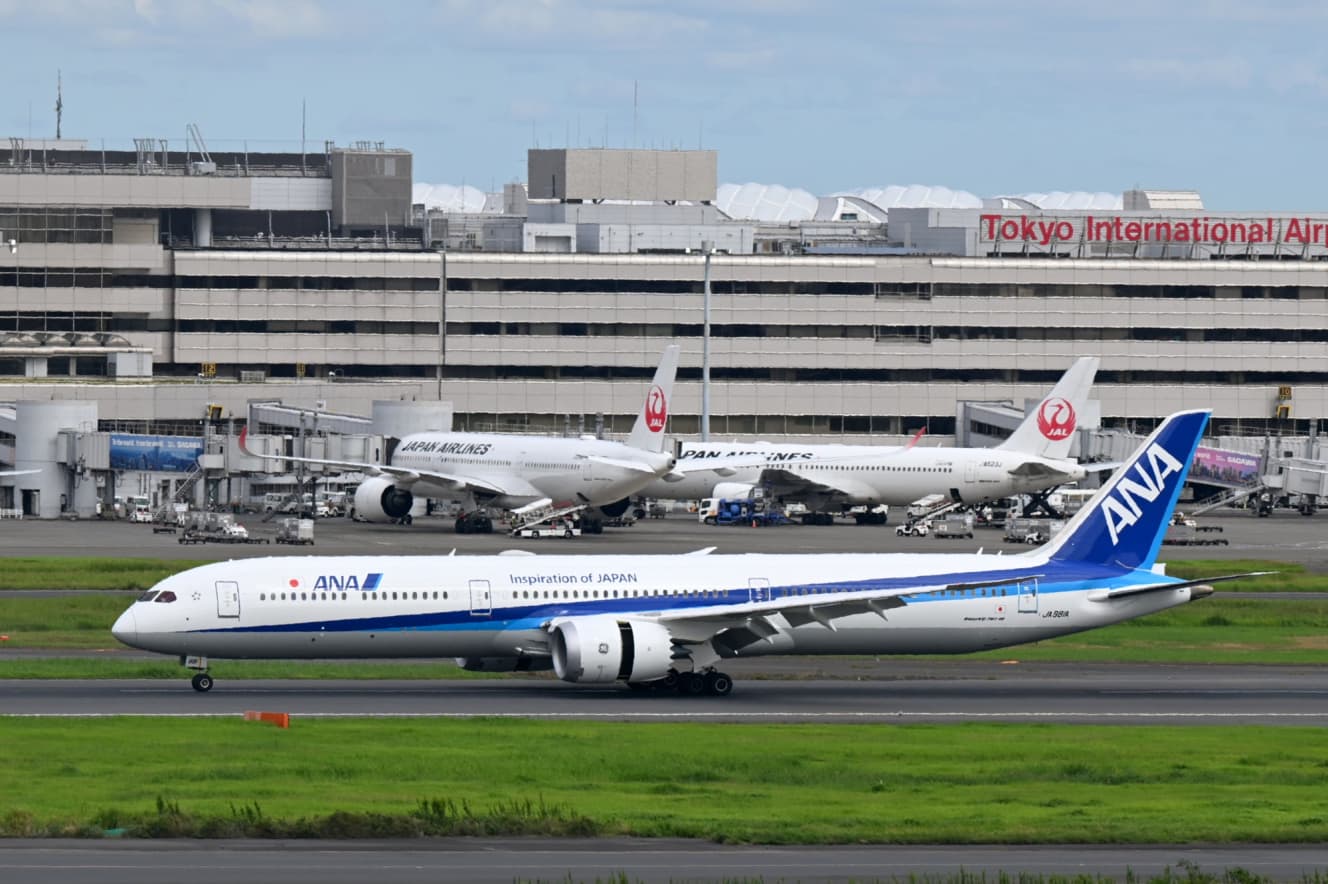
The impact of “continent-based” fares in the 300,000-yen range
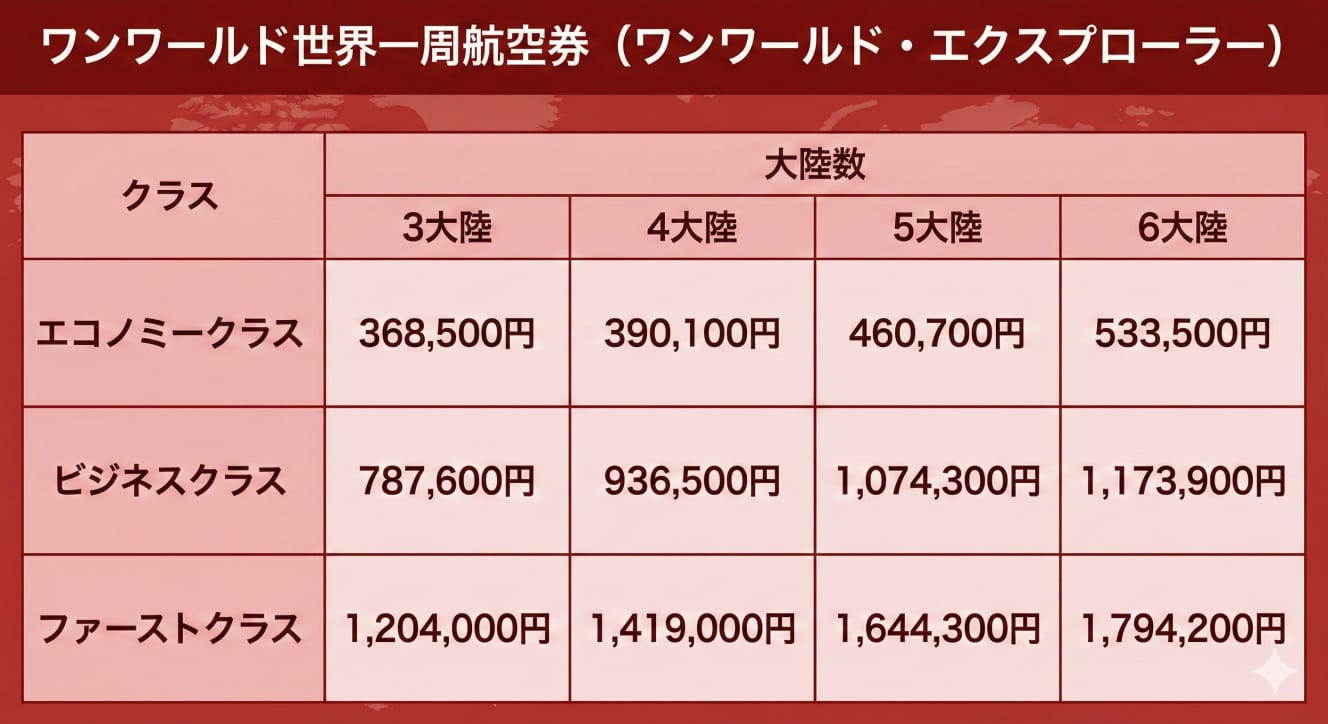
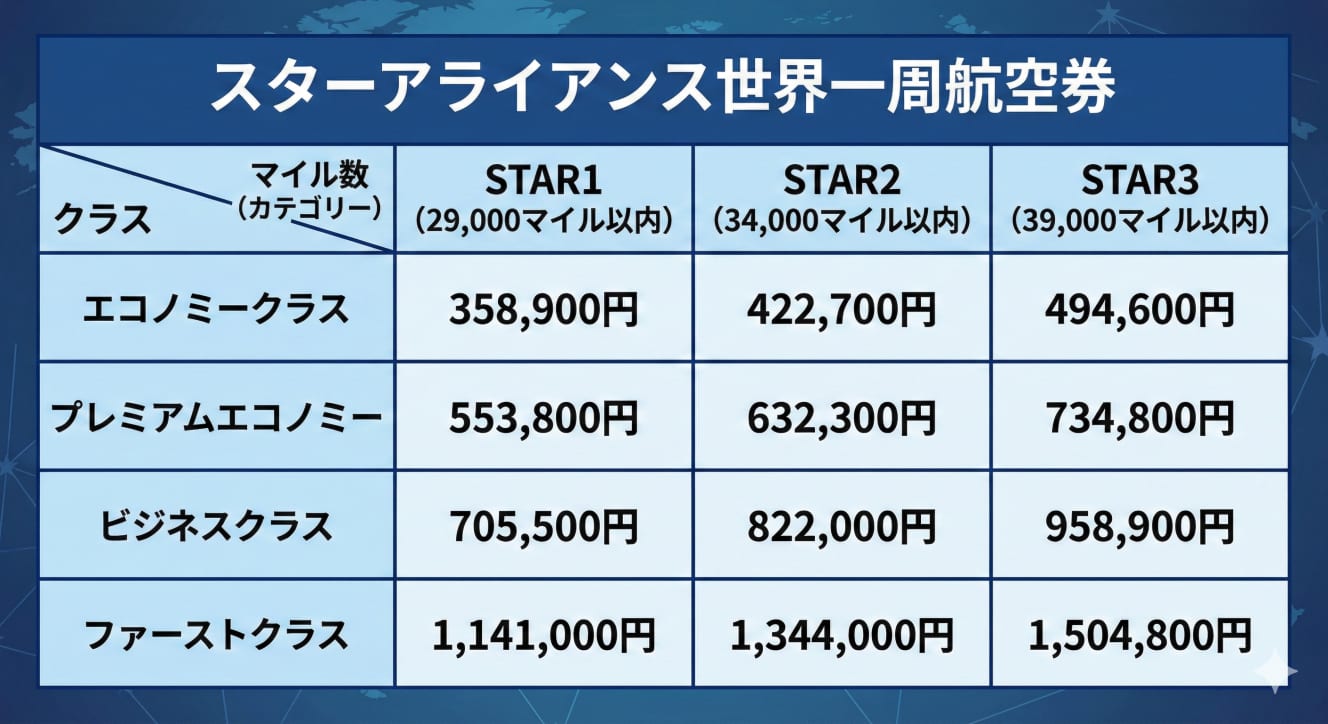
The most important issue is the cost of the Round-the-World ticket.
The Star Alliance round-the-world ticket has a simple fee structure with three categories of fees based on the distance flown (miles).
On the other hand, oneworld has “oneworld Explorer,” where fares are determined based on the number of continents visited, as well as “Global Explorer,” where fares are determined by the distance flown (in miles) and are available on Jetstar Airways and Bangkok Airways, in addition to oneworld member airlines. Global Explorer” is also available, which allows customers to fly with Jetstar Airways and Bangkok Airways in addition to oneworld member airlines.
In addition to these fares, fuel surcharges, airport facility charges, and other taxes (approximately 200,000 yen or more) are charged separately.
The Round-the-World ticket can be purchased through the “official websites” of Star Alliance or oneworld. It can also be purchased at “major travel agencies” such as JTB and HIS, but be aware that while you can expect support, you may be charged a fee.
Total cost: ¥500,000 “Dream Route” Verification
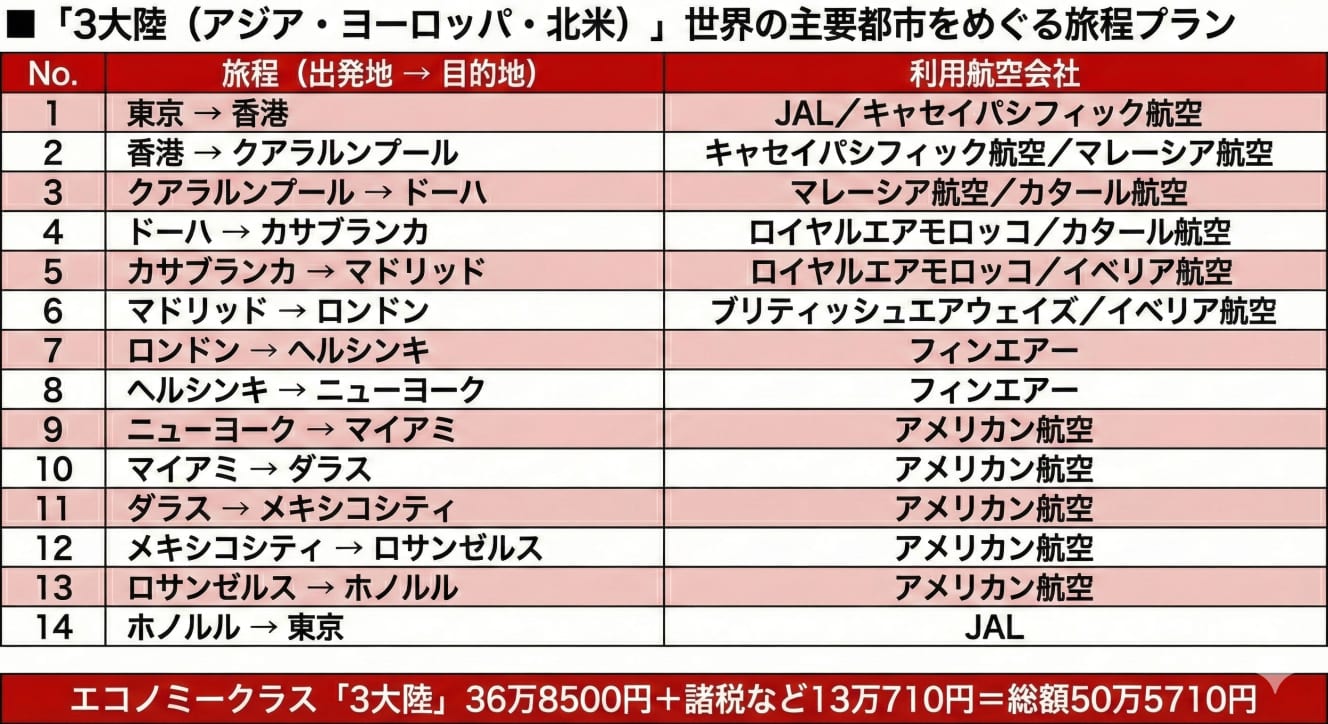
The “oneworld” round-the-world ticket, of which JAL is a member, is available on 14 airlines worldwide.
The main features include: a “continental system” in which fares are determined by the number of continents to be visited (3 to 6 continents) rather than the distance flown; a maximum of 16 flights; a limit on the number of flights per continent (6 for North America, 4 for other continents); and a validity period of one year. The six continents are (1) Europe and the Middle East, (2) Africa (Egypt, Morocco, etc. are included in Europe), (3) Asia, (4) Oceania, (5) North and Central America, and (6) South America (for departures from Japan, Asia is counted as one continent).
The “3 Continents” package is suitable for those who want to tour more cities and continents, those who want to make at least two stopovers in Asia, and those who want to tour within Australia (where Qantas is available).
For example, we have created an itinerary that visits major cities around the world on the cheapest “3 continents” (Asia, Europe, and North America). This resulted in two stopovers in Asia, four in Europe and the Middle East, and six in North America, for a total of 14 flights (up to a maximum of 16 flights).

Strengths of ANA member “Star Alliance
Next, let’s talk about the “Star Alliance” round-the-world ticket. The major difference from oneworld is the large number of member airlines: 26, including ANA, Singapore Airlines, United Airlines, and Lufthansa German Airlines. In particular, there are more airlines based in Asia, Europe, and Africa than in oneworld.
And the large number of stopover cities and routes makes it easy to create routes. However, since the mileage system is based on the number of miles you travel, you will exceed the number of miles if you visit many destinations. If you want to visit many continents, oneworld Explorer, which is continent-based, is better suited for you.
You can make from two to 15 stopovers, with only one stopover in the same city and up to three transfers or transfers. The basic rules are almost the same as for oneworld: one trans-Pacific and one trans-Atlantic crossing, tickets valid for up to one year, and eligible for mileage accrual.
For example, in the case of the cheapest “STAR1” ticket. The route Japan→North America→Europe→Asia→Japan is possible. Adding fuel surcharges and airport facility charges to the basic fare almost doubles the cost.
ANA used to offer a popular “Star Alliance Round-the-World Award Ticket” that could be redeemed with miles. However, new tickets were discontinued in June 2013. Just prior to that date, there was some “rush ticketing” by frequent flyers.

The destructive power of “one price” even during peak season
The round-the-world airline ticket attracts attention for its advantage of being “inexpensive and economical anyway,” but there are, of course, some points to be aware of.
Advantages
- Fares do not fluctuate even during peak periods such as GW and Obon.
- The validity period is up to one year.
- Mileage can be earned.
- It is possible to change the itinerary within one year.
Points to note
- There are detailed rules such as restrictions on travel in the same direction and the number of flights on each continent.
- ・Cities that can be visited depend on each member airline (e.g., Star Alliance: only destinations served by Star Alliance member airlines).
- All routes and itineraries must be decided and purchased in advance.
- Additional fees such as airport facility charges and fuel surcharges are required.
First of all, it is certainly a “good value” to be able to take up to 16 flights around the world for a minimal fare, with a total economy class fare of around 500,000 yen and a total business class fare of about 1,000,000 yen. Currently, international flights to/from Japan are at an all-time high, and a simple round trip between Japan and Europe/US can cost more than 300,000 yen in economy class and nearly 1,000,000 yen in business class.
In general, airfares are affected by demand. Although the fares are higher during peak periods such as Japan’s major consecutive holidays (GW) and Obon, round-the-world airline tickets are more economical during these periods because the fares are “flat.
It is also possible to return to Japan during the round-the-world trip within the one-year validity period, and then resume the trip a few months later by going back to the place where you left off. Although the airfare will be out of your own pocket, this is a great advantage for Japanese people who work in companies and find it difficult to take a large amount of time off.
On the other hand, when buying a round-the-world ticket, all routes and itineraries must be decided at that point. If the itinerary or route is changed, a change fee ($125 for oneworld, approx. 20,000 yen) or the difference in fare must be paid, and if the departure point is changed on the same day or after departure, the entire itinerary may be cancelled. It is also important to know that since a round-the-world ticket is a single itinerary, it is not possible to abandon a route or use it separately.
Cheaper than a Round Trip to Europe or the U.S.” A Curious Phenomenon
For Japanese people today, international travel is expensive. Airline tickets, which account for the majority of travel costs, have skyrocketed and remained at a high level due to the influx of inbound travelers. Fuel surcharges, which are added to the airfare, also continue to be high.
A round-the-world airline ticket costs about 500,000 yen in total, and including the cost of local accommodation, it is by no means inexpensive, especially with the recent depreciation of the yen. However, it is an excellent cost-performance ratio considering that the schedule includes travel to Europe and the U.S., where airfares are expensive to begin with, and that one year is equivalent to “X number of trips abroad.
Furthermore, although a round-the-world ticket costs about 1 million yen in total, a business class ticket offers overwhelming physical and mental comfort on long flights, lounge access at airports, and reduced burden of waiting for connecting flights. Nowadays, it is not unusual for a simple round-trip ticket to North America or Europe from/to Japan in business class to cost close to 1,000,000 yen. When you think about it, you can see how economical a round-the-world ticket is.
Above all, the experience of “traveling around the world” will be a valuable one in your life. If you are considering an overseas trip that takes you a little farther afield, why not consider a Round-the-World ticket?

Interview, text, and photographs by: Shikama Aki