Ukrainian Born Ozeki Aonishiki Shares His New Year Resolve and Pursuit of Greater Heights | FRIDAY DIGITAL

Ukrainian Born Ozeki Aonishiki Shares His New Year Resolve and Pursuit of Greater Heights

Ukrainian-born, fluent in Japanese, enjoys going to the public bath near the Ajikawa stable

  • Share on Twitter
  • Share on LINE
Aonishiki Arata / Born in March 2004 in Ukraine. He began practicing sumo at age seven and joined Ajigawa Stable at 18. After making his professional debut in September 2023, he was promoted to ōzeki last November in a record-fast 14 tournaments.

“No worries, no worries.”

“I couldn’t really believe I had won the championship, so I honestly couldn’t hear the cheers very well.”

Aonishiki (21), who claimed his first championship by defeating yokozuna Hōshōryū on the final day of the Kyushu Grand Sumo Tournament, said this with a touch of youthful innocence.

After the tournament, he achieved promotion to ōzeki in the extraordinary span of just 14 tournaments.

“I will devote myself to my training so as not to disgrace the rank of ōzeki, and I will aim even higher.”

The formal pledge he delivered when receiving the envoy announcing his promotion to ōzeki was simple—very much in Aonishiki’s style.

“When my promotion to ōzeki was almost certain, my stablemaster (Ajigawa-oyakata, former sekiwake Aminishiki) told me, ‘Come up with the pledge yourself!’ and basically tossed it to me (laughs). I don’t really know many four-character idioms, so in the end I decided on it after consulting with my master.”

Recalling the moment, Aonishiki sticks out his tongue playfully and smiles shyly.

After his promotion was finalized, he went on greeting rounds and made numerous media appearances, and from November 30, the winter regional tour began, held across Kyushu, Kansai, and the Kanto region.

Yokozuna Ōnosato sat out the tour, and as a new ōzeki, Aonishiki drew intense attention from fans. He endured a grueling schedule of consecutive “hane-dachi” days—traveling to the next venue on the same day after a one-day exhibition event. Though only 21 years old and the second-youngest wrestler in the top division, the fatigue must have reached its peak. When reporters visited him late last year, he fell ill during morning practice and had to rush to a nearby hospital.

Yet, to the relief of those around him, he returned to the dressing room in about an hour.

“My stomach just hurt a little. I’m fine. No worries, no worries.”

Even during the interview, staff members kept coming into the dressing room asking Aonishiki for autographs and commemorative photos, but he responded to everyone without showing any sign of exhaustion.

“I want to properly respond to the people who support me. That’s something my master always tells me.”

Saying this, he happily polished off the bread and yakitori brought by the editorial staff. His youthful powers of recovery are nothing short of astonishing.

“I was hooked (laughs).”

During his boyhood in Ukraine, Aonishiki first encountered sumo. That he began practicing sumo alongside wrestling at the age of seven was purely by chance.

“My mom always picked me up from the gym, but one day she happened to be late. So I thought, ‘Maybe I’ll try joining the sumo practice (held after wrestling)?’ and gave it a shot without much thought. And then I got hooked (laughs). I realized there was a kind of fun in it that was different from wrestling, something like that.”

At age 15, he placed third at the World Junior Championships held in Osaka. It was there that he met Arata Yamanaka, who was then captain of Kansai University’s sumo club.

“I was the one who spoke to him first. I thought he looked like he’d become strong in the future… Then, some time later, Ukraine was invaded by Russia, and I received a message from Danya (Aonishiki’s nickname), who wanted to continue sumo,” Yamanaka recalls.

At 18, Danya boarded at Yamanaka’s home, attended a Japanese language school during the day, and continued training in the evenings at Kansai University and the sumo club of Hotoku Gakuen High School.

“Danya was strong right from the start. None of the sumo club members at our university could beat him,” Yamanaka says.

Supported by his teammates, his Japanese steadily improved. He tried out newly learned Japanese words two or three times a day, and whenever he didn’t understand something, he asked those around him for explanations. Through these daily efforts, he eventually mastered everyday conversation with little difficulty.

Danya’s dream was to “become a professional sumo wrestler.” However, under sumo rules, each stable is generally allowed only one foreign-born wrestler. This meant that he could not join a stable that already had a foreign wrestler, leaving him with the reality that his only path forward was to find one that did not.

Taking these circumstances into account, Koji Fukuda, then head coach at Hotoku Gakuen High School—where Danya had been training—approached the newly established Ajigawa Stable about taking him in. At first, Ajigawa-oyakata planned to refuse any foreign recruits, but Danya’s earnest gaze and sincere attitude reportedly led him to change his mind.

Thus, Danya inherited the character “A” from his master’s ring name, Aminishiki, and incorporated “blue,” the color of the Ukrainian flag, to become “Aonishiki.” He made his professional debut at the Autumn Tournament of 2023 at age 19.

After joining the stable, his training initially focused on basics such as shiko stomps, push-ups, and suriashi footwork, all aimed at building a body suitable for a sumo wrestler. Ajigawa-oyakata explains:

“When Aonishiki does suriashi, he leans so far forward that his upper body is almost parallel to the ground. That leads directly to his strength—his sumo style built from a strong forward-leaning posture.”

His favorite singer is Eigo Kawashima.

During his free time at the stable, he repeatedly rewatched DVDs of bouts he had borrowed from his master. At 182 cm and in the 140-kg range, Aonishiki is relatively small for a top-division wrestler. Sometimes he would even watch DVDs while eating—especially of Wakatanakage, an active makuuchi wrestler who, like him, is on the smaller side and whom he looked up to.

“My master gives me tons of DVDs—from those of wrestlers from the old days to ones who are active now. What really moved me were the bouts I watched back in Ukraine featuring yokozuna Takanohana and ōzeki Asashōryū (Autumn Tournament 2002).

From an earlier era, I was also really impressed by the sharp, cutting style of Wakano hana (the third generation, Masaru Hanada), who was also smaller in stature, and by Kotonishiki—known for his explosive speed and dubbed ‘F1 Sumo’—who is now Asahiyama-oyakata. I use all of them as references.”

His devotion to sumo knows no bounds.

Because wrestlers have three regional tournaments a year and also go on regional tours in between, they don’t get many chances to return to their Tokyo stables. Still, when he is at the stable, he spends time with his stablemates going to a nearby public bath or out for yakiniku. This New Year, they went for their first shrine visit to a small local shrine near the stable. He also says he goes to karaoke occasionally, and when asked about his favorite singer:

“Eigo Kawashima. Is that too old-fashioned? (laughs) Sumo wrestlers often sing in front of supporters as a way to build confidence. If a young wrestler with a face like mine sings one of Kawashima’s songs, the gap is kind of funny, right? (laughs) This song was something my master taught me too.”

He speaks with an easygoing smile.

“My goal for 2026? Rather than a goal just for this year, what I’m aiming for is ‘even higher’—to become a yokozuna. I want to post better results than I did at the Kyushu tournament and move up as soon as possible.

Last year, I first achieved my goal of becoming a makuuchi wrestler, and then I was able to climb the rankings to komusubi and sekiwake. But if I had to give myself a score, maybe about 75 points. Too strict? Maybe—but out of six tournaments, I only won one championship.”

This year, we hope to see him charge ahead as an ōzeki and perhaps witness the birth of the first Ukrainian-born yokozuna.

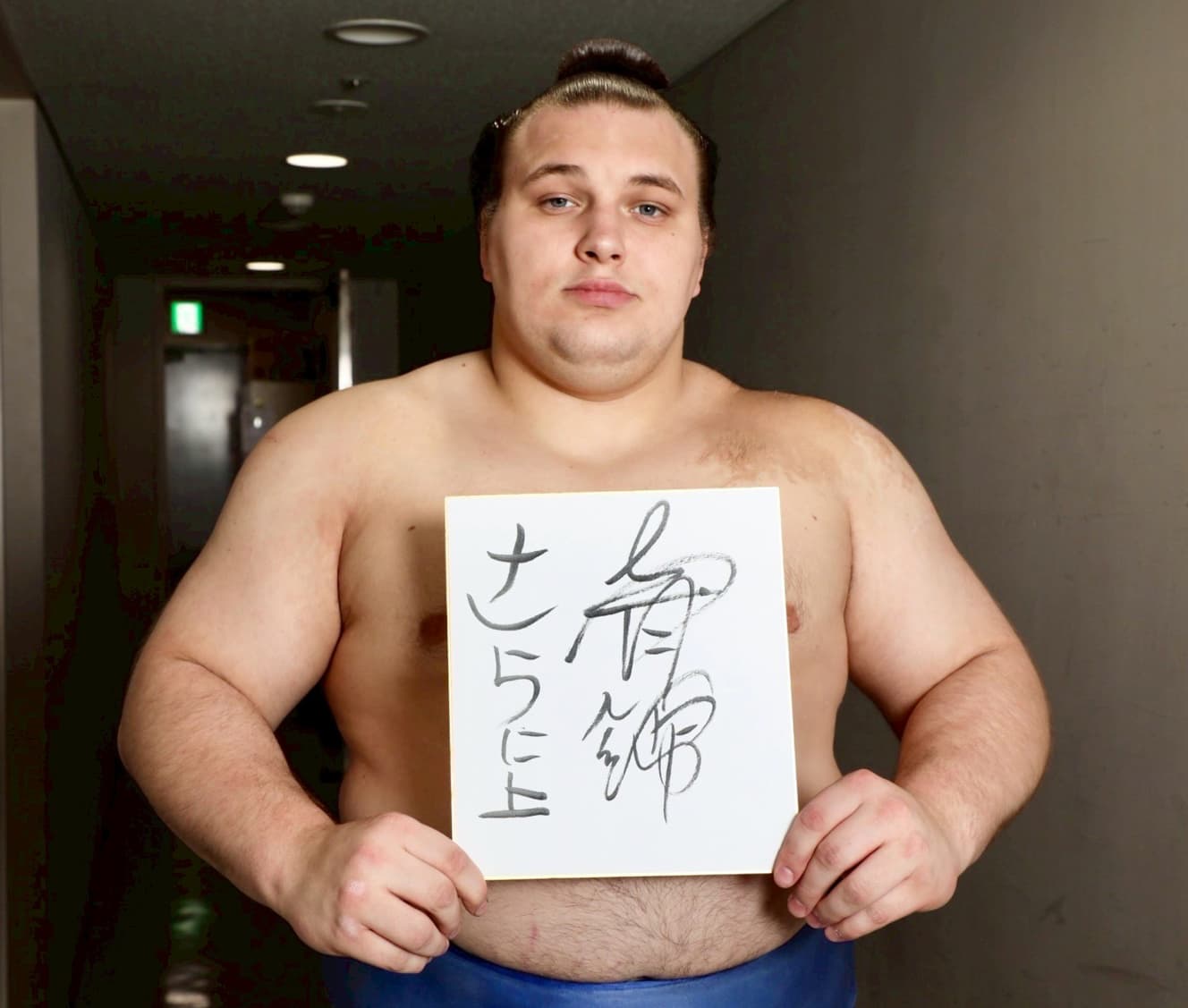
A piece of colored paper handwritten by Yasushonishiki. The Japanese word “further up” written next to his signature shows his strong desire to become a yokozuna.
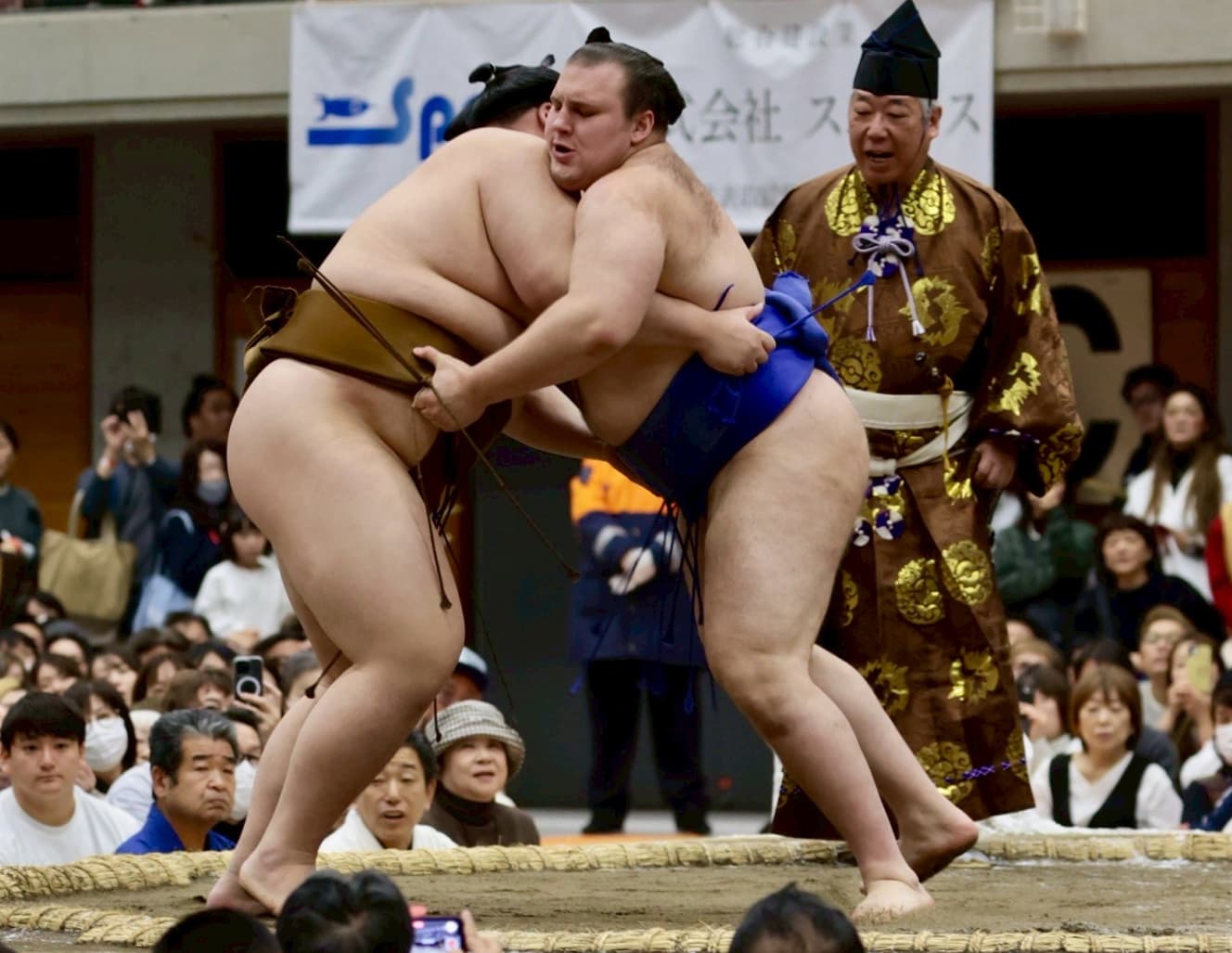
A scene from a tour in Osaka last December. Even though it was not the main tournament, his expression was serious during the matches.
In between tournaments, he chats with callers in Japanese. The gap between his expression in the ring and on the ring is one of his charms.
Waving to the crowd as he leaves the venue. He never neglects fan service.
Unpublished Photos from This Magazine — New Ōzeki Aonishiki: The Feelings Behind His Aim for “Even Greater Heights” (New Year Interview)

From the January 23, 2026 issue of “FRIDAY”

  • Interview and text Hatsuki Takeda (Nonfiction writer) PHOTO Yanagawa go!

Photo Gallery7 total

Related Articles