Drunk on Approval? The Dangerous Logic Behind Takaichi’s Unilateral Dissolution


Was only one person aware of the information?
At 11 p.m. on January 9, just before a three-day weekend, Yomiuri Shimbun Online reported: “Prime Minister Takaichi is considering dissolving the House of Representatives, possibly at the opening of the ordinary Diet session on the 23rd. with voting likely in early to mid-February.” The report caused a major stir in Nagatacho and Kasumigaseki.
Since its launch in October ’25, the Takaichi administration has boasted one of the highest approval ratings, at 60–70 percent, in opinion polls conducted by various media outlets. When asked by reporters whether she might dissolve the House on the strength of that high approval rating, Prime Minister Sanae Takaichi (64) had denied it, saying, “In the Diet session after the New Year, we will aim for the swift passage of the budget bill and tax reform bill” (December 26 last year), and “We will shift into a higher gear and steadily implement policies. That is what I will focus on this year” (January 5). She has also expressed her determination to pass the FY2026 budget in the ordinary Diet session convened on the 23rd, under the banner of responsible proactive fiscal policy.
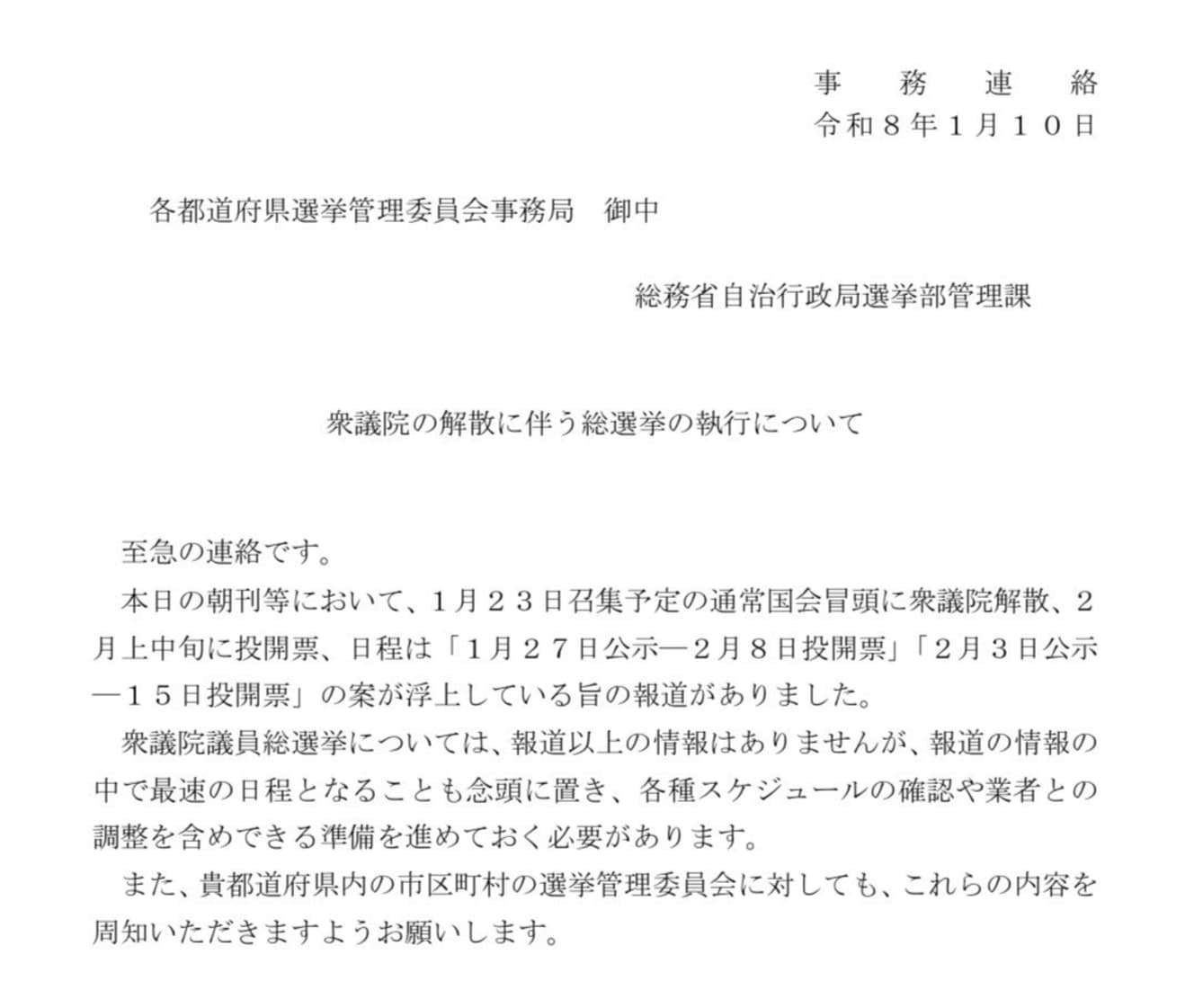
While the Yomiuri report should have been nothing more than speculation, its credibility increased the following day, the 10th. The Ministry of Internal Affairs and Communications sent an urgent administrative notice to the secretariats of prefectural election management committees titled “Regarding the conduct of a general election accompanying the dissolution of the House of Representatives,” instructing them that with the possibility of the earliest possible schedule in mind, it is necessary to proceed with preparations, including confirmation of schedules and coordination with vendors.
“Although the ministry’s notice states that ‘there is no information beyond what has been reported,’ this would normally be communication carried out in coordination with the Prime Minister’s Office. At the very least, it should be understood that the Chief Cabinet Secretary has agreed to the dissolution.
However, Deputy Prime Minister and LDP Vice President Taro Aso (85), as well as party officials such as the secretary-general who oversees election operations, were not aware of it. It is the party that handles the practical work, including candidate selection and drafting campaign pledges. With no prior notice, Mr. Aso appears to be displeased, and concerns about the absence of a coordinator have been laid bare,” said a veteran LDP staffer.
Within the Takaichi administration, it is believed that only Chief Cabinet Secretary Minoru Kihara (56) was informed, and that no advance groundwork had been laid with party executives, including Mr. Aso, who serves as her patron.
She neither denied nor affirmed it
Even during the holiday period, documents of unclear authenticity were circulating. One was believed to be a political situation survey conducted by the LDP sometime in November.
House of Representatives: 465 seats / Majority: 233, LDP 199 → 260, Ishin 34 → 38, DPFP 27 → 35, Sanseito 3 → 17, CDP 148 → 70, Komeito 24 → 18, Reiwa 9 → 7, JCP 8 → 5, Japan Conservative Party 3 → 5
It appears that the LDP had already been headed for a landslide victory in a situation survey conducted last December as well, and voices grew saying, “It would be better to dissolve the House before approval ratings peak.”
“Naoya Imai (67), a Cabinet advisor who served as executive secretary to the prime minister under the Abe administration, as well as the party’s powerful secretary-general, had been urging Ms. Takaichi to dissolve the House since the end of last year. In addition, defeated lawmakers and Diet members who supported her in the party presidential election were also strongly calling for an early dissolution. Ms. Takaichi reportedly smiled and listened, but avoided committing herself, taking a noted but noncommittal stance” (same source).
Once budget deliberations begin in the Diet, they would take at least a month. During that time, she could be pressed over a deterioration in Japan–China relations stemming from her own Diet remarks, as well as issues related to politics and money. Meanwhile, opposition parties strongly resisted the Japan Innovation Party’s flagship bill to reduce the number of Diet members, calling it too hasty, with no prospect even of deliberation, let alone passage.
“There seemed to be frustration with Ishin. On one side was Ishin, which wanted to legislate the reduction in the number of Diet members, and on the other were growing voices of opposition within the ruling party, including to forceful methods, leaving her caught in between. Messages from adviser Kei Endo (57) came via short email, saying things like, ‘May I speak with you about this?’ and she would return the call at her own convenience. But calls from Fumitake Fujita (45), Ishin’s co-representative, came regardless of timing, clearly irritating her. Ishin’s votes in the prime ministerial designation election led to the birth of the administration, but the stress of being jerked around by threats of withdrawing from the coalition had been building” (a close aide to the prime minister).
To this day, Ms. Takaichi herself has offered no explanation of how the decision to dissolve the House came about. She has repeatedly said that the people’s livelihoods come first, yet the delay in passing the FY2026 budget—which directly affects daily life—is inevitable. What issue, then, will she ask the public to render its judgment on?
Interview and text by: Daisuke Iwasaki PHOTO: Takeshi Kinugawa