Odors and Stains Expose the Truth of a Lonely Death—Traces of a Vanished Daily Life


Reporting from the scene of a lonely death
“This is the room two days after the discovery of a solitary death. The body has already been removed, but everything else remains as it was.”
In early December 2025, a rental property management company contacted us. They had a rundown apartment in Tokyo where a solitary death had just occurred. For the purpose of reporting, they agreed to show the apartment under the conditions that it would be done quietly—since other residents were living in the building—and that the location would not be disclosed.
In recent years, solitary deaths among the elderly have become a social issue. These are cases in which elderly people with no close relatives die in their homes for some reason. According to the Tokyo Metropolitan Police Department, out of 204,184 deaths handled by the police in 2024, 76,020 were people living alone who died at home, and among them, 58,044 were aged 65 or older—accounting for nearly 80 percent.
With ongoing demographic changes such as a declining birthrate and aging population, solitary deaths are expected to increase and have become a pressing social problem. The property manager interviewed for this story handled two such cases in 2024 alone. To report on the reality of solitary deaths, the author requested access to this management company.
The solitary death in the apartment was discovered following a complaint from another resident about a strange smell.
“The body has already been removed, but everything else remains as it was. Special cleaning has not yet been called. The resident living here was not good at cleaning, so it’s a little messy—please feel free to wear shoes. If you don’t wear shoes, there’s a risk of stepping in liquid. We’ll call special cleaning later.” (Property manager; all following comments are from him)
The exterior of the apartment was a typical old four-story building. From the first floor, the sounds of residents’ daily life could be heard—someone seemed to be humming while cooking—and it was hard to believe that a solitary death had occurred in this building.
Upon opening the door, the first thing that hit was the stench. Most people rarely experience the smell of human decomposition. While rumors describe it as the smell of rotting meat or like an animal carcass on the street in summer, the reality was completely different.
It was closer to the smell of a sweat-soaked shirt left damp in the summer, intensified about threefold. This was clearly unlike anything normally experienced in a living space. The musty odor filled the room and made it hard to breathe; if it weren’t for reporting, one would likely hesitate to enter the room just because of the smell.
Scattered black discoloration
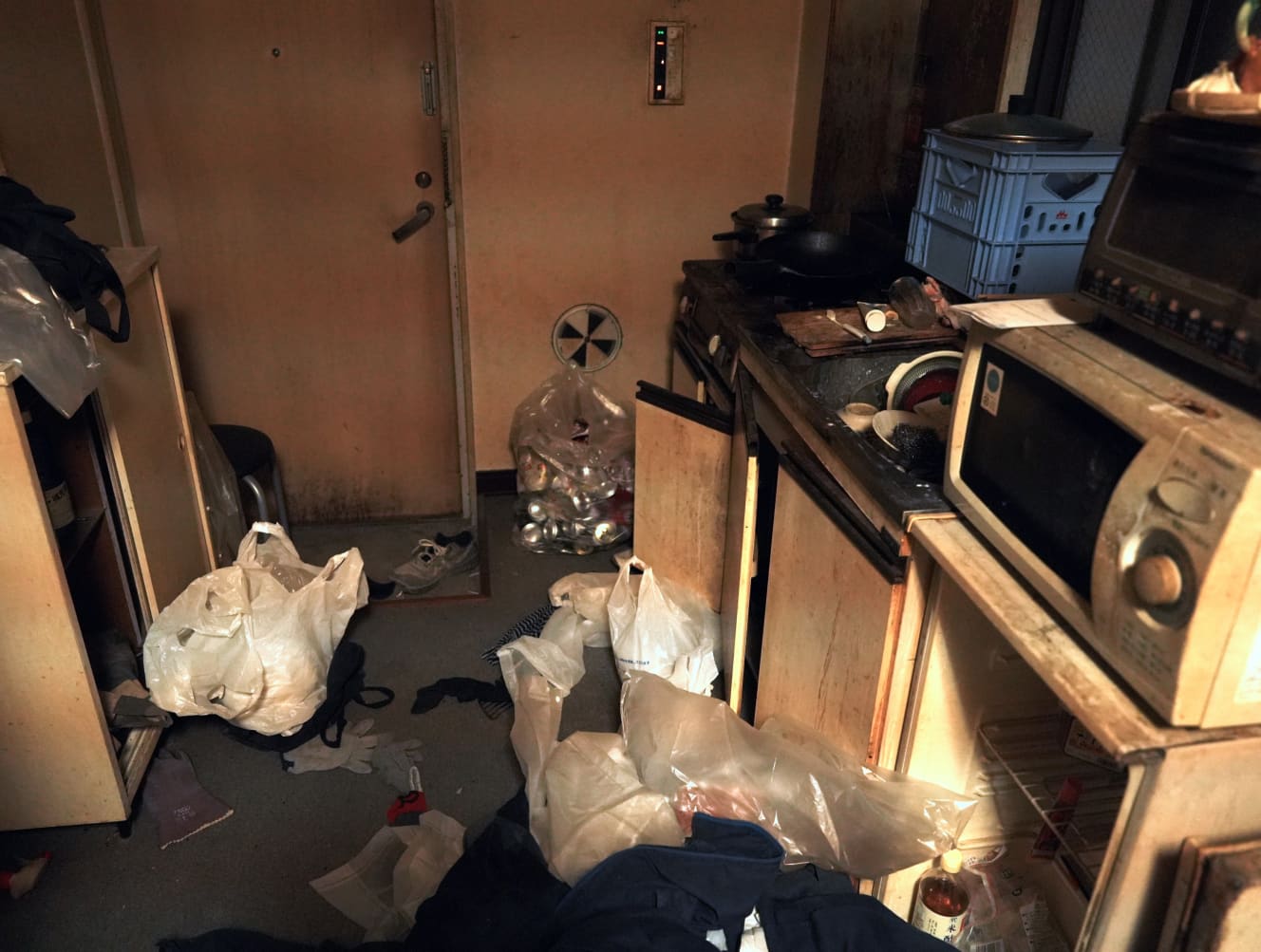
Using the light from a smartphone, I searched for the switch to turn on the room light, and a degraded fluorescent lamp cast a dim glow. From the narrow entrance, looking into the room, the roughly six-tatami-mat one-room apartment was scattered with trash. Around the kitchen area were plastic bags stuffed with empty beer cans, dishes left in the sink, and scattered coins, leaving the traces of daily life intact.
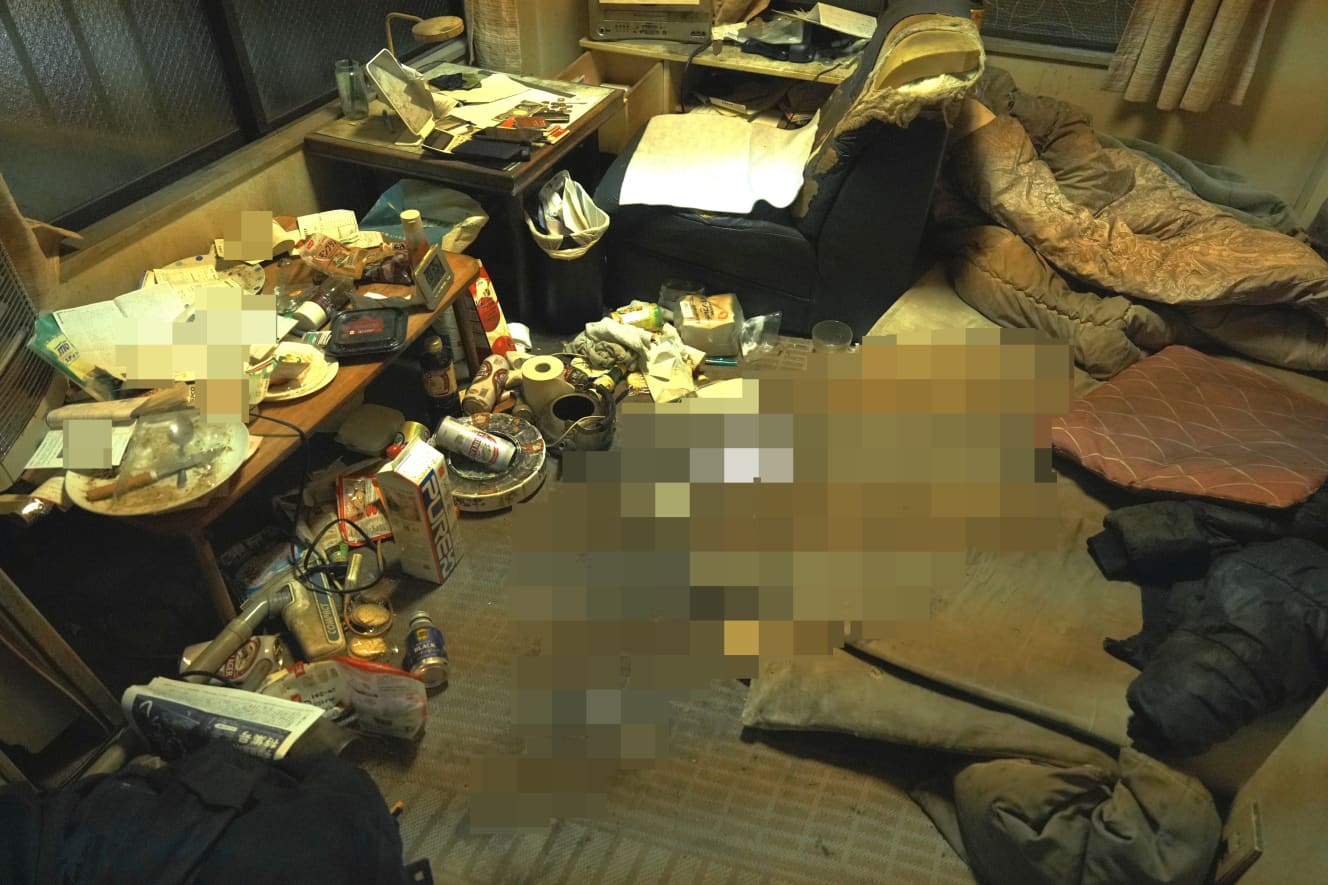
“The body was discovered next to this futon. The carpet here is blackened and discolored.”
Next to the kitchen space, a futon had been left spread out. Beside the discolored futon were black stains, and it was on the center of the blackened carpet that the body was found.
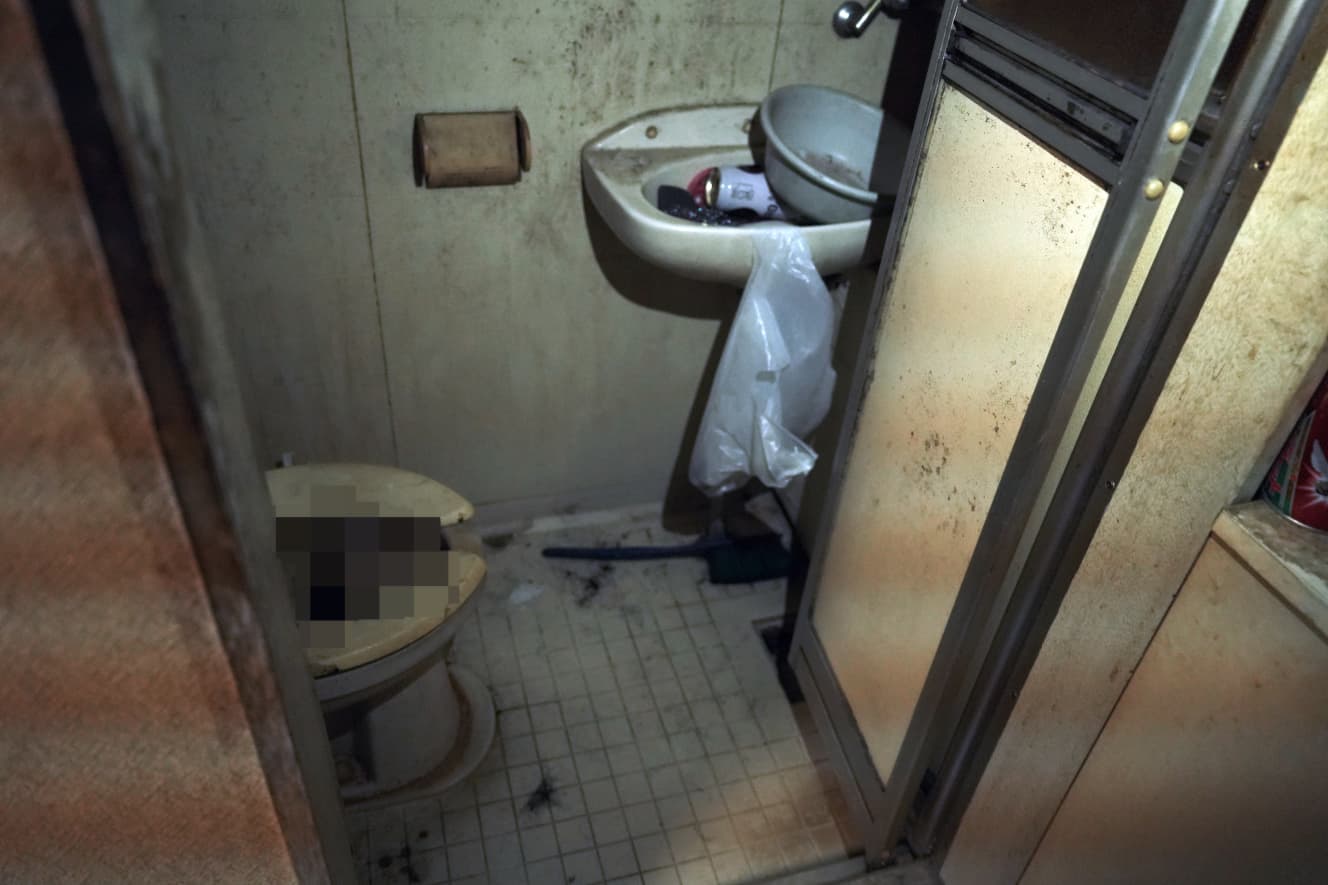
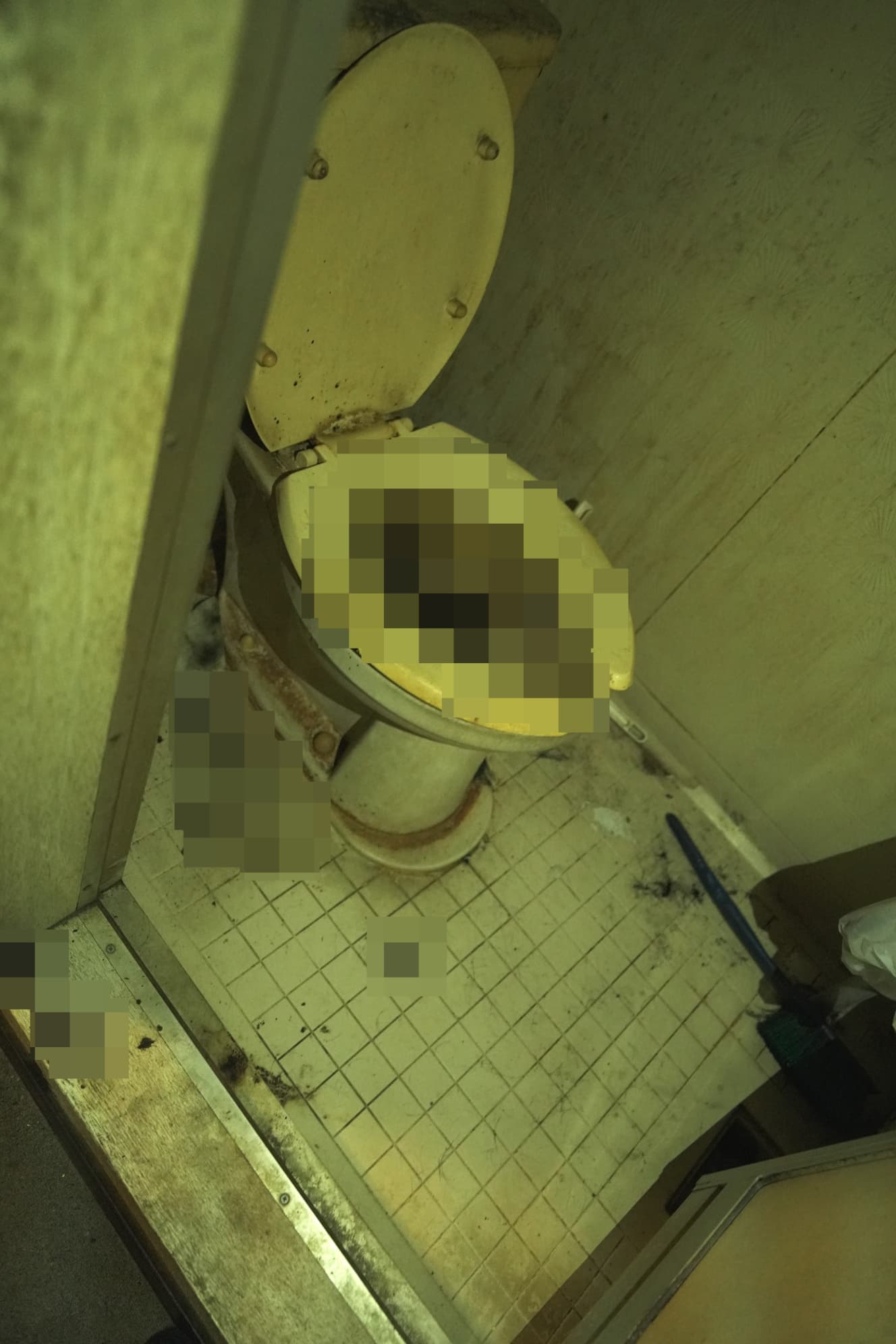
Immediately upon entering the apartment, there was a door on the right that was left open. This led to the unit bath, which also had black stains. There were also mysterious traces of black liquid on the floor. While observing the unit bath, I noticed that besides the liquid stains, there were also moving stains. Upon closer inspection, small cockroaches were wriggling about.
Although it felt unusual to see cockroaches in winter, the room had apparently been heated continuously until the body was discovered. In that case, the presence of cockroaches is not surprising. Watching the cockroaches, which are known to eat almost any organic matter, brought unpleasant thoughts to mind.
It took courage to step into the unit bath. Even wearing sneakers, a sense of revulsion could not be shaken.
“We haven’t yet received detailed information from the police or hospital, so we don’t know for sure, but it is likely that some kind of seizure occurred in this spot. The person went to the toilet and then crawled toward the futon before collapsing.” (same source)
Near the toilet were scattered substances thought to be discolored excrement, around which small cockroaches had gathered. Since the cause of death has not yet been medically confirmed, this is only speculation, but heat shock may have been a factor.
From the heated room, the person may have gone to the toilet to relieve themselves, and the sudden change in temperature caused them to collapse. The unit bath was cold, and during the act of excreting, a sudden rise and fall in blood pressure from heat shock could have caused collapse, especially if there was an underlying condition. In a dazed state, the person may have crawled from the unit bath back toward the futon and passed away there. There likely was no time to call an ambulance.
The remaining traces of everyday life
Returning from the unit bath to the main room, taking another look around, the sense of daily life seems stronger than the sense of dirtiness. Scattered coins, empty cigarette packs and ashtrays, empty beer cans, uneaten slices of bread, shochu. Although messy, there are clear traces that someone had been living there.
“We understand that this person made a living as a temporary security guard or similar work. He was 75 years old. He lived alone, but he had siblings, and we contacted them.”
A calendar stuck above the TV had the companies and locations where he was scheduled to work written on it, with the dates he apparently worked circled. Even at this age, it wouldn’t be unusual to live solely on a pension, but it seems he had done a fair amount of temporary work.
The November calendar was densely filled in, showing that he worked about four days a week. However, the circles marking days he had actually worked stopped at November 7. Looking at the October calendar, it was filled in similarly, so the abrupt stop here seems unusual. This may suggest the man passed away around November 7. If so, his body was discovered about a month after death.
Another striking point was the scarcity of personal belongings. Clothes were carelessly placed on the floor, but the number was obviously small. There were no clothes in the closet either, only one set of clothes for his work as a security guard and a single down jacket. Even including what appeared to be his work bag at the entrance, his personal belongings were extremely few. It gave a sense of the routine that had been repeated purely to survive, evoking a feeling of melancholy.
On the way out, looking at the mailbox for his apartment, flyers were overflowing and a few had fallen out. Among them were notices from service providers, showing that he had been struggling financially.
Most are discovered due to unpaid rent
According to the management company, cases like this are rare.
“This case was discovered because of a report of a strange smell. In many cases, solitary deaths are discovered due to unpaid rent, with about 70% of reports coming from landlords or guarantee companies. Other patterns include 20% from caseworker visits, and the remaining 10% from neighbors. Reports due to odors are relatively uncommon. Even in Japan, properties are generally well-built, so unless it’s a scene where a body is severely damaged, such as in a sealed room during summer, a report usually won’t occur.”
According to the management company, in older properties—especially 1K units with a unit bath a short walk from the station—low rent often means elderly tenants, and the likelihood of solitary death is higher.
“To be honest as a real estate agent, we don’t want to rent to elderly people because of the risk of solitary death. However, landlords make a profit if someone rents the property, and it’s easier to sell a fully occupied property, so they do rent it out.”
However, if a solitary death does occur, costs for cleaning, restoring the unit to its original condition, and removing leftover belongings are usually borne by the landlord. Even if the deceased has relatives, they often renounce inheritance.
“Today, with the demand for investment apartments, more people are becoming owners than in the past. But few consider the risk of solitary death when purchasing. If a solitary death occurs, even in a one-room unit, it can cost 1 to 2 million yen, and recovering that cost can take years. My advice is to get any insurance you can.”
In an aging society, solitary death is becoming an issue for property owners, tenants, and residents alike. Solitary death among elderly people with no relatives has become a social problem and cannot be ignored. Yet there is no concrete solution. Even those who consider themselves healthy can suddenly collapse due to illness. Social connections are essential, but the reality is that many people are isolated.


Interview, text, and photographs: White Paper Green