The opening of the World Cup year: Uchida’s solitary struggle, Kagawa’s true value, Qatar’s joy… Famous scenes from the World Cup: “The Fierce Struggle of Japan’s National Team”.


The curtain has opened on the World Cup year. The current “Moriyasu Japan” team is the fastest in the world to qualify for the World Cup in North and Central America, and its strength is recognized around the world, including a victory over Brazil in a friendly match last October. Writer Etsuko Motokawa, who has covered the World Cup on the field, looks back on the history of the fierce battles that have brought Japan to this level.
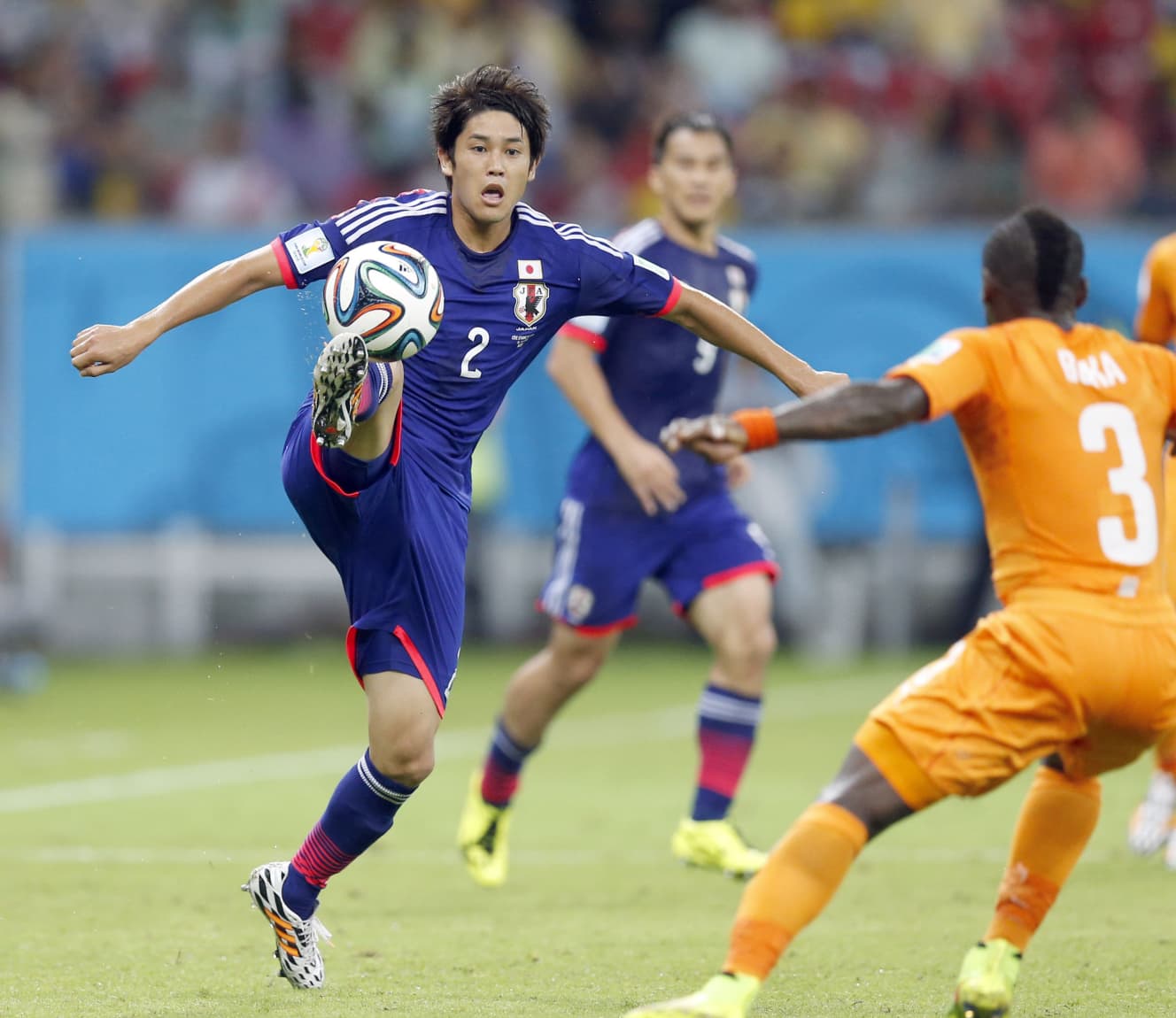
After the defeat, Uchida revealed, “It was all on our own.
After the 2010 World Cup in South Africa, where Keisuke Honda, Yuto Nagatomo (FC Tokyo), Shinji Okazaki (Basara Mainz), and other players born in 1986 emerged as leaders of the national team, the Italian coach Alberto Zaccheroni took over the national team. He strengthened the team for four years with the midfielders and youngsters from the South African World Cup as the core of the team. Eventually, he added young players such as Yuya Osako (Kobe) and Hotaru Yamaguchi (Nagasaki) to the team and took on the challenge of the World Cup.
However, the team suffered from a series of miscalculations, including the withdrawal of captain Makoto Hasebe (national coach), Yasuhito Endo (Gamba Osaka coach), and Yasuyuki Konno (Nankatsu SC), and failed to win a single point in a group that included Ivory Coast, Greece, and Colombia.
Uchida, the right back who had suffered a serious right knee injury four months prior to the World Cup, was still recovering from the injury and played a full match in every game. He played the entire match and was a standout performer.
Personally, I think it was the same as usual. No change. Well, I can play better at Schalke (laughs). I don’t know why. That’s been a problem for me for the last four years.
He expressed his frustration at not being able to give his best, partly due to injury, but he also showed the pride and determination of a top player. But the team could not win.
If we could play our own soccer, we would win, of course, but we can’t,” he said. But we couldn’t. The level of the opponent was too high. We can’t hold the ball, and they have players who have a shot. Well, we have to do it on our own.
While Toshihiro Aoyama (Hiroshima coach) cried and Maya Yoshida (LA Galaxy)
Kagawa talks about the “joy of a great start.
Looking back four years later, Japan’s team for the 2006 World Cup in Russia, in contrast to Zac Japan, was not well received by the public. Two months before the tournament, coach Vid Halilhodzic was ousted and Akira Nishino, who had been serving as technical committee chairman, was brought in on an emergency basis, so there was certainly no telling how things would turn out. The team was not settled until the very last minute, and there was nothing but uncertainty about how things would turn out.
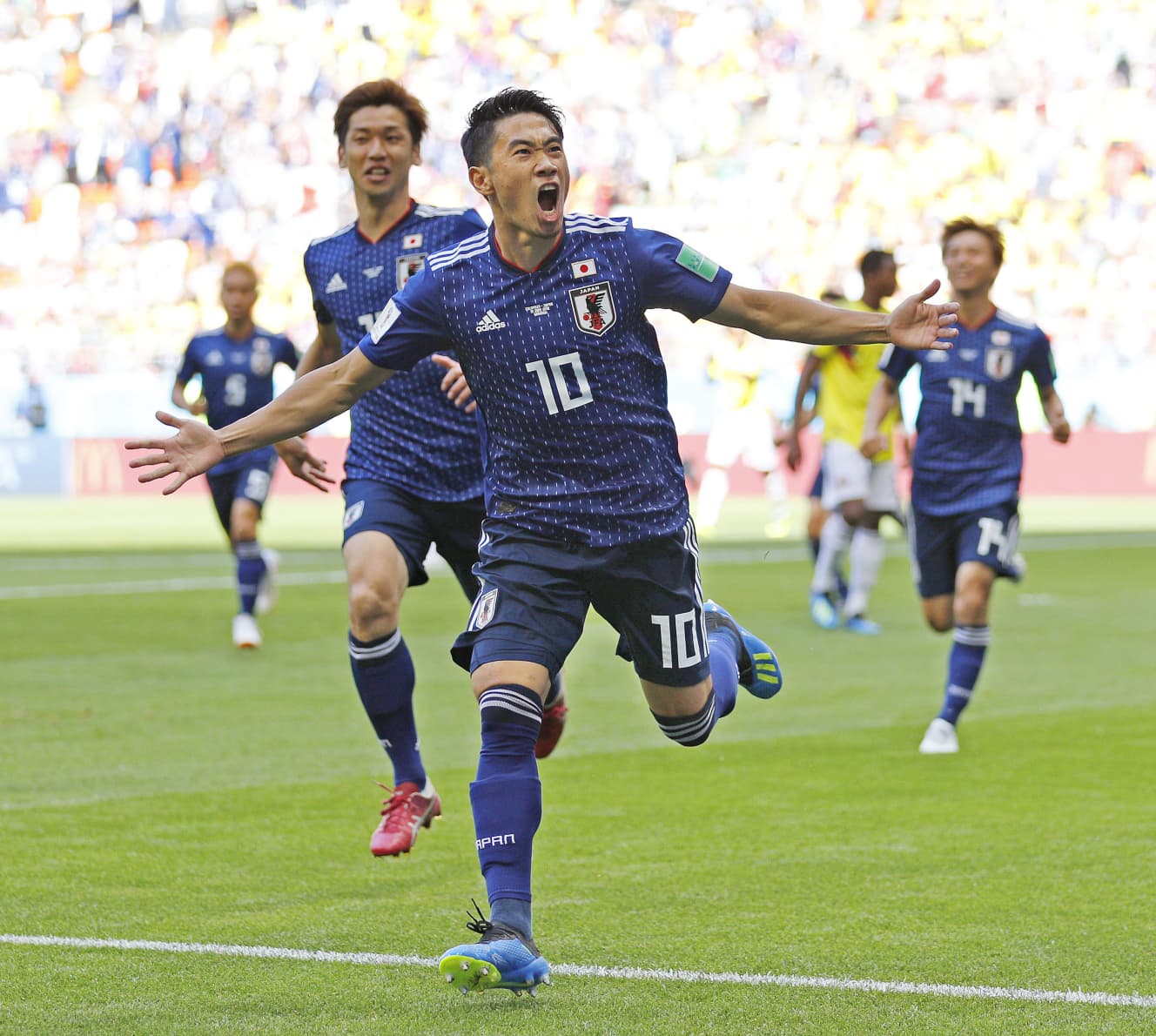
The team did not gel until the last minute, with Takuma Kano (Mallorca) and Yosuke Ineguchi (Kobe) being left out of the squad, and the team started out with only a few uncertainties. Kagawa, who had been carrying the No. 10 since the 2011 Asian Cup, began to be treated coldly by coach Halil before he turned 30, and at one point he was even eliminated from the squad. After the Nishino regime took over, Kagawa was named in the squad for the tournament, but he did not get a starting spot until just before the first match against Colombia, in which he scored on a penalty kick. In the big game, he scored the first goal, albeit on penalties, to lead his team to a 2-1 victory. After the game, Kagawa told the press.
I took the penalty myself, so I was ready to kick it (laughs). In the national team, if Keisuke was playing, Keisuke would have kicked it, but other than that, it was not decided. I had to believe in myself.
I will never forget the first game four years ago (an upset loss against Ivory Coast). After those four years, we were able to win one game together with everyone like this.
Kagawa started all the qualifying matches in the top half of the lineup. Kagawa started in the top half of the lineup in all the qualifying matches, showing strong performances both offensively and defensively, and leading the attack strongly. In the end, they fell one step short of their long-cherished goal of advancing to the last eight, as they fell behind 0-2 to Belgium in the last 16, but Kagawa’s performance was overwhelming.
Key player Doan shows “for the team
The most recent World Cup in Qatar in 2010 is still fresh in the minds of many Japanese. In the ’18 World Cup, the team led by Hajime Moriyasu, who was the coach of Japan’s national team, defeated Germany and Spain, both of which had won the World Cup. Many people must have felt the great growth of Japanese soccer after witnessing the team’s close victory over Croatia, the runner-up in the ’18 tournament.
There were many famous moments, such as “Kaoru Misuzumi’s millimeter” against Spain and the tears of Minamino and Misuzumi after they missed the penalty kick against Croatia, but the goal scored by Ritsu Doan (Frankfurt) against Germany and Spain had the most powerful impact. As you know, Doan has been the mainstay of the attacking lineup since the start of the Moriyasu coaching regime. However, he has not always been used heavily, and was subbed for Junya Ito (Genk) in the Asian qualifiers, and was not selected for the match against Australia in March 2010, which earned the team a ticket to the World Cup, and it was unclear whether he would be available for the World Cup.
In the end, Moriyasu gave him the role of “super sub. It was no wonder that the egoistic player felt frustrated, wondering why he was being treated like this. But after scoring the final goal against Germany, he said, “I started on the bench.
I was grateful to my colleagues for helping me qualify for the World Cup when I was eliminated in March, and there were others who were not selected this time, so I really thought, ‘I’m going to give it everything I have. I was not happy about personal things when I got on the pitch.
Doan has transformed into a player with a “for the team” mentality. His coach was the first to notice this change.
When he was removed from the team for the final qualifying round, he had the mentality of ‘use me’ and ‘I will beat 11 opponents by myself. After the come-from-behind win against Germany, Ritsu said, “The other team had only 11 players on the pitch, but we were able to win with 26, including the bench. When I saw him say that, I felt deeply that he had definitely changed.
As Hajime Moriyasu’s comment shows, the World Cup is a stage where a single player and a single team can make remarkable progress, and only a handful of people can make it to this place that comes only once every four years. Only a handful of people can make it to this once-every-four-years event, and only a handful more can make it to the World Cup. Behind the success of the team, there was a lot of effort, hard work, and tears of many people. It is precisely because of the efforts of those who wear the Hinomaru that over the past 28 years Japan has been able to say that it is aiming for the top of the world.
At the 2014 World Cup in North and Central America, I would like to see a strong Japanese national team that will go far beyond the past while taking into account the past history. Who will play the leading role? We cannot help but look forward to the moment when a new drama will be born.
PHOTO: Kyodo News