Hiromi Nagasaku Reflects on the Role That Changed Everything
A special interview with Hiromi Nagasaku, a talented actress with a healing nature, who had a turning point in her career.


Going with the flow
“When I was young, I hated being called baby-faced. Because I didn’t look mature, I would even wear heavy makeup on purpose (laughs),” reminisces actress Hiromi Nagasaku (55), her smile crinkling adorably.
“But now, even if people say I have a baby face, it doesn’t bother me. I’m just being myself, so if that’s how everyone sees me, that’s fine.”
She began her entertainment activities in 1989 with the idol group ribbon and made her serial drama lead debut in 1995 with Sankaku Heart (TV Asahi). The esteemed actress, nicknamed the eternal baby face, marked the 37th year of her career in 2025. In the February 6, 2026 release Hodoku, Owakare Desu, she plays the mother of 25-year-old Minami Hamabe, a rookie funeral planner. She is also set to star in her own film, Akirame Masen!, maintaining a strong presence on the forefront of the industry.
Surprisingly, her beginnings were more going with the flow than planned.
“During the summer break of my second year of high school, I saw an announcement on our TV for All Night Fuji High School Girl Special (Fuji TV). I actually wanted to appear on High School Quiz (Nippon TV), but none of my friends would join me (laughs). Since I could do this alone, I applied. I was only thinking of it as a memory-making thing.”
What was supposed to be a one-time appearance led to ongoing contact from TV stations.
“They kept asking, ‘How about this new show?’ I would appear, and then the next, and the next. Before I knew it, I had graduated high school and was in Otome Juku (laughs). It wasn’t so much that I chose it myself, I just went with the flow.”
Otome Juku was a talent development project born from Fuji TV variety programs. From there, she was selected as a member of the idol group ribbon.
“I was happy I could sing. But at the same time, I was aware that being an idol at 19 was late I thought, ‘It’s the best memory ever!’ but I didn’t believe it would last forever.”
Though she didn’t intend to treat it as temporary, she also wasn’t obsessed. Naturally, those around her sometimes saw her as not serious.
“People on set thought, ‘She’ll quit anyway,’ and they said it too (laughs). But at that time, I was giving it my all. Everyone around me was fired up, thinking, ‘I want to do this! I want to do this!’ but I just couldn’t match that energy. I wasn’t interested in makeup or clothes, and I didn’t know the ‘correct’ way to respond. I really didn’t understand the reactions people expected. So I just said what I liked (laughs).”
This gap was both her clumsiness and her greatest charm.
“Looking back, I think, ‘I could’ve tried a bit harder,’ but at the time, that was my best. I would get the work, handle it, and move on to the next. I wasn’t thinking about whether to continue or quit—it was nothing that big.”
She threw herself into the work she was given. A turning point came with her encounter with the stage. She was standing in the rehearsal room of the renowned Gekidan☆Shinkansen.
“During the premiere of TIMESLIP Ougonmaru in 1993, I kept thinking about how to escape (laughs). Even though my agency said I had to do it, I had no idea about acting. My rebellious side was stronger.”
The rehearsal room was notoriously demanding and high-energy. Thrown into that environment, Nagasaku was shaped through challenge and resistance.
“To put it nicely, they took good care of me; to put it harshly, it was incredibly strict. But by the end, I felt such a sense of accomplishment that I thought, ‘Maybe acting is fun.’ That’s how the offer for the drama Hi no Ataru Basho (1994, Fuji TV) came.”
This first serious drama role was clearly different in quality from her previous work.
“Until then, whether singing or doing variety shows, it didn’t feel like my talent was recognized—I was just doing the work my agency brought me. But drama was different. It felt like someone outside was calling me for the first time. ‘Ah, there are people noticing me.’ That made me genuinely happy.”
Me Between the Buildings
She stepped into the world of television dramas, but at first, it was a constant series of confusions. She couldn’t understand the meaning of acting and found the direction full of awkwardness. Still, supported by her experience with Gekidan☆Shinkansen and the warmth of the set, she managed to carry out her roles.
At the time, it was still an era when idols acting in dramas faced strong criticism. When asked directly about that label, she squinted her eyes and laughed it off: “I think it was strong.”
“But that was just everyone else caring about it. Personally, it didn’t bother me at all. I thought, ‘That’s that. This is the path I’ve taken.’ I wondered, what’s so wrong about it?”
In fact, what troubled her had nothing to do with others’ evaluations.
“Around my late twenties, I felt, ‘Maybe I’ve reached my limit.’ I found my own acting boring. If the person performing isn’t having fun, the audience can’t enjoy it either. I was stuck in that feeling for a while.”
Was there any point in continuing? Feeling this sense of stagnation, Nagasaku received an offer for a movie.
“It was Doppelgänger (2003), directed by Kiyoshi Kurosawa. Having been on TV drama sets for so long, this was the first time I truly encountered the world of cinema. The distance from the camera, how to get into the role, how the filming worked—everything was different from TV drama, and I was constantly amazed.”
Nagasaku expresses the impact of that experience in her own unique words.
“Until then, I felt like I had been acting in a space between tall buildings. But suddenly, it was like standing in an open place with a view of the sea. That was the moment I realized, ‘Ah, there’s still more ahead.’”
That realization gave her a tangible sense of confidence. As she accumulated achievements, she was also blessed with encounters with works that would become her defining roles.
In the 2011 film Rebirth, Nagasaku won the Best Supporting Actress Award at the 35th Japan Academy Prize. She played the sinful woman Kiwako, who, after an affair, kidnaps her lover’s baby (Erina) and raises her for four years. At the time, Nagasaku herself had just given birth to her first child.
“When I read a script, I categorize it intuitively: ‘I want to do this,’ ‘I should do this,’ or ‘I feel like I have to do this.’ This work was exactly in the ‘I have to do this’ category. Before I knew it, a path had already formed in that direction.”
However, the filming was tougher than she had imagined. Her co-star was a baby who couldn’t communicate in words.
“Babies never do what you expect, right? They cry, sleep, suddenly laugh. On that set, it wasn’t really acting, it was more like just being with a child who didn’t do what I wanted that might be the correct way to describe it.”
Yet Nagasaku’s raw emotions were vividly captured on camera.
“Having become a mother in real life, I already had the feeling of holding a baby, which really helped. If I hadn’t had that experience, I think I would have been so preoccupied with the baby that I would have gotten stuck.”
The film swept across various awards and became a deeply significant work in her career. There is, in fact, a later story related to it. She fondly recalls reuniting with child actress Konomi Watanabe (19), who played Erina as a young child.
“I think it was about two years ago. I had suddenly felt I had to meet Konomi. Then someone told me, ‘She’s on Instagram,’ so I sent her a DM using the character’s name. Immediately, she replied, ‘Yes, this is Konomi! Is it really you, Nagasaku-san?’ That’s how we connected.”
When they actually met, the emotions overflowed.
“You always wonder how a child actor you worked with has grown. I had been curious about Konomi, and the moment I saw her face, I couldn’t help it I couldn’t stop crying. She kept talking about everything from after the movie until now. I just listened and cried the whole time. It was completely from a mother’s perspective (laughs).”
Living with Few Regrets
In her private life, Nagasaku is a mother of two. She says her real-life experiences give more substance to the skeleton of her acting.
“I’ve always thought that acting angry was difficult. But when you have children, it’s not difficult at all. I think, ‘I can get angry as much as I want!’ (laughs). Having a family has really taught me a lot about the range of emotions. Regarding my family, there’s only gains. Everything comes back as a positive.”
She also revealed that recently, she’s been sharing her own words on social media, which provides her with fresh inspiration.
“I started cautiously, but surprisingly, I enjoy it. When I write, I try to focus on what I think is the most beautiful part of myself. It’s not about vanity—just whether it’s beautiful or not. Brighter is better, isn’t it? (laughs) No matter where you go in the world, everyone’s trying their best, so I just want to support them. If someone happens to see my words and thinks, ‘I’ll try my best tomorrow too,’ that’s the best. Even small things—just winning once against the day’s pressure—becomes an incredible energy. It’s like generating tens of thousands of horsepower.”
Sometimes, her free-spirited posts make those around her nervous.
“Sometimes I wonder, ‘Is this okay?’ and write while testing the borderline. Negative opinions are inevitable. We’re alive. My agency sometimes says, ‘Please, be careful~’ (laughs).”
Changing from a pensive expression to a playful one, her charm shone through. When the reporter asked, “How do you age so beautifully like you, Nagasaku-san?” she shrugged happily.
“Eh that’s not really true~. I’m already 55 (laughs). But seriously, I think it’s about being natural. When I was younger, I was afraid of adults labeling me as the bad me, so I avoided facing things honestly. But now, whether it’s work or relationships, I focus on properly facing things as they are, not thinking about can or cannot. Doing that makes life definitely easier than before. Of course, I still get nervous. But I feel I have fewer regrets. Being bad or good isn’t everything. So even if I’m nervous, I do it fully and feel satisfied—it’s more fun that way. There are still so many things I want to do.”
In a world she entered initially just to make memories, she has lived consistently, honestly, and true to herself.

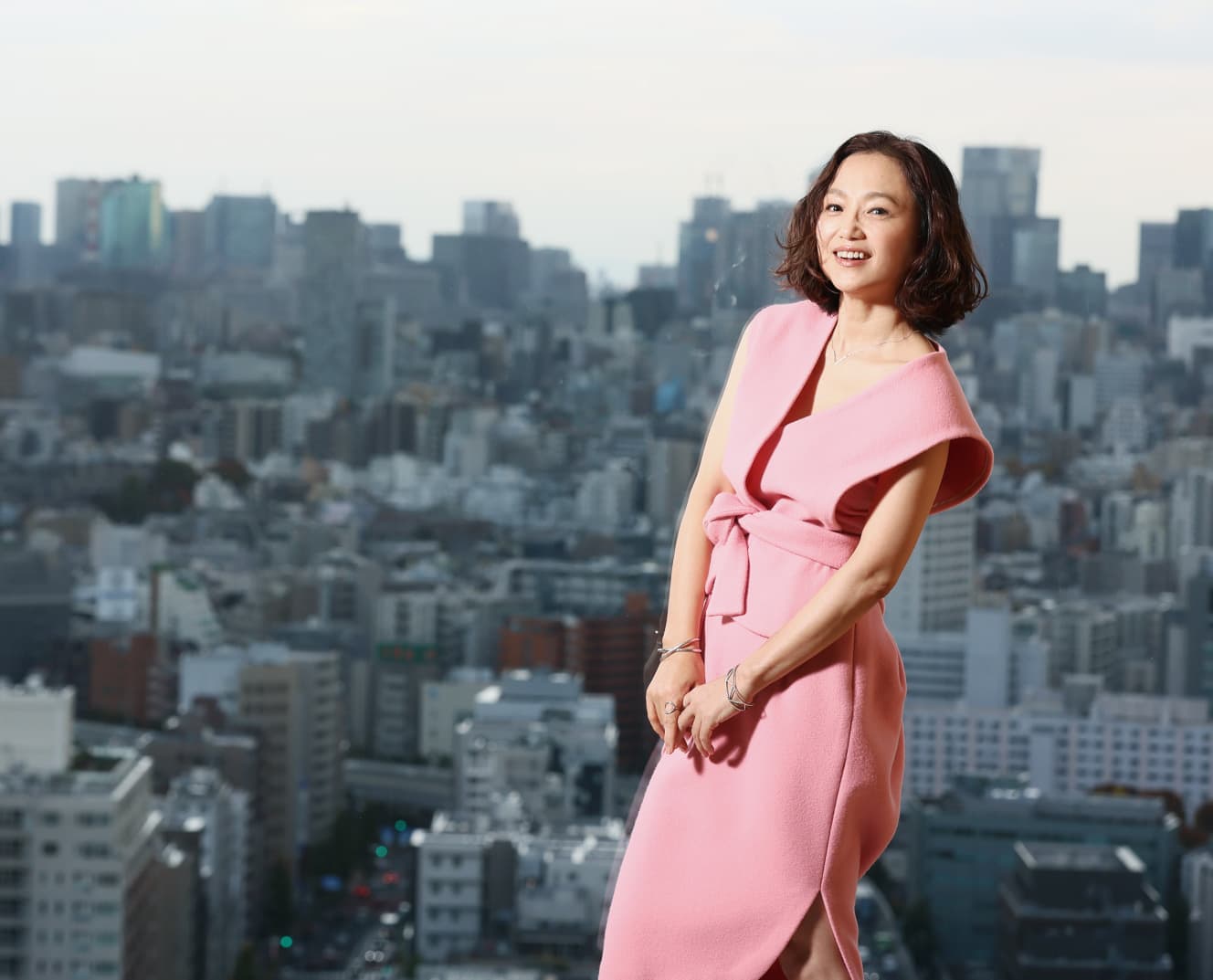


From the January 2, 9, and 16, 2026 issue of “FRIDAY”
PHOTO: Takehiko Kohiyama Stylist: Tomoko Yasuno Hair & Make-up: Aiko Tokashiki Jewelry Cooperation: CASUCA