Hong Kong Apartment Fire Kills 160+ — Experts Reveal the Crucial Differences with Japan


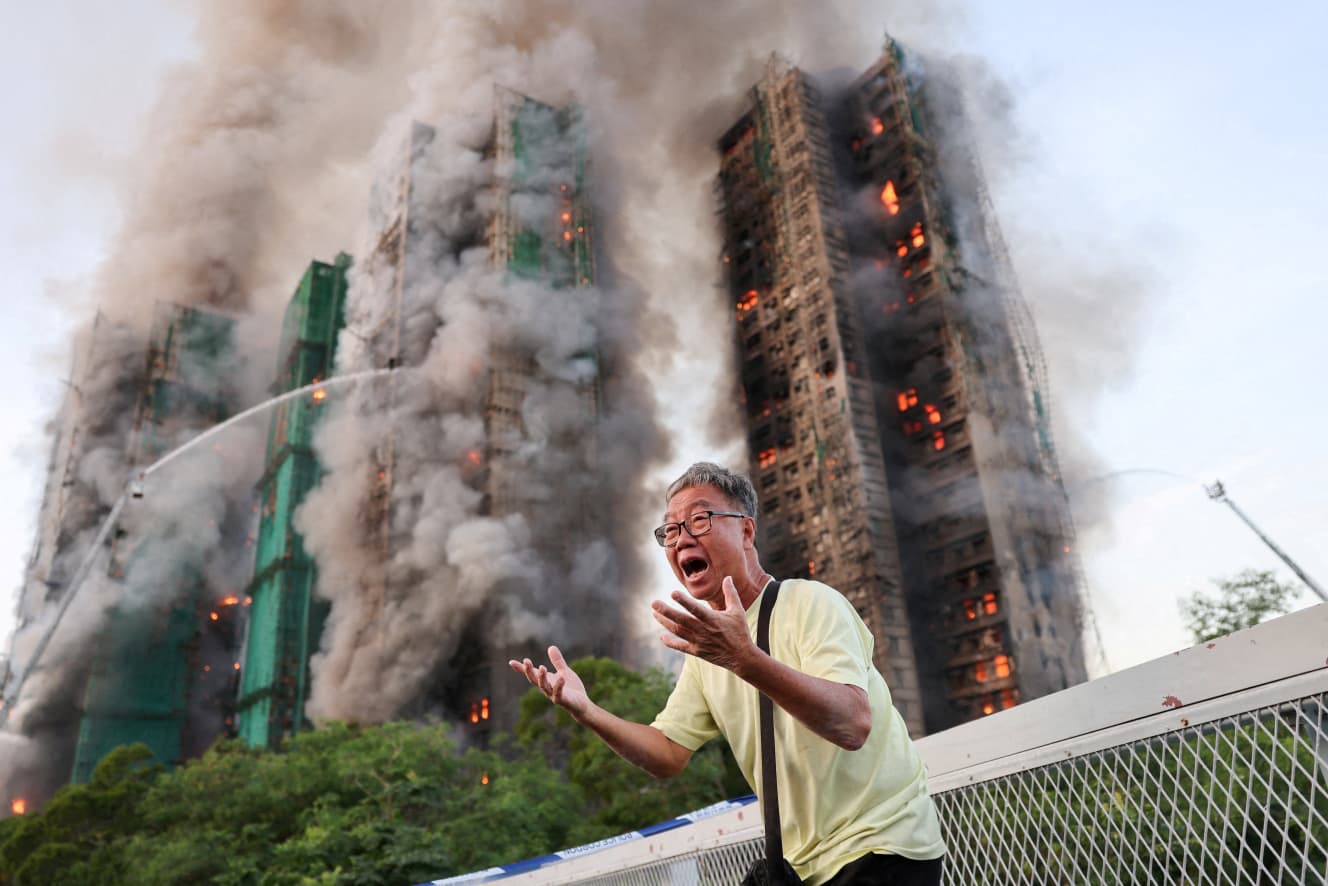
Even though the fire should have been contained to one unit
“Watching the footage, it spread upward at an unbelievable speed. The way it burned looked just like the worst-case fire spread in a wooden house,” said Takao Sakaguchi, former chief of Azabu Fire Station and a board member of the Citizens’ Disaster Prevention Research Institute, reflecting on the scene.
Flames climbed the exterior walls of a high-rise condominium, burning through the green netting that covered the building. During the fire at the Hong Kong high-rise complex “Hung Fuk Court” on the afternoon of November 26, seven out of eight towers were affected, resulting in 161 deaths (as of December 26).
The netting covering the buildings under renovation was made of combustible material, and the scaffolding was also flammable bamboo.
“Especially on the exterior windows, polystyrene was attached for protection, which accelerated the vertical spread. The heat from burning polystyrene likely shattered the window glass and allowed the fire to penetrate indoors,” Sakaguchi explained.
Many high-rise condominiums also exist in Japan. Could a similar fire happen there? Sakaguchi firmly denied it:
“A fire like Hung Fuk Court could not happen in Japan. First, combustible scaffolding is never used for exterior construction, and protective nets must have flame-retardant properties. Attaching polystyrene to windows for protection would not happen. In other words, fire cannot enter the interior from outside. Japanese condominiums use fireproof walls and floors to prevent fire spread, so even if a fire breaks out, it is contained within the affected unit.”
Hung Fuk Court reportedly lacked sprinklers. In Japan, sprinklers are generally required for floors above the 11th floor(they can be omitted only if equivalent safety is guaranteed). Sprinklers automatically activate when a certain temperature is reached, spraying water to suppress the fire.
Residents of Hung Fuk Court also claimed that the fire alarms did not work. During renovation, the alarms may have been disconnected.
“Because the fire was not detected, residents could not evacuate, leading to large-scale damage. In Japan, fire alarms, sprinklers, and other firefighting equipment are mandated by law. Even during construction, a fire safety plan must be prepared and submitted detailing alternative measures. It is not a situation where such rules can be ignored.”
Even approaching the building was difficult
At Wang Fuk Court, the detection of the fire was delayed, and the only evacuation route—the emergency stairwell—was filled with smoke, preventing residents from escaping.
“In Japan, measures are taken to secure evacuation routes, including smoke- and fire-prevention for stairwells. For high-rise buildings of 15 floors or more, an even safer special evacuation stairwell must be installed. To prevent smoke from entering when people open doors, a small room is placed in front of the stairwell, equipped with mandatory smoke-exhaust functions.
Evacuation routes are designed for ‘two-direction evacuation, allowing escape via different routes. In Japan, besides the strictly regulated stairwells, most apartments have balconies, and residents can move to neighboring units by breaking through partition walls. Repeating this, one can get farther away from the fire. If you reach a location with an installed escape hatch, you can use the ladder to descend to lower floors or the ground.”
Firefighting on upper floors is extremely difficult. From the ground, water hoses can only reach about the third floor. Ladder trucks can spray water up to roughly the 10th floor. At Wang Fuk Court, the fire spread to seven buildings, including the higher floors. Burning bamboo and other debris fell from above, preventing firefighters from approaching the building, making ground-level extinguishing impossible.
To fight fires on upper floors, firefighters would have to carry hoses via stairwells, but smoke and heat had filled the stairwell, making that impossible.
“In Japan, buildings of seven floors or more are required by the Fire Service Act to have standpipe systems. Near the entrance of each building is a standpipe inlet, with piping running to each floor.
For floors below the 10th, firefighters can safely take hoses up stairwells and connect them to outlets on each floor above the third. For floors above the 11th, hoses are already installed in pairs on each floor, so there is no need to carry them upstairs.”
In Japanese high-rise apartments, the tragedy like Wang Fuk Court cannot occur. The only exceptions would be something extreme, like terrorism or an arsonist pouring gasoline, says Mr. Sakaguchi.

“I believe Japanese apartment safety is among the highest in the world. But no matter how safe the equipment is, if the people using the building don’t understand it, it’s as if it doesn’t function. That creates a risk of death. Even if it doesn’t become like Wang Fuk Court, fires that could have been contained on each floor can still spread to other floors.”
Mr. Sakaguchi asks the following:
“Do you know the safety features of evacuation stairwells? Don’t leave the stairwell doors open to prevent smoke inflow! Do you know about two-direction evacuation? Does your home have at least one fire extinguisher? Do you know how to use it? If the fire hasn’t reached the ceiling, don’t just escape—try to put it out yourself! And above all, never use the elevator!
The Fire Service Act requires fire equipment inspections twice a year and one annual disaster drill. Unfortunately, the same people usually participate, and many don’t. But these opportunities are extremely important.”
Functions built to protect life do not save you by themselves. Whether people understand and can use them correctly is what determines life or death.
Interview and text: Takeshi Nodo PHOTO: Afro (1st photo)