Playback ’95] Poisonous spiders, which are not supposed to be in Japan, are swarming all over the country… The “reality” of the panic that gripped the nation.


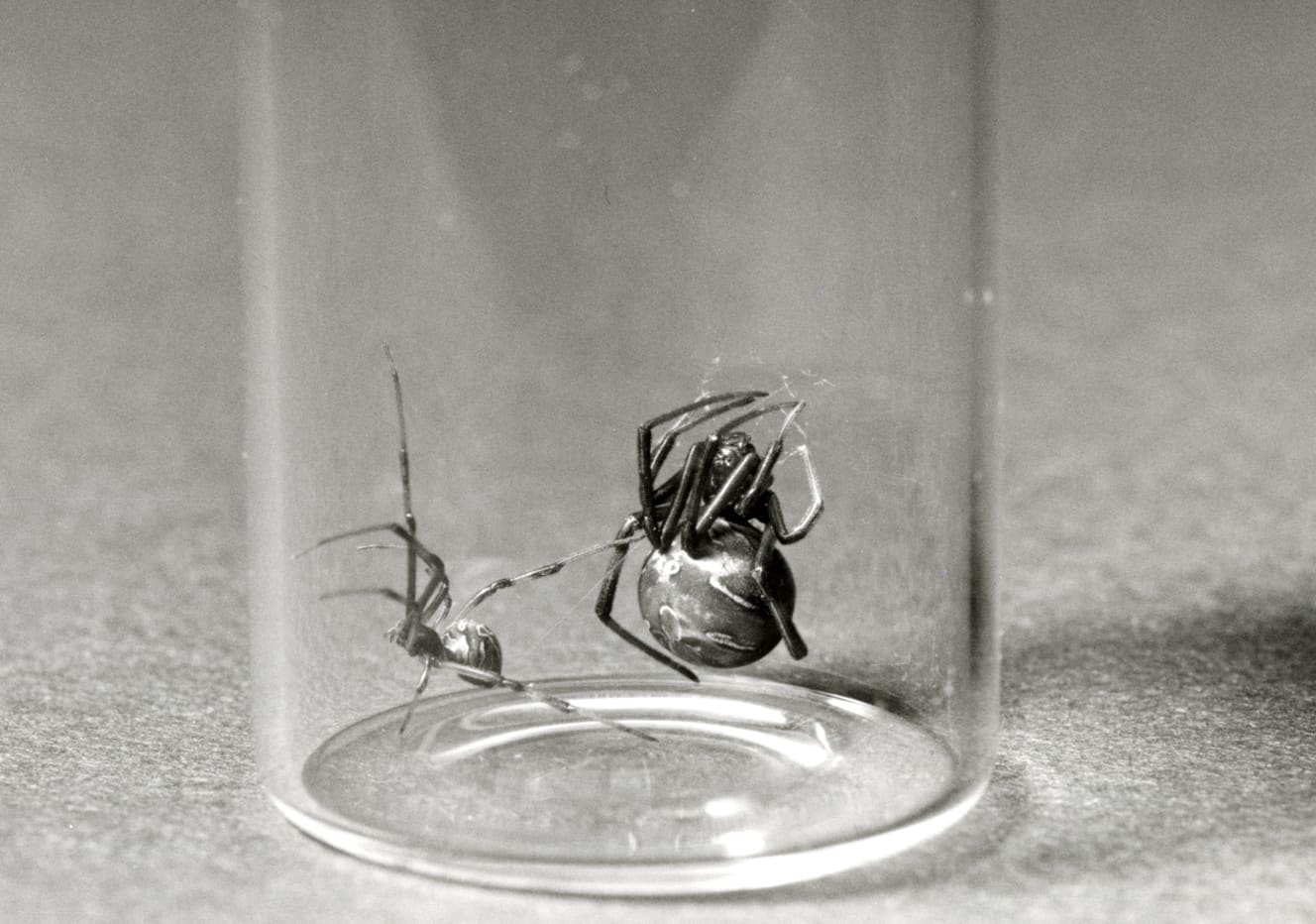
What did “FRIDAY” report 10, 20, and 30 years ago? In “Playback Friday,” we revisit the topics that were hot at the time. This time, we will introduce the December 16, 1995 issue, 30 years ago, which reported on the “Osaka poisonous spider” outbreaks of more than 1,000 spiders, and their “unexpected breeding source.
It was November 24, 1995, when newspapers carried such headlines as “Poisonous Spider, Not Found in Japan, Found in Osaka in Large Numbers. In September, an insect-loving office worker in Takaishi City, Osaka Prefecture, found a spider with red stripes on its back in the parking lot of his office, but he could not identify it even after checking it out in an illustrated book. Yoshiro Nishikawa, then president of the Spider Science Society of Japan, examined the spider and discovered that it was a “poisonous spider living in the tropics. He immediately investigated the area where the spider was found and found nearly 80 poisonous spiders, and the whole country was plunged into a poisonous spider panic.
The bite of a child can be fatal
Later, more than 1,000 spiders were found in Sakai City and Izumiotsu City adjacent to Takaishi City, as well as in Yokkaichi City in Mie Prefecture.
Based on the number of spiders, Nishikawa’s theory is that “there is a strong possibility that the spiders had already come ashore more than two to three years ago.
The spider is neurotoxic, and its bite can make you feel sick or nauseous. Although the venom is minute, children should be careful,” said entomologist Masayasu Konishi.
It is frightening that the bite of a child can be fatal.
The female of the redback spider is 10 mm long, while the male is about 4 mm long. They are distributed in tropical and temperate zones in Australia, the United States, India, and Southeast Asia, and inhabit bright forests and rocky areas. As Konishi pointed out, the bite of the sessile spider, which has the neurotoxin “ratotoxin,” can cause death in physically weak infants.
In addition to identifying the landing route, the Osaka Prefectural Government has launched an investigation to determine whether the spider is also found in other areas, and the Ministry of Health and Welfare reportedly plans to dispatch experts in sanitary pest control to the area. The Ministry of Health and Welfare also reportedly plans to dispatch experts to the area to exterminate the pest. Surveys are also being conducted throughout Japan, and the whole country has fallen into a “poisonous spider panic.
There seemed to be no need to make a fuss blindly.
However, the people of Takaishi City, the epicenter of the earthquake, seemed to be in a surprisingly “easygoing” mood, perhaps because the city had not suffered any damage up to that point.
On November 25, elementary and junior high school students in the neighborhood happily jumped into the action to catch poisonous spiders at a cemetery in Takaishi City.
They were so happy that they jumped in and took part in the operation to catch the poisonous spiders, even though they were stopped by prefectural government officials. They quickly captured one spider by wielding a splitter. They felt like heroes, calling out to the press, “Hey, there it is!
Incidentally, this reporter also found one, but when he poked it with a splinter, it immediately curled up and went into a state of suspended animation. They are not aggressive, so they will not bite unless you are very careful, and they are easy to catch if you wear gloves and grab them with a splitter. Some experts believe that wasps are much more dangerous than hornets, and although it is better to be cautious, it is probably best not to make a fuss about them.
Why did the redback spider, which lives in the tropics, wash up in Osaka and breed there? The prevailing theory was that they were mixed in with lumber and other cargo aboard cargo ships arriving at Osaka’s Nanko port.
“I think they came from Southeast Asia,” he said. There was once a commotion when scorpions were found among the lauan wood,” Konishi said.
Mr. Nishikawa added, “The areas around people’s homes and drainage outlets are warm even in winter, and the fact that the last few years have been mild may be the reason for their proliferation.”
The fuss died down as word spread in December that there was little immediate life-threatening danger. However, there was also information that “they can breed in areas other than cold regions where snow accumulates,” so in reality, one could not let one’s guard down.
Spreading throughout Japan after 30 years
As of ’25, the redback spider has been confirmed to live in 46 prefectures throughout Japan, excluding Aomori Prefecture. The spider was supposed to be “able to breed outside of cold regions,” but it seems to be able to live in cold regions as well. It has also been designated as a Specified Invasive Alien Species since 2005.
Only the female is poisonous, and the male is harmless. The female’s venom is said to be extremely potent, stronger even than that of a king cobra. However, since the female of the redback spider is very small (10 mm) and can inject only a small amount of venom at a time, it is generally believed that even if a human is bitten, it will not cause serious symptoms.
So far, there have been no deaths due to spider bites, but there have been many cases of people being taken to the hospital. Experts warn , “As long as there have been cases of people being bitten by spiders, there is a possibility that the bites can cause shock symptoms and lead to death. It is necessary to take countermeasures.” Each city, town, and village has been urged to take precautions and not to touch them.
The recent disturbance caused by alien species that were not native to Japan, such as fire ants, which were discovered in various regions in 2005, is still fresh in our minds. As the borderless flow of traffic between Japan and foreign countries continues, the introduction of unwelcome alien species into the country may be inevitable.


PHOTO.: Takero Shigumo (1st), Yutaka Asai (2nd-4th)