Japanese Tourists Shocked by Korea’s Strict Bus Etiquette — Coffee in Hand Gets You Denied!


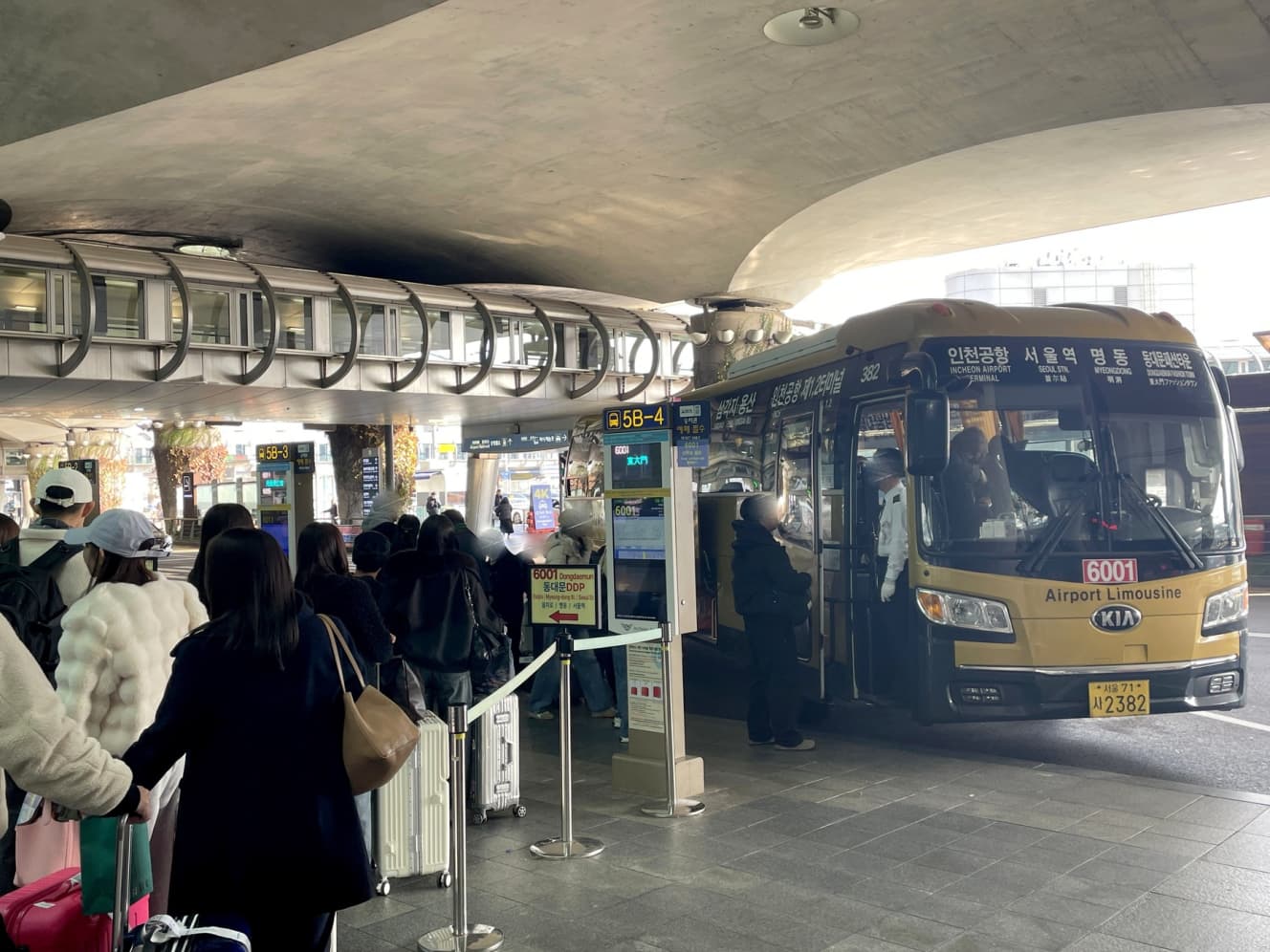 Seoul, South Korea – The airport limousine bus stop at Incheon Airport. While bringing food and drinks onboard is not as strictly regulated as on regular city buses, in Korea it is considered common sense not to eat or drink on public transportation, so travelers should be especially careful.
Embarrassing manners violations Japanese travelers often make in Korea
Korea, Japan’s neighboring country, is popular with Japanese travelers year-round. According to a recent forecast released by JTB, while the share of Japanese choosing Korea as their overseas travel destination slightly decreased to 19.5% this year, it still surpassed Hawaii (16.9%) and Europe (16.2%), making it the top choice once again.
Because Korea is geographically close and historically linked to Japan, there are many similarities in culture and manners. However, there are also notable differences. For example, rules regarding eating on public transportation, prohibitions on photography at airports, payment methods while shopping, and the usability of smartphone map apps differ. A travel journalist who visited Korea five times this year explains the main common sense and accidental manners violations to avoid embarrassment.
Turned away from the bus with a coffee in hand
Many travelers use public transportation such as limousine buses or trains to reach their hotels upon arrival in Korea. One important rule to note is no eating or drinking onboard.
In Japan, eating or drinking is rarely prohibited, even on subways and city buses. In Korea, however, at least on city buses and subways, beverages like coffee or foods with strong odors (e.g., kimchi) are prohibited due to potential spills or smells. In the worst cases, passengers may be refused boarding or fined. Sealed items like bottled water or packaged snacks are generally allowed.
In practice, almost no Koreans drink even water on public transport. The mindset that eating or drinking on public transport is a breach of manners is deeply ingrained. While airport limousine buses and the high-speed train KTX are more lenient than regular city buses and subways, even on these modes, Koreans rarely eat or drink onboard.
It is safest to finish eating or drinking before boarding. On buses, enforcement may depend on the driver; some travelers have been told you may eat when opening a snack, while others have had to discard a freshly purchased coffee before boarding.
This rule is not unique to Korea. In Taiwan, China, Hong Kong, Singapore, Thailand, and many Western countries, eating or drinking on short-distance public transportation is prohibited, and violators may face fines. In some places, even drinking water onboard can result in a penalty, so travelers should exercise caution.
 Major bus terminals in South Korea have many shops and cafes. However, it’s important to note that these facilities are intended for passengers to eat and drink before boarding, not while on the bus.
Taking commemorative photos at the airport could be treated as military secrets?
Taking photos as a memento of your trip is common, especially now that smartphones make it easy. In Korea, travelers should be cautious about photography at airports.
It is not unusual to see “No Photography” signs or hear announcements on planes stating that photography is prohibited. For example, major airports with direct flights from Japan—such as Seoul Gimpo, Busan Gimhae, Daegu, and Cheongju—also serve military purposes, so photography is strictly prohibited.
As you know, although Korea and North Korea signed an armistice in July 1953, no formal peace treaty has been declared, meaning the countries are technically still at war, and mandatory military service exists. Naturally, you will rarely see Koreans taking photos enthusiastically at airports.
Travelers should also be cautious about photography at airports in other countries, including Taiwan, China, India, and Middle Eastern nations. Airports, train stations, and ports are often key military facilities abroad, and this is noted on official sites such as the Embassy of Japan.

Toilet paper goes in the trash — lingering restroom customs
Compared to other countries, South Korean toilets are generally clean. However, there are a few points to be aware of.
Used toilet paper is basically not flushed but thrown into a trash bin next to the toilet. This is because water pressure in Korean toilets is weaker than in Japan, and flushing paper can cause clogs. That said, toilets that allow paper to be flushed are gradually increasing in South Korea.
Another thing to note is that while convenience stores are even more common in Korea than in Japan, using the restroom in a convenience store is generally not allowed—unlike in Japan where it often is. Travelers should keep this in mind.

You’re stuck without cash — unexpected situations
Credit card payments are the norm in South Korea, and there are a number of stores that do not accept cash. This is said to be partly for tax evasion prevention. Japanese-issued credit cards generally work without issue, but occasionally they may not be accepted. It is recommended to contact your credit card company before arriving in Korea to unlock any security blocks.
However, there are still cases where Korean won in cash is necessary. For example, charging the transportation IC card T-money. While some vending machines now accept credit cards, they are still limited. The same applies to charging the “Climate Companion Card,” which allows unlimited use of Seoul’s subway and buses.

High-speed buses and KTX rejecting Japanese-issued cards
For the high-speed train KTX, tickets purchased via the official website can be paid for with Japanese-issued credit cards. Additionally, special counters for foreigners are available at Seoul Station and other locations.
On the other hand, high-speed and intercity buses are a bit tricky. In March 2025, the author purchased a high-speed bus ticket from Japan via the official KOBUS website. However, in November of the same year, the site could not be accessed, preventing ticket purchases. It seems the site blocks connections from outside Korea. Another site recommended by a Korean acquaintance opened, but the purchase page had errors, so tickets could not be bought online.
Ultimately, all tickets for high-speed and intercity buses used in November were purchased at automatic ticket machines or counters at the departure bus terminals. The automatic machines support four languages, including Japanese, and accept credit card payments.

At Seoul Station, the ticket machines display “Only Domestic Cards are Accepted.” In fact, there are surprisingly many cases in Korea where only domestically issued cards are accepted.
Don’t trust Google Maps in Korea
Many travelers rely on Google Maps abroad. However, in Korea, its usability is somewhat limited. While bus, subway, and train routes and travel times are displayed, walking routes, times, and distances are not shown. This is because the Korean government restricts the provision of map data to foreign companies like Google for national security reasons.
The recommended map app for use in Korea is NAVER Map. It displays walking routes, times, and distances. That said, many people still want to use Google Maps, so the author uses both apps concurrently.

Even if the subway or bus is empty, don’t sit in priority seats
Subways and buses in Korea have priority seats. In Japan, people sometimes sit there if the seats are empty or if there is no one in need nearby, and it’s usually fine as long as they give up the seat when necessary.
However, in Korea, it’s extremely rare for anyone other than the intended users to sit in priority seats. Middle-aged and elderly passengers sit there first, and on airport trains, seats reserved for pregnant women remain empty no matter how crowded it gets. Even in regular seats, if an elderly person or someone with an injury boards, people immediately stand and offer their seat. The speed and attentiveness are greater than in Japan, and sitting without giving up your seat can earn disapproving stares.
Don’t forget duty-free procedures
When shopping locally, it’s important to complete duty-free procedures. In souvenir shops frequented by Japanese travelers, the store staff often handle the tax exemption automatically. Duty-free is usually applied to purchases of at least 15,000 won (about 1,500 yen). Duty-free stores often operate on a pre-tax refund system, meaning the tax is already excluded at the time of purchase.
In stores with fewer foreign customers, you may need to declare it yourself. For example, in supermarkets like Lotte Mart or E-Mart, if there are many Japanese tourists, the cashier may ask for your passport and process the duty-free refund. However, Japanese travelers who resemble Koreans in appearance may sometimes not be recognized as foreigners.
In supermarkets, the tax amount is often deducted immediately at the register (instant refund), so there’s no need to handle it at the airport, which is convenient. Stores like Olive Young and some convenience stores also offer instant refunds. In such cases, you need to request “I’d like to process a duty-free refund” at the register or service counter.
Duty-free procedures were also available at East Yokohama INN hotels in Korea. This is done as a post-tax refund at the departure airport, which is the same system used by regular stores.

You need to signal “I’m getting on!” or the bus will ignore you.
When boarding route buses, you must actively indicate at the bus stop that you are getting on; otherwise, the bus may pass by. When getting off, even if you press the “STOP” button in advance, the bus may not stop unless you stand near the door and tap your transportation IC card first. Bus driving in Korea is rougher than in Japan, and regular taxis are similar.
Cultural and etiquette differences between countries have long been covered in travel guidebooks. However, recently many travelers rely solely on internet or social media information and rarely buy or read printed travel books, resulting in an increase in visitors who are unaware of local customs and manners.
When traveling abroad, even ordinary travelers can be seen as representatives of Japan. It is crucial to remember that common sense from home does not automatically apply overseas. Following the principle of “When in Rome, do as the Romans do,” travelers should respect the culture and etiquette of the country or region they are visiting while enjoying their trip.

Interview, text, and photos: Shikama Aki