FBI-Indicted Prince Group Throws Massive Tokyo Party — Exclusive Photos


One of Asia’s largest transnational crime organizations, as recognized by the United States
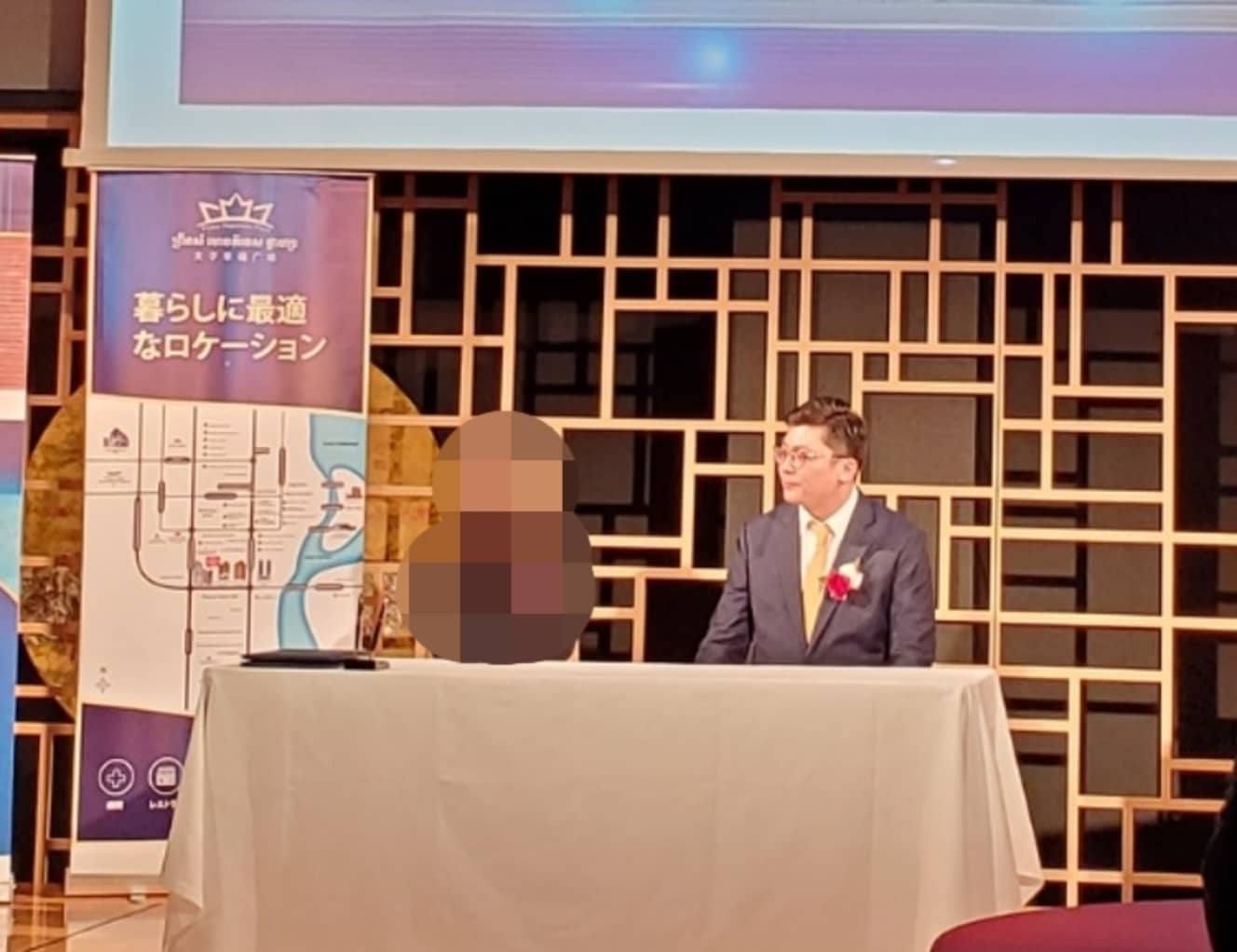
Happo-en in Shirokanedai, Minato Ward, Tokyo, known for its expansive Japanese garden and as a popular venue for weddings and banquets, hosted a strange press conference three years ago, on December 8, ’22.
The hall was lined with crown-shaped logos, and men and women in suits were chatting. On the podium, a portly Chinese man delivered a passionate speech.
“We will present on the appeal of Cambodia, the current state of Phnom Penh amid accelerating globalization including explanations of commercial facilities and properties.”
This is what the distributed materials stated. At first glance, it seemed merely an overseas real estate investment promotion event. However, the organizer of this event was none other than Cambodia’s massive conglomerate Prince Holding Group (太子集団控股, hereafter Prince Group), now under scrutiny by investigative agencies worldwide.
The man on the podium was Wang Yutang (Wang). About three years after this event, on November 4, ’25, he would be handcuffed by Taiwanese authorities, facing charges of money laundering and organized crime.
The situation escalated in October ’25. The U.S. Federal Bureau of Investigation (FBI) and British authorities indicted the Prince Group and its chairman Chen Zhi (Chen, 38), adding them to sanction lists including the U.S. Treasury Department. In an official statement released October 14, U.S. and U.K. authorities named the group and announced:
“Washington — Today, the U.S. Department of the Treasury’s Office of Foreign Assets Control (OFAC) and the Financial Crimes Enforcement Network (FinCEN), in close coordination with the U.K.’s Foreign, Commonwealth & Development Office (FCDO), took complementary measures against a criminal network targeting U.S. and allied nationals through online fraud and stolen funds laundering.”
In other words, the group was officially recognized not just as a fraud ring but as
“One of Asia’s largest transnational crime organizations.”
This announcement was shocking for those familiar with Cambodia’s economy, as the Prince Group had been considered a premier conglomerate representing the nation. Its headquarters in central Phnom Penh housed commercial complexes and a five-star hotel, while subsidiaries included Prince Bank and an airline. Chairman Chen, active in philanthropy, had earned immense credibility in society as a young and respected public figure.
〈Thousands of people gathered through human trafficking were imprisoned〉
However, the publicly released indictment reveals shocking details (the summaries within 〈〉 are from the indictment).
〈They built massive facilities in Cambodia, surrounded by high walls and barbed wire, resembling forced labor camps. Thousands of people gathered through human trafficking were imprisoned there, operating an organized phone farm. They set up a system to automatically control thousands of smartphones and millions of phone numbers, forcing the confined workers to send messages indiscriminately to targets worldwide. Furthermore, records show that Chairman Chen tolerated the torture of workers who failed to meet quotas, and specifically instructed subordinates, “Do not beat them to death (because they would no longer be useful as labor).”〉
〈The profits from their crimes were laundered through legitimate-seeming businesses such as real estate development and financial services. The corporate network, spanning over 30 countries, functioned as a laundering apparatus, not only in Cambodia but globally.〉
The U.S. Department of Justice has identified approximately $15 billion (around ¥2.25 trillion) worth of Bitcoin from assets managed by Chairman Chen. These assets have already been placed under U.S. government control, and the largest-ever forfeiture lawsuit in history has been filed.
Additionally, Singaporean police have seized 11 luxury cars, yachts, and real estate owned by Chairman Chen and his associates, totaling more than SGD 150 million (about ¥17 billion).
It is highly likely that this massive criminal organization had even infiltrated Japan. Returning to the opening story:
In December ’22, Wang served as the main speaker at an event held at Happo-en. The event was titled Cambodia Prince Real Estate Group Tokyo Presentation. The organizer, Prince Real Estate Group (the real estate branch of the Prince Group led by Chairman Chen), had Wang acting as CEO of the group’s Japanese branch, Prince International Real Estate, promoting the purchase of high-end Cambodian condominiums such as Happiness Plaza.
Attendees included Japanese investors and corporate executives. One executive from a consulting firm who attended the event recalled:
“Since it was an event by a Cambodian company, I participated out of curiosity. The hall was lined with Prince Group crown logos, and I think Wang was talking about ‘We want to expand our real estate business in Japan’ or ‘Why not invest in Cambodia?’ There were a few individuals who appeared to be executives of the Prince Group. I assumed Wang was the most important person and exchanged business cards, but there was one young man who seemed to be an executive. In hindsight, that man may have been Chairman Chen.”
The Japan-Cambodia Association that was exploited
A public-interest Japanese association also participated in this event.
“The Secretary-General of the ‘Japan-Cambodia Association’ gave a lecture on stage, so I thought maybe the association was sponsoring the event?” (the same executive)
The General Incorporated Association Japan-Cambodia Association was established in 1963. Its chairman is a former ambassador to Cambodia, the honorary chairman is Masahiko Takamura, and its board includes former foreign ministers and Takaharu Ando, a former commissioner of the National Police Agency—making it a highly prestigious general incorporated association.
Given the association’s long-standing history, why did it give a lecture at an event organized by the Prince Group?
FRIDAY Digital sent a questionnaire to the Japan-Cambodia Association, asking about the circumstances under which the Secretary-General gave a lecture at the event and about the association’s relationship with the Prince Group. In response, the association’s secretariat replied:
“Regarding this matter, the information our association can provide has already been given. Official documents are everything, and we will not respond to additional questions or new interview requests.”
The official documents referred to by the association appear to be releases posted on the website regarding the withdrawal of the Prince Group’s related Japanese companies. When asked again about the relationship between Prince Real Estate, which organized the Happo-en event, or the group’s chairman, Chen, the association stated:
“We are unable to provide any further responses to inquiries, including identifying individual company names or answering additional questions.”
As a result, this prestigious public-interest organization—comprising politicians and former bureaucrats—ended up participating in an event organized by an organization suspected of criminal activity, yet the truth behind this involvement was never revealed.
Wang, who had been delivering impassioned speeches at Happo-en, was arrested by Taiwanese prosecutors in November ’25. Wang had also been acting as the general manager (CEO) of the Prince Group’s Taiwan branch, Taiwan Prince.
Arrest in Taiwan and the base in Tokyo
The charges involve laundering criminal proceeds. It is alleged that money defrauded in Cambodia was sent to Taiwan via cryptocurrencies and other channels, and used for real estate purchases and online gambling businesses. Taiwanese authorities seized real estate and luxury cars worth NT$4.5 billion (approximately ¥20 billion).
What is even more astonishing is the existence of a Japanese base.
Among the executives arrested in Taiwan alongside Wang was a man named Lin Yangmao, who had served as a director of the Prince Group’s Japanese affiliate, Prince Japan.
This company had been a member of the Japan-Cambodia Association from June ’23 until this October, when the scandal came to light. This suggests that Taiwan and Japan may have operated as an integrated laundering route for the Prince Group.
Furthermore, it has been revealed that the group’s chairman, Chen, himself maintained a base in Tokyo’s Minato Ward.
The location is a prime luxury condominium in Kita-Aoyama. According to the registry, Chairman Chen had been officially residing there since January ’24.
Was their expansion into Japan aimed at laundering illicit funds obtained through fraud by investing in legitimate real estate development? Or did they have other objectives? The truth remains to be uncovered.


Interview and text by: Shinsuke Sakai