Ōita Fire Leaves 182 Buildings Destroyed, No Compensation Paid


Falling asleep while smoking or hot oil — Can you claim compensation if a fire spreads from a neighboring house?
A massive fire broke out in Saganoseki, Ōita Prefecture, on November 18. The fire that spread to a nearby island was eventually extinguished, and on December 4 — 17 days after the outbreak — the disaster response headquarters announced that the fire had been completely put out.
The fire destroyed 182 houses, covering approximately 49,000㎡. One death has been confirmed. While the cause is believed to have originated from a private home, investigations are ongoing.
Even smaller-scale fires than Ōita’s can cause damage from a neighboring house. Can the original fire source be held liable for compensation?
“Compensation can only be claimed if the fire originator is found to have acted intentionally or with gross negligence, according to the Fire Liability Act,” says Daisuke Izawa, head of Toranomon Sakura Law Office, who has handled numerous fire-related compensation cases.
Gross negligence refers to situations where the outcome could easily have been prevented with ordinary care, but it was carelessly ignored. Examples include fueling a kerosene stove while it is lit, or smoking in bed while heavily intoxicated.
What about leaving a frying pan unattended while cooking tempura, resulting in a fire?
“The conditions for a fire vary by case, and not every action is automatically considered gross negligence. In general households, simple forgetfulness like leaving a stove on rarely counts as gross negligence. It is extremely rare for ordinary households to be held liable for gross negligence,” Izawa notes.
He adds that he himself has seldom dealt with cases where ordinary households were held responsible for gross negligence.
“Even if neighbors suffer damage from a fire, lawyers will likely advise that claiming compensation is difficult.”
Cases where gross negligence is often recognized involve businesses handling fire professionally, such as restaurants.
“If a restaurant has liability insurance for the facility, the insurance company may pay compensation. Even then, whether gross negligence occurred is usually disputed, and in many cases, litigation is required to obtain compensation.”
If a Restaurant Fire Occurs, Is Compensation Paid? Cases Where Victims Cry Themselves to Sleep Even After a Verdict
At the end of 2016, a large-scale fire occurred in Itoigawa City, Niigata Prefecture. A total of 147 buildings were damaged, 120 of which were completely destroyed. The cause was attributed to a ramen shop leaving its stove unattended.
“In such cases, there is a high likelihood that a legal claim for damages can be recognized. However, whether compensation was actually paid is unclear. Even if the restaurant had liability insurance for property damage, the payout would generally be around 100 million yen.
It would not be enough to cover all affected households. Even if legal liability for compensation is recognized, if the perpetrator lacks financial resources, payment cannot be made.”
What about in cases where the fire is not large-scale, and only two or three houses are affected?
“Even if liability for compensation is recognized, it would likely be insufficient to rebuild a house. The amount of compensation for the damaged house is determined by its market value. If the building is old, only a modest amount will be paid.”
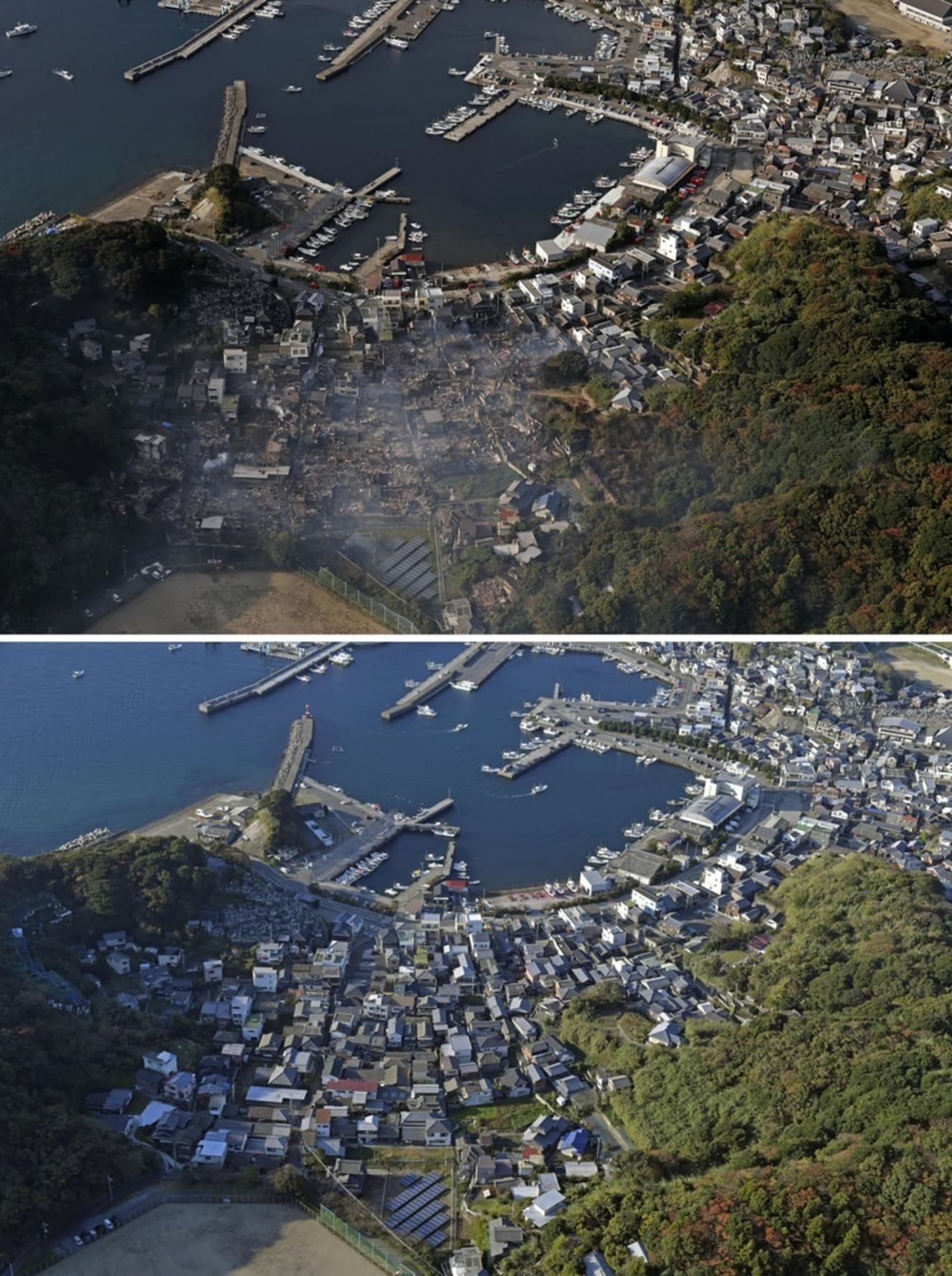 Oita City Saganoseki Fire: Spread of Flames Fueled by Multiple Factors. The site of the large-scale fire in Oita City Saganoseki, which burned nearly 50,000 square meters (top, 19th). Before the fire, many houses were lined up on land surrounded by mountains and the sea (bottom, December 2019).
Market Value vs. Replacement Cost: Fire Insurance Can Be Heaven or Hell for Rebuilding Lives
If a restaurant is not found to have acted with gross negligence, compensation may not be paid—and even if it is, it often comes only after a court or mediation process. The payout may still be insufficient to fully rebuild a home. So, what’s the best approach?
Key Point: Opt for Replacement Cost Coverage, “If your house suffers major damage from fire, you should have fire insurance that covers the replacement cost—the amount needed to rebuild a new home. This ensures you can reconstruct your house regardless of its age.”
Having fire insurance is crucial. Even if your home isn’t burned, damage from neighboring fires, such as water exposure, can be covered. This applies to both houses and condominiums. When taking out a mortgage for a condo, fire insurance is typically required. For condos, the insurance covers private areas, while shared spaces like hallways and elevators are covered by the building’s management association insurance.
For instance, in the large-scale Itoigawa City fire, according to the General Insurance Association of Japan, nearly ¥1.2 billion was paid out for 67 claims. That suggests 80 of the 147 properties did not file claims. While ¥1.2 billion sounds large, it averages less than ¥20 million per property—insufficient to rebuild many homes.
Adding replacement cost coverage provides peace of mind, though premiums can be 4–5 times higher than standard policies.
“Compensation from others is often unreliable. To rebuild your life after a fire, you must rely on insurance, balancing coverage and premiums. Personally, I focus on survival first, so my home insurance coverage is moderate.”
Ultimately, the best approach is prevention—avoiding fire in the first place.
Interview and text by: Izumi Nakagawa PHOTO: Kyodo News