Why is “YOASOBI” so strong? NHK Kohaku Uta Gassen: “How well the viewers are attracted to the music” – An in-depth analysis by generation!
Hiroshi Miyama's "Kendama" is not to be missed!


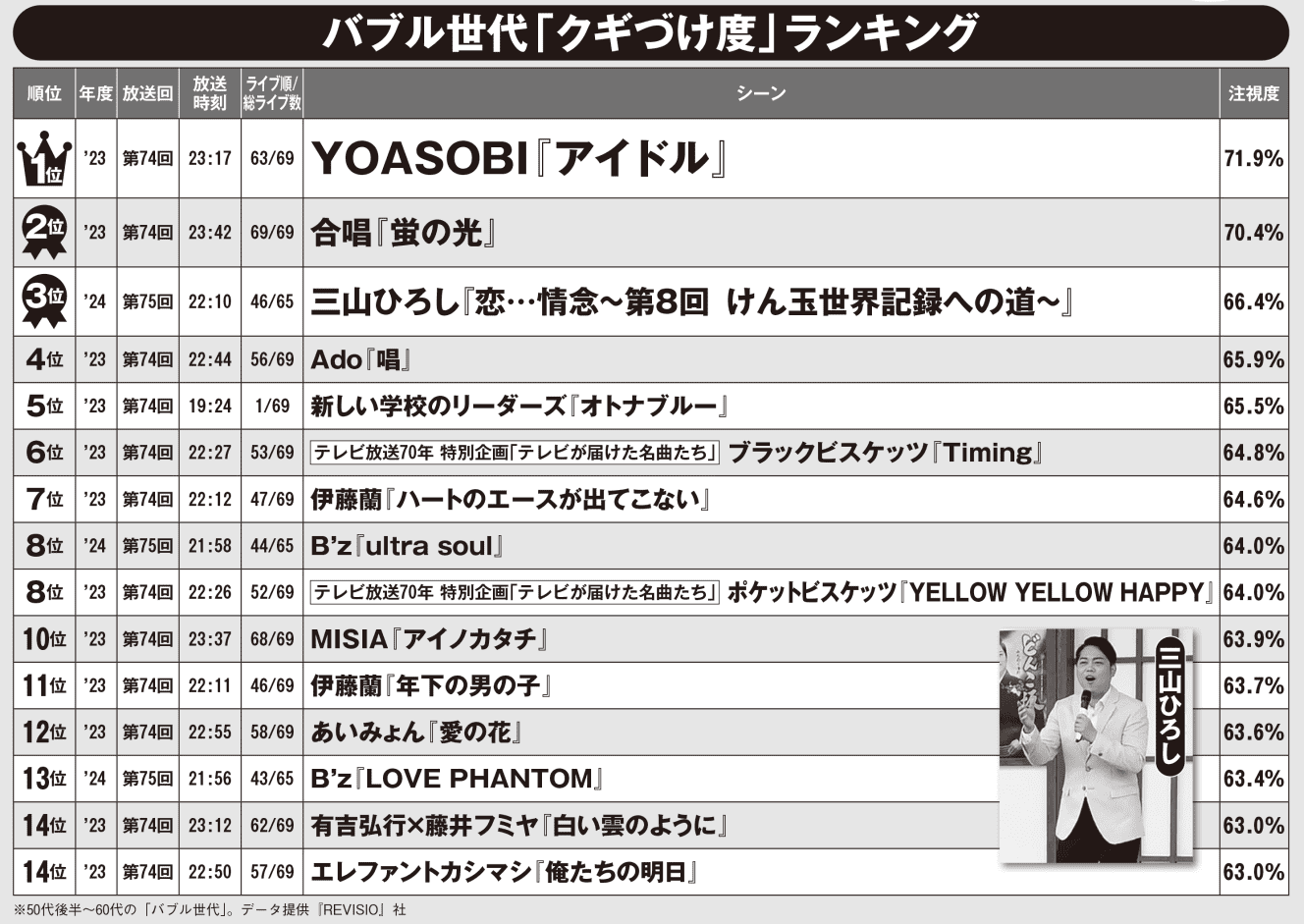
YOASOBI conquers three generations
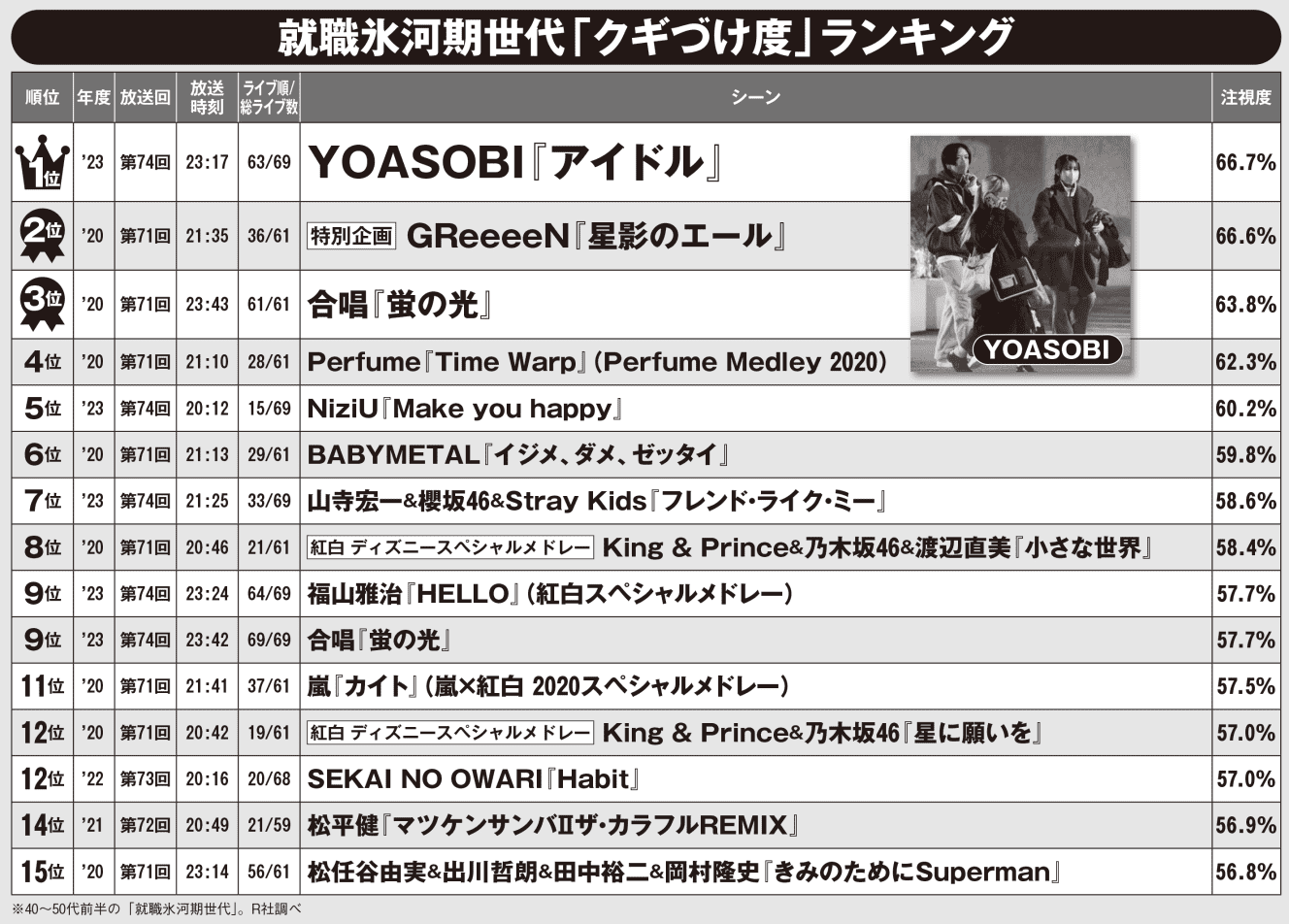
Here is the ranking. Of the four generations of the “Bubble,” “Ice Age,” “Yutori,” and “Alpha” generations, YOASOBI’s“Idol ” (74th edition in 2011) has won first place in three of the NHK Kohaku Uta Gassen held over the past five years.
The song had been streamed more than 500 million times (at the time), and since it was being performed for the first time on a Japanese music program, expectations were high even before it was broadcast. Moreover, in addition to top Japanese and Korean idols such as “Nogizaka46,” “JO1,” “NiziU,” and “LE SSERAFIM,” host Kanna Hashimoto and others participated in the collaboration stage. The spectacular production kept viewers entertained and attracted many generations.
Sori Yasutake, public relations and marketing manager of REVISIO (R), a TV viewing data analysis company, explains: “R conducted an in-depth study of which singers and song scenes from the 71st through 75th Kohaku (red and white) seasons from 2008 to 2012 kept viewers hooked on the show. The company conducted an exhaustive survey of which singers and songs from the 71st through the 75th Kohaku from 2008 through 2012 made viewers stick around. The top 15 were ranked according to the four generations introduced at the beginning of this report (see below for detailed measurement methods). Yasutake continues.
Although it is impossible to make a simple comparison, the percentage of viewership for regular variety shows can be said to be high if it is 50% or higher. In the case of Kohaku, the majority of programs exceed 60%. Moreover, the broadcast lasts more than four hours. The fact that it keeps viewers glued to the program for such a long period of time makes it one of Japan’s most popular programs to close out the year.
Let’s take a look at the program by generation. First, there is the “bubble” of viewers in their late 50s and 60s, according to Koki Mitsuhashi, Marketing Team Manager of Company R. “Scenes after 10:00 p.m. are the most popular,” he says.
There are 12 scenes that take place after 10 p.m.,” said Koki Mitsuhashi, marketing team manager at R Corp. The second most popular song is “Hotaru no Hikari” (Light of Fireflies), which is sung by all the contestants at the end of the show. The next program after Kohaku, “Yuku-nen Kuru-nen,” is also popular among the “Bubble Generation. It is likely that viewers who are looking forward to “Yukunen Kuru Nen” are paying close attention to it.
In third place was the Guinness World Record attempt to have 128 people in a row play kendama while Hiroshi Miyama sang “Koi…Kanren” (Love…Passion).
Just watching it makes me nervous, but even more so because the previous year’s event (the 74th in ’23) failed with the 16th player. The viewers must have been so excited to see if they could get revenge this time that they couldn’t take their eyes off the screen (a world record was set in the 75th contest in question),” said Mitsuhashi.

Junrei is No. 1 in the “Alpha Generation”!
Next is the “Ice Age Generation” in their 40s and early 50s.
The year GReeeeN’s “Hoshikage no Yell” came in second place (the 71st in ’20) was the first year the festival was held without an audience due to the COVID-19 crisis. The theme of the festival was “Let’s sing now, Yell with everyone. The symbol of this theme was “Hoshikage no Yale” (“Yale in Starlight”). The song is also the theme song of the morning drama “Yale. The song must have resonated with the “Ice Age Generation,” who had a tough time with Corona and often watch morning dramas.
What about the “Yutori” generation in their 20s and 30s?
What about the “Yutori” generation in their 20s and 30s? “This generation has small children, and in many cases, both parents and children watch these dramas together. Many songs that they can sing and dance along with their children were ranked in the top 10, such as “Jambori Mickey! and Ken Matsudaira’s “Matsuken Samba II” (No. 4) are probably familiar to kindergarten playground games and elementary school athletic meets, while “Brother Beat” (No. 3) is another dance number by Snow Man that is very popular among elementary school students and their parents.
It is the playful element that sticks with “Alpha,” which is mainly composed of teenagers. Mr. Yasutake explains.
It may seem surprising that Junrei’s “Give Me Love,” which is popular among middle-aged and older women, is No. 1. The scene was a device in which the viewer pressed the “decision” button on the remote control, and the red and white flowers danced wildly as the number of times exceeded 5 million, 10 million, and so on. The second-place winner, “Small World” by King & Prince, Nogizaka46, and Naomi Watanabe, also featured a famous scene from a Disney movie, and many stuffed animals made an exciting appearance.
Entertainment journalist Yuka Sakaguchi said.
For the 50-plus generation who watch until the end, Kohaku is a ‘big New Year’s Eve event,’ but for the younger generation who watch in the early hours before 9:00 p.m., it is a ‘content for watching interesting scenes. It is changing from a program that is watched by the whole nation as a family to a medium that is enjoyed separately by each generation.
What will be the best scenes in this year’s Kohaku that will make each generation stand out from the rest?


NHK Kohaku Uta Gassen” Measurement Method
R Corp. conducted an independent survey to determine the degree to which people in front of the TV screen were looking at the screen. The degree of gazing was measured based on the number of seconds spent looking at the TV screen. When people are “watching while cooking” or doing other tasks, they are often not looking at the screen, so the degree of fixation does not increase. With the cooperation of about 2,000 households (about 4,800 people) in the Kanto region and 600 households (about 1,500 people) in the Kansai region, we conducted an independent survey to determine which scenes of the artists and celebrities who participated in the Kohaku Uta Gassen were watched by the viewers. The percentage of viewers’ attention to the popular scenes in Kohaku exceeded 60%, while the percentage of viewers’ attention to ordinary variety shows was about 50%, indicating the high level of attention paid to the Kohaku Uta Gassen. The survey covered the 71st through 75th seasons (5 years from ’20 to ’24). It shows a big difference in popular scenes among generations.
From the December 12, 2025 issue of FRIDAY
PHOTO: Kumataro Arai, Ichiro Takatsuka, Kazuhiko Nakamura, Shinya Nishizaki, Shinji Hamasaki, Kyodo News