Suzuki, Imanaga, Kikuchi—How Did They Perform? Evaluating 14 Samurai Japan Players in MLB for 2025
Special Report


Shohei Ohtani and Yoshinobu Yamamoto are in a league of their own —
How well are the other Dodgers’ trio performing?

This season, in which the Dodgers achieved back-to-back World Series titles, the Japanese player who earned World Series MVP—becoming only the second Japanese in history to do so after Hideki Matsui (51) in 2009—was not Shohei Ohtani (31), but Yoshinobu Yamamoto (27).
“Without him, the Dodgers might not only have failed to repeat—they might not have even reached the World Series. His performance was legendary.” —Former MLB pitcher Keiichi Yabu
Of course, the combined success of Yamamoto and Ohtani led the Dodgers back to the top of the baseball world, but the awakening of Roki Sasaki (24) was also a crucial piece.
“After coming back from injury, manager Dave Roberts (53) made the bold decision to move him to the bullpen—and it worked perfectly. In the postseason alone, he provided performance worth a 1-billion-yen salary.” —MLB analyst Nachi Tomonari
The Japanese media talked daily about the Dodgers’ “Big Three,” but they weren’t the only Japanese players in the majors. So FRIDAY compiled the season statistics of Japanese MLB players and gathered evaluations from three experts, including Yabu, to create overall ratings and skill charts.
With this report card, let’s look back at the 2025 season.


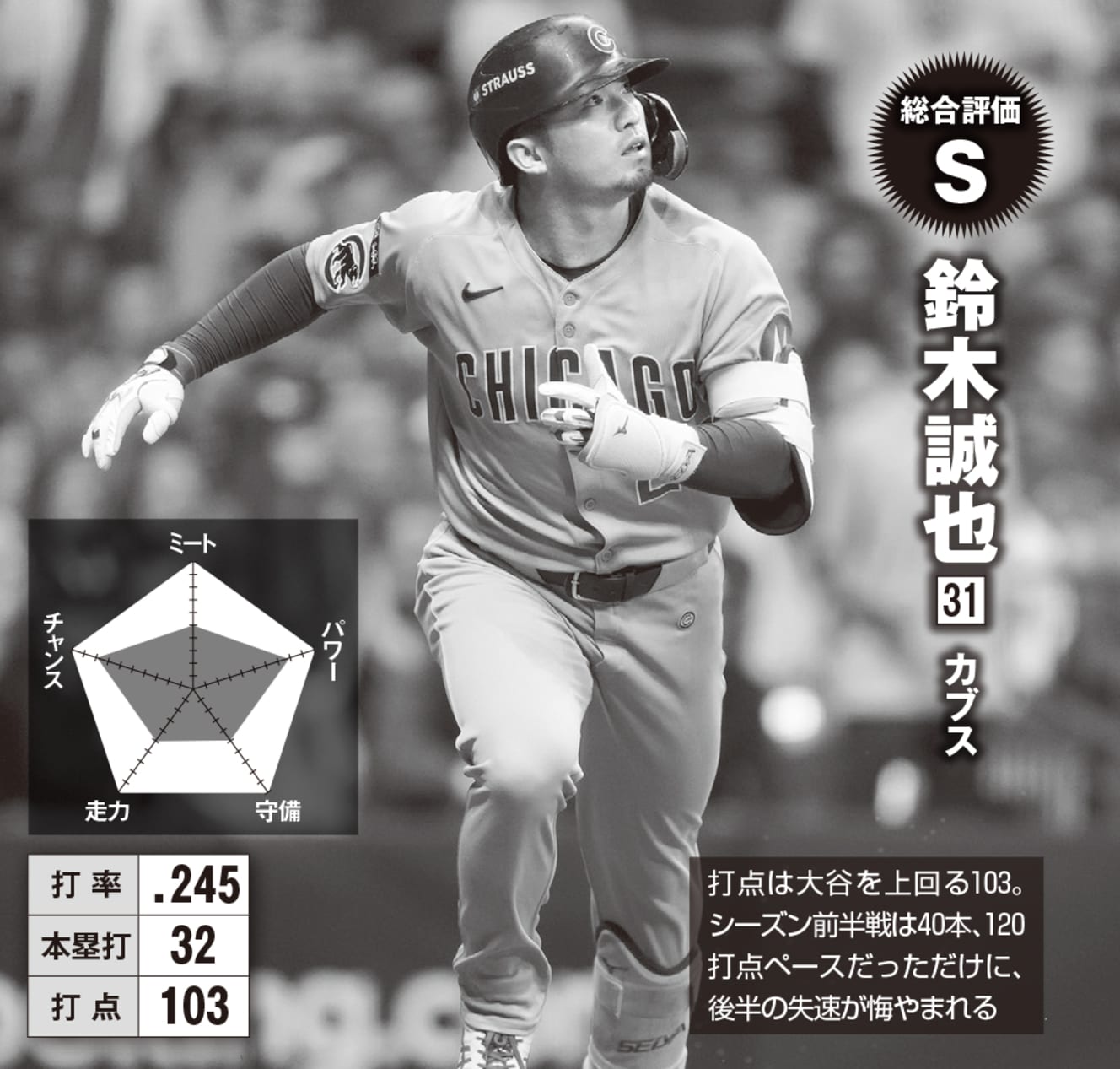
“Aside from Ohtani, the hitter who performed best this year was Seiya Suzuki (31) of the Cubs. His batting average was .245, lower than last year, but he hit 32 home runs, surpassing Hideki Matsui’s record of 31. This is the second-highest total ever by a Japanese MLB player, behind only Ohtani. He also cleared 100 RBIs, which adds to his evaluation. However, once he stops hitting, his slumps tend to last a long time. This instability lowers his rating a bit.” —Nakahiro Tokutsu, NPB analyst
Suzuki’s teammate Shota Imanaga (32), who won 15 games as a rookie last season, finished this year with only nine wins.
“Because of a thigh strain, he missed time and pitched fewer innings, which was unfortunate. His outstanding debut season also meant opposing lineups studied him seriously, and that affected his numbers. But that simply means rival clubs now recognize Imanaga as an elite pitcher. His ability is top-class even in MLB.” —Former MLB pitcher Keiichi Yabu
For the Mets’ Kodai Senga (32), things changed drastically after he missed time due to a hamstring injury. He had a stunning 1.47 ERA at the end of June and seven wins, but after returning, he didn’t win a single game.
“His first-half performance was undoubtedly the best among Japanese players. But in the second half, he gave up too many home runs. Instead of experimenting with too many new breaking balls, if he had relied more on his trademark forkball with confidence, his numbers might have been different.”—Yabu
While many pitchers struggled with injuries, Yusei Kikuchi (34) of the Angels delivered steady production all year.
“He went 7–11, so the win–loss record doesn’t look great, but he often pitched on four days’ rest and worked as an innings-eater. MLB pitchers miss a lot of time, so Kikuchi’s durability gives him a high evaluation.”—Analyst Nachi Tomonari
Two Padres pitchers—Yu Darvish (39) and Yuki Matsui (30)—who battled the Dodgers’ Big Three for the NL West title, did not have seasons they could be satisfied with.
“Darvish was expected to perform like an ace, but he missed time from Opening Day to mid-season, and even after returning, his ERA stayed in the 5s. He underwent elbow surgery and will miss all of next season, and with his large contract, he has become a burden for the team. Matsui contributed by appearing in over 60 games as a reliever, but he wasn’t included on the postseason roster. Next year, he needs to move beyond mop-up duty and become a true setup man.”—Tomonari
Two rookies, Tomoyuki Sugano (36) of the Orioles and Shinnosuke Ogasawara (28) of the Nationals, felt the harsh reality of MLB in different ways.
“Sugano racked up wins in the first half with his crafty pitching, but stamina and velocity were issues, and he faded later on. He struggled against MLB hitters whose ability to adjust goes beyond what experience alone can overcome. As for Ogasawara, he needs improvement across velocity, command, and breaking pitches.”—Yabu
Kenta Maeda (37), who was released by the Tigers and moved through the Cubs and Yankees organizations, has announced he will return to Japanese baseball. He is rumored to be joining the Giants, Sugano’s former team.
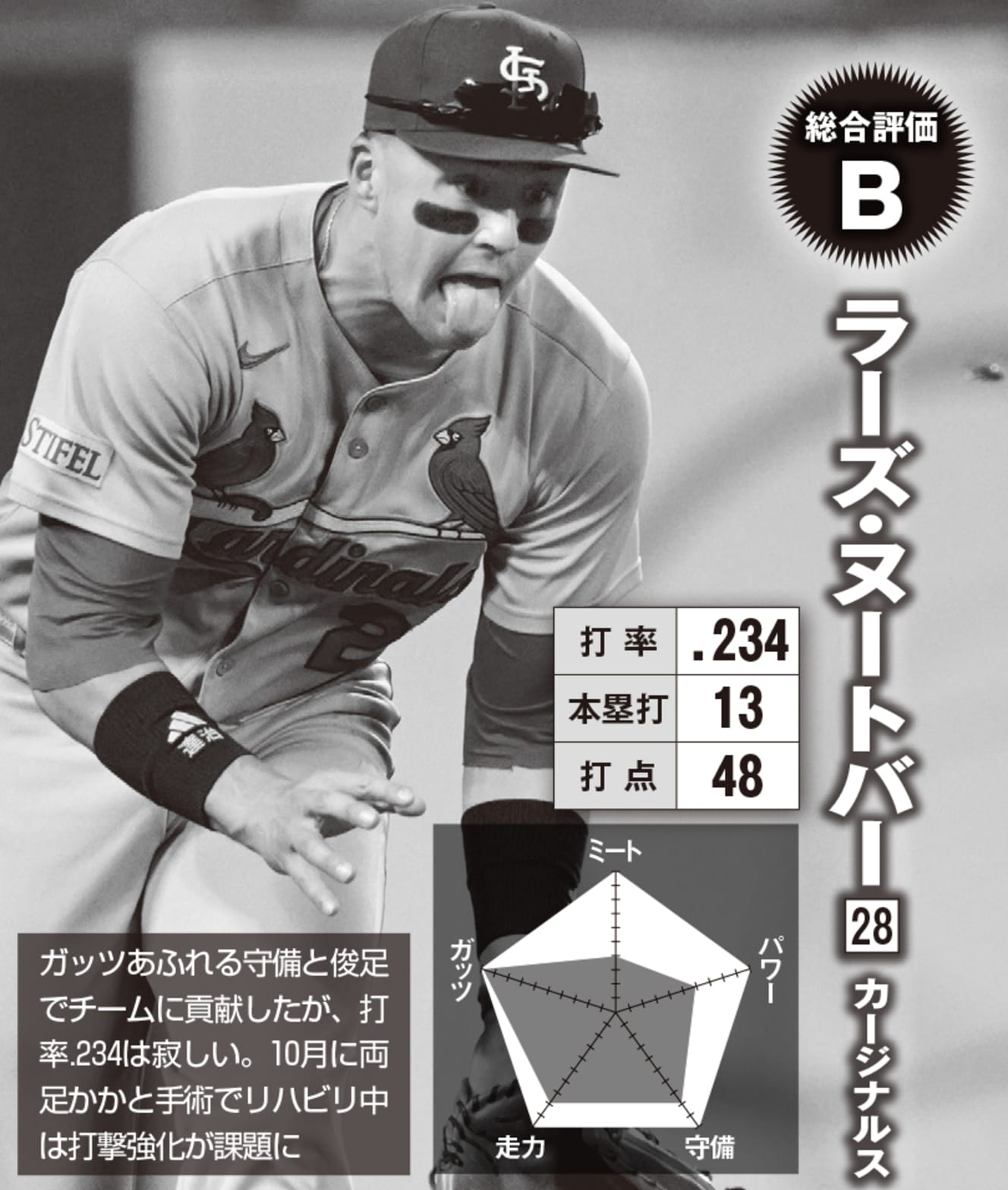
For the Red Sox’s Masataka Yoshida (32) and the Cardinals’ Lars Nootbaar (28)—both of whom patrolled the outfield together in the 2023 WBC and helped Japan become world champions—this season brought both achievements and challenges.
“Yoshida still has extraordinary bat control, but hitting .266 while often playing DH is underwhelming. However, he was the team’s best hitter in the postseason, so he should rebound next year. Nootbaar is known for speed and defense, but he just can’t hit (laughs). He has power, so once he heals up, he needs to focus on improving his contact rate.” —Tokutsu
If only the Dodgers’ Big Three stand out, MLB becomes less exciting. Next season, which Japanese players will rise to match them?




From the November 28 and December 5, 2025 issue of “FRIDAY”
PHOTO: AFLO