Tomohisa Ōhzeki on Mastering the 140 km/h Fastball—Full Interview and Insights Into His Approach
Left-handed ace overcame the removal of a tumor due to suspected testicular cancer.


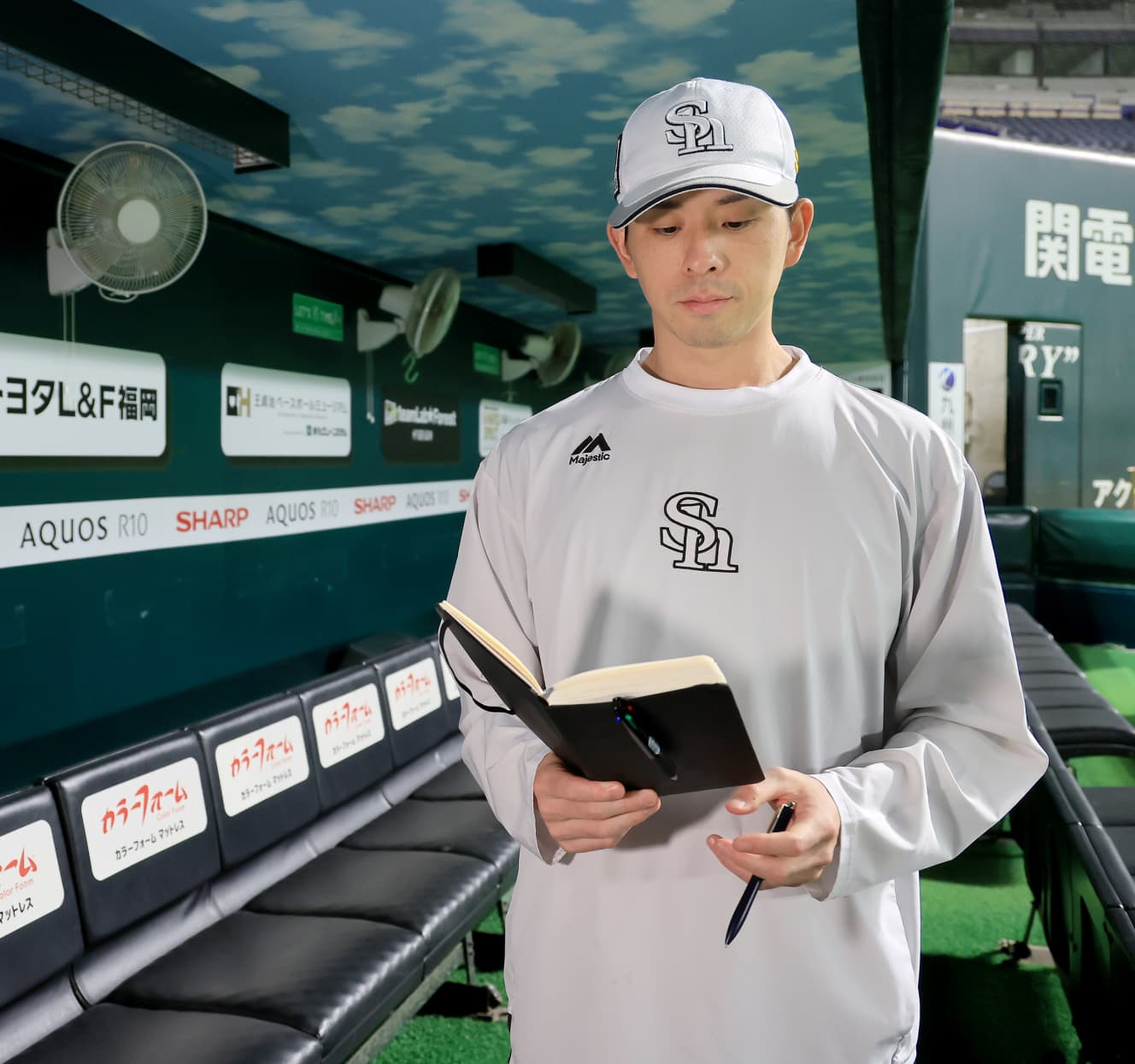
He never lets his notebook out of his sight
“Three years ago, I relied on a fastball that topped out at 152 km/h. But this year, no matter how hard I threw, it was mostly in the low 140s.”
Despite that drop in velocity, SoftBank’s Tomohisa Oozeki (27) made a huge leap forward this season. He posted the best winning percentage in the Pacific League (.722), a personal-best 13 wins (5 losses), and a 1.66 ERA, performing at an ace level.
Being able to shut batters down with a slower fastball—could he be throwing some kind of magic pitch that doesn’t show up on the radar gun? Yet even the SoftBank team analysts, equipped with cutting-edge technology, were puzzled:
“Even after checking all the detailed data, both his fastball and breaking pitches are average statistically. We don’t understand why he wins,” one analyst said, scratching his head.
So where is the secret? When asked, Ohzeki produced a large notebook with a black cover.
“I keep this notebook with me at all times. I bring it to the bench during games. Before pitching, I form hypotheses—then on the mound, I test them and gather data. The moment I return to the bench, I jot down everything I noticed.”
He continues:
“Based on sports psychology principles, writing in my notebook helps me put my insights into words and organize my thoughts.”
Sports are often described in terms of mind, technique, and body, but today’s sports world, driven by technological advances, tends to prioritize quantifiable elements—technical improvement and physical conditioning. The first character, mind, often ends up neglected.
“Once, a senior SoftBank pitcher said, ‘For me, body is number one.’ That sparked a debate among the pitchers. I believed all three were important, but as I reflected on myself, I realized I’d been prioritizing sharpening my technique and strengthening my body more than cultivating my mind.”
A Pitch From the Soul
Ohzeki is a true grinder. He never went to Koshien in high school, and even at Sendai University he wasn’t the ace. He entered the pros as a developmental draft 2nd pick.
“Still, ever since I was three or four years old, sitting next to my dad watching baseball on TV, I vividly imagined myself becoming a pro baseball player and performing on the first team someday. I grew up without ever doubting that image.”
Ohzeki laughs, calling it confidence without any basis. Even so, in his second year he earned a full roster spot. In his third year (2022), he won a place in the Opening Day rotation, made his first All-Star team, and was even chosen as the starting pitcher for Game 1—his dreams coming true in rapid succession.
But about a week after standing on that glorious mound, he found himself lying in a hospital bed. He was diagnosed with suspected left testicular cancer and immediately underwent tumor removal surgery.
“I put life before baseball. I was scared and anxious. But I didn’t feel like I’d been thrown into the bottom of a pit. Not being able to stand on the mound made me realize again how much I truly love baseball. And fortunately, my recovery period was short—I was able to return to pitching in about two months.”
The following year, 2023, he was chosen as the Opening Day starter. It seemed like smooth sailing again, but he struggled with poor performance.
“I needed to change something, so in the 2023 offseason I bulked up to over 100 kg. But I gained not only muscle—also fat. I realized that during the next spring camp, and that’s when I turned to sports psychology as a new approach.”
Ohzeki bought five psychology books, and the one that resonated most with him was by sports psychology PhD Tsutomu Fuse.
“I studied from books last year, then around a year ago I contacted Dr. Fuse and began training with him directly.”
In sports psychology, the first step is defining your personal ideal.
“I heard that speed skater Nao Kodaira pursued the ultimate glide, and gymnast Kohei Uchimura pursued the ultimate gymnastics. Not the result, like a gold medal, but the performance itself. So I chose a pitch from the soul. To achieve an ideal built on mind, technique, and body, I write down every insight in my notebook immediately.”
When he boiled everything down, he concluded that what he needed wasn’t a 150 km/h fastball—it was a refined pitching form. Hitters struggle not only because of measurable factors. His answer was a pitching motion he describes as load, set, and pull, executed smoothly to give life and carry to the ball.
“I think baseball is both art and science. If art is the example, Ichiro’s batting would be perfect. He would intentionally get jammed and still produce a hit. Getting jammed is usually a loss for the batter—but if it becomes a hit, then Ichiro wins, right? On the other hand, even a hard-hit ball can go straight to a fielder and become an out.
Speed and power—the measurable stuff—is the science. But baseball still has aspects that can’t be explained by numbers. The fact that I can get outs throwing in the 140s is its own kind of art. Wanting to experience real art, I even went to museums during the season. I haven’t quite connected it to my pitching yet (laughs). But once you start sports psychology, there’s no finish line. I feel like the era of the mind is coming. That’s just my personal belief.”
Perhaps a time is coming when baseball itself will be called art.


From the November 14-21, 2025 issue of “FRIDAY”
Photo by Ryoji Shigemasa: Ryoji Shigemasa Interview and text by: Kotaro Tajiri