Koizumi-Era Deregulation Behind Mega-Solar Resale Troubles


The problematic Kushiro Wetland megasolar project is now owned by foreign capital
A series of new issues has emerged regarding the megasolar power plant being developed near the Kushiro Wetland National Park in Hokkaido by Osaka-based Nihon Ecology Co.
The company planned to install about 6,600 solar panels on approximately 4.2 hectares of private land in Kushiro City. However, in September the project was halted after violations of the Forest Act, the Land Embankment Regulation Act, and inadequate surveys of protected species were revealed. In October, violations of the Soil Contamination Countermeasures Act were also discovered.
But that was not all. It has also come to light that the planned construction site had been sold—first from Nihon Ecology to a company in Aichi Prefecture, and then in March of this year to the Japanese subsidiary of a Singaporean firm. According to the Hokkaido Shimbun, this Japanese subsidiary is set to acquire ownership once the megasolar facility is completed.
“I suspect Nihon Ecology intended from the beginning to acquire the land for the purpose of reselling it,” says Professor Tomohiko Nakamura of Kobe International University, an expert in regional economics (quotes below are all by Prof. Nakamura).
“We have no idea what the Singaporean company’s strategy is in buying the planned solar site. They could resell it to a third country; we simply don’t know what direction this will take.
If trouble arises, what happens then? Nihon Ecology, having already sold the land, is in principle no longer responsible. If ownership keeps getting transferred to overseas companies, it’s entirely possible that the land could end up owned by a company from a nation hostile to Japan.”
Nihon Ecology began construction on the megasolar site near Kushiro Wetland in March—the same month the land was sold to the Singaporean firm. The company had already been penalized in Yamaguchi Prefecture for repeated violations of the Construction Business Act in another solar project.
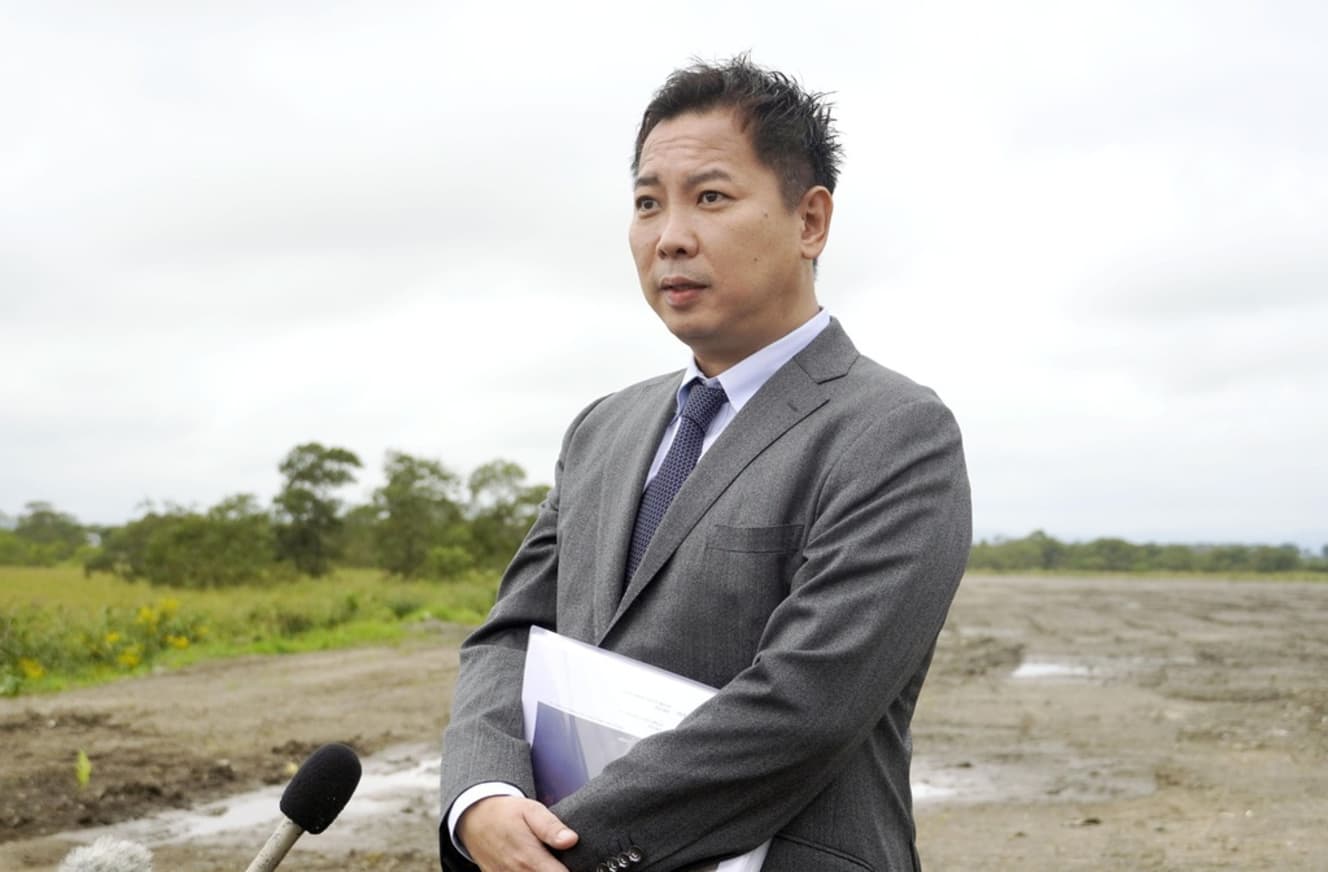
“The president of Nihon Ecology appeared before the press and explained everything confidently. He had absolutely no intention of taking responsibility—because once he sells the land, he no longer has any. He attended the press conference based on that assumption.”
Problems involving the resale and transfer of megasolar project sites are occurring across Japan.
“How does the megasolar business work? Developers first purchase land—often worthless plots once involved in fraudulent wilderness land schemes—from owners for next to nothing, and then install solar panels.
Of course, some companies carry out power generation legitimately, but bad actors solicit investments and then subdivide and sell the land together with the solar facility. Once they sell it, they bear no further responsibility. I believe many of the megasolar projects currently under construction are intended primarily for resale.”
The Problem Is That We Haven’t Eliminated Bad Actors
The rapid spread of megasolar projects in Japan began with the introduction of the Feed-in Tariff (FIT) system for renewable energy in 2012.
This system—mandated by the 2012 Act on Special Measures Concerning the Utilization of Renewable Electric Energy—requires electric utility companies to purchase electricity generated from solar and other renewable sources at government-set prices for a fixed period.
“Looking back at the solar power situation, around 2008 major companies like Sharp, Sanyo, and Panasonic began building large panel factories along the Osaka bay area, expanding into LCD and solar panel manufacturing.
In 2009 the surplus power buyback program for residential solar systems began, and in 2012 the FIT system launched. When the system shifted from buying only surplus electricity to buying all generated electricity, many companies saw business potential and entered the megasolar market.
However, as FIT buyback rates were later revised downward, many companies withdrew. Domestic panel manufacturers also lost market share to overseas competition and were forced to exit the business. At that point, the original purpose of supporting the domestic panel industry had already evaporated, and the subsidy system should have been reviewed.
But cheap Chinese and Korean solar panels kept flowing into Japan, driving prices down and reducing investment costs. As a result, megasolar construction continues.”
Still, renewable energy—which reduces greenhouse gas emissions and improves energy self-sufficiency—is now indispensable. Prof. Nakamura also says:
“Introducing solar power itself is not wrong. The real issue with megasolar projects is that we haven’t eliminated unscrupulous developers who pursue profit alone.”
In 2020, under the Suga administration, then-Environment Minister Shinjiro Koizumi announced regulatory easing to allow renewable energy power plants to be built within national parks. This easing has been criticized as having accelerated unchecked megasolar development inside national parks.
“Whether it’s solar or wind, Japan has very little land suitable for commercial-scale renewable energy. That’s why regulations were loosened to allow such facilities within national parks if certain conditions were met—but once you relax rules, some developers will inevitably abuse them. So the government should have created laws to crack down on such abuses. That mindset was missing.
This time, violations of environmental laws and resale to foreign companies were exposed in the symbolically important Kushiro Wetland, so the issue has drawn attention. But in reality, problems surrounding megasolar projects have occurred all over Japan for the past decade. There have even been cases involving trouble with foreign-owned megasolar developments.
Yet the government has failed to implement effective, fundamental countermeasures. Because renewable energy promotion was a national policy, the government had a responsibility to create laws to curb improper practices.”
Legal development that has been left unaddressed for more than ten years
According to a survey by the Hokkaido Shimbun, as of August, there are about 450 mega-solar facilities in Hokkaido using the FIT system, and roughly 20% of them are foreign-owned. Although Japan Ecology Co. does not use the FIT scheme, it is believed that there are many non-FIT facilities in the region as well—and foreign companies are likely involved in those too.
“For example, when I lived in Singapore, there were extremely strict regulations on land purchases by foreigners. Not only in Singapore but in many countries, areas around airports, ports, military facilities, national parks, or important water sources are heavily regulated. The idea that foreigners could purchase land right next to a Self-Defense Forces base—as happens in Japan—would be unthinkable overseas.
Japan should also impose strict regulations to prevent foreigners from owning land near military facilities, locations tied to national security, and even around national parks such as the Kushiro Wetlands. International relations are fundamentally based on reciprocity. It makes no sense that citizens of countries that restrict land purchases by Japanese nationals are free to buy land in Japan.”
The government plans to strengthen regulations on mega-solar developments that cause environmental destruction or disaster risks, and toward this end, it aims to revise or review 16 laws and compile a policy package by year-end, led by the Ministry of Economy, Trade and Industry and the Ministry of the Environment.
“National-level problems like mega-solar development must be addressed through national legislation. Local governments are creating ordinances and guidelines, but without penalties, it’s difficult to restrain developers.”
According to the Local Autonomy Research Institute (Tokyo), as of September 17, municipalities across Japan have enacted 326 ordinances regulating the installation of solar power equipment.
In response to the mega-solar issue at the Kushiro Wetlands, the city of Kushiro also enacted an ordinance this year to regulate the construction of industrial solar power plants with outputs of 10 kilowatts or more. Mayor Hidenori Tsuruma has requested that the Ministry of the Environment establish laws that would allow such development to be regulated.
“Local government employees feel extremely frustrated. For more than ten years, people on the ground have been saying, ‘We want to stop illegal projects, but we can’t because there are no laws.’ While municipalities across the country are accelerating the creation of regulatory ordinances, national legal reforms have not kept pace. The national government must urgently amend the law to halt the disorderly construction of mega-solar facilities.”
▼ Tomohiko Nakamura — Professor, Faculty of Economics, Kobe International University.
Graduated from Sophia University (Faculty of Letters) in 1988. Completed doctoral coursework at Nagoya University Graduate School of International Development in 1996. Worked for Thai Airways, PHP Research Institute, and the Osaka Prefectural Institute of Industrial Technology. In current position since 2007. Specializes in regional economic studies and contemporary Japanese industrial studies.
Interview and text by: Sayuri Saito PHOTO: Afro (1st photo), Kyodo News (2nd photo)