NHK Party Suspect Takashi Tachibana, who “Causes Terrorism,” Has 17 Items of “Illegal Acts and Statements” Found to be True in a Civil Trial


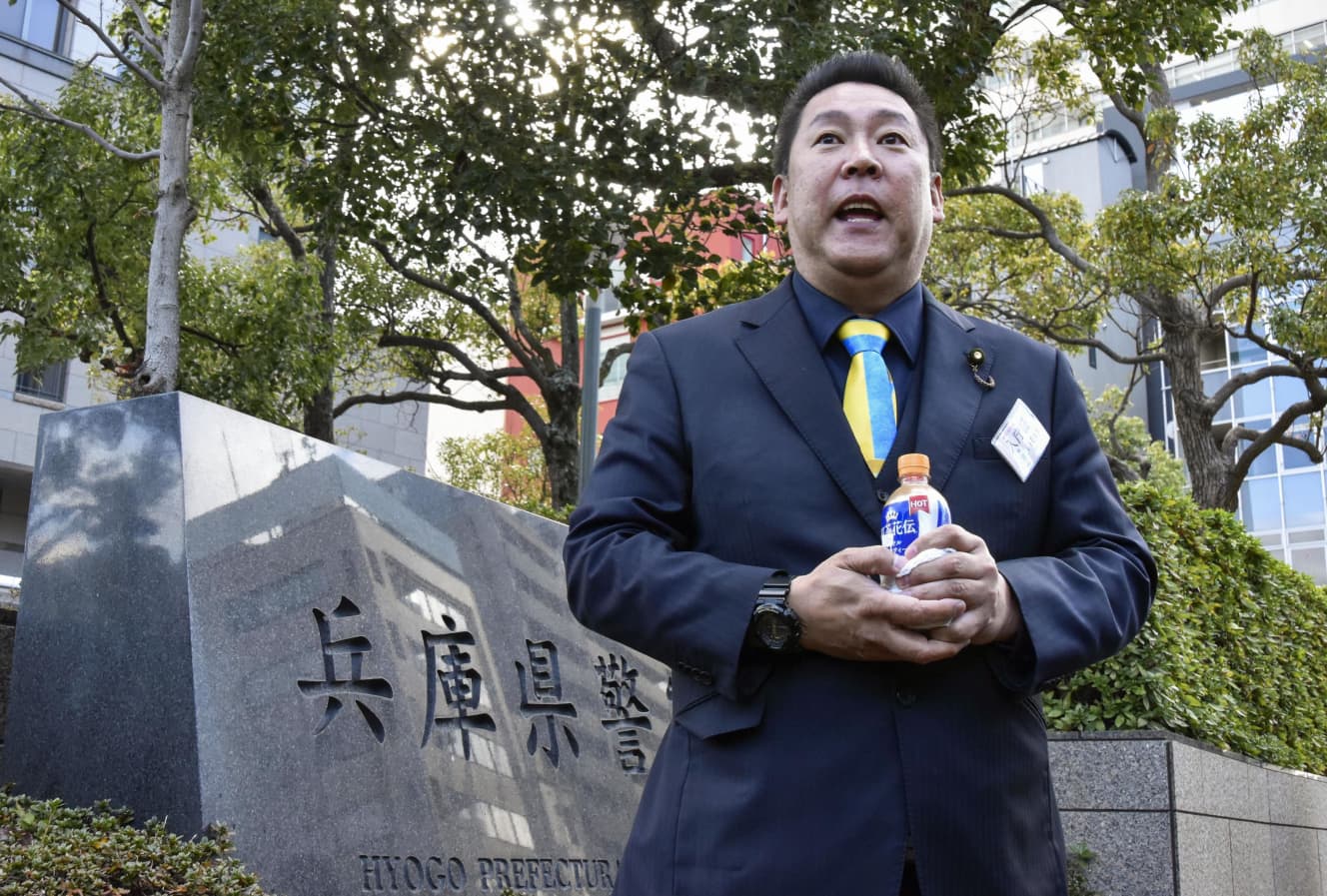
His own words and actions “are not illegal.
The Takeuchi councilor, who left without saying anything, is in a bad way. He is probably being interrogated by the police.”
The suspect, Takashi Tachibana, 58, leader of the political group “NHK Protecting People Party,” grabbed the microphone and said these words during a street speech in the Izumiotsu mayoral election in Osaka Prefecture. Hideaki Takeuchi, the former Hyogo Prefectural Assembly member he named, had been a member of the Article 100 Committee investigating the prefecture’s whistle-blowing documents, but resigned from the assembly last November. In January of this year, he took his own life.
Tachibana’s “tongue” did not stop even after Takeuchi’s death. On his SNS, he wrote
Takeuchi, a former prefectural assembly member, had been under continuous voluntary questioning by the Hyogo Prefectural Police since around September of last year.
Apparently, he was scheduled to be arrested tomorrow.
The postings included such statements as “Takeuchi was scheduled to be arrested tomorrow,” “He was arrested tomorrow, apparently. On November 9, the Hyogo Prefectural Police arrested Tachibana on suspicion of defamation. This was an unprecedented arrest of a political party leader who was on probation. It is unusual to file a defamation case against a dead person.
The suspect, Tachibana, stated at a press conference held in August in response to the charges against him: “I don’t dispute that I defamed him.
I don’t dispute that I defamed him, but I made the statement with sufficient grounds to dismiss the illegality of the statement.
His words and actions were justified and not illegal. It remains to be seen whether this argument will hold up in this criminal case, but in fact, the judiciary has already given a clear “no” to Tachibana’s illegal acts and statements in past civil trials. If you unravel the text of the judgments, you will understand that this arrest was an inevitable outcome that was bound to happen.
The scene was the Tokyo District Court in November 2012. The plaintiff was the “Party to Protect the People from NHK” and the defendant was “Election Watcher Chidai. The case started when Mr. Chidai bitterly criticized the NHK Party on his X (formerly Twitter) and video feeds, calling it an “antisocial cult group” and “like an Aum that doesn’t spray sarin gas.
The NHK Party filed a lawsuit against the group, claiming that it had defamed its reputation and demanding 1.6 million yen in damages. Common sense dictates that expressions likening a person to a cult or terrorist organization could be considered libelous.
Even if Declared an “Anti-Social Cult Group,” NHK Party Loses the Lawsuit
However, the court decision was a “total defeat,” dismissing all claims by the NHK party.
Why was such radical expression “unimpeachable”? The answer lies in the attached document on which the court based its decision. It was a “list of facts” submitted by the defendant Chidai’s side, claiming that “we have this much basis for our criticism.
It listed numerous illegal acts and statements made by Tachibana and NHK party officials in the past. Surprisingly, the court officially recognized 17 out of the 18 items listed as “facts.
The court’s decision reads as follows (quotations in parentheses below are from the editor’s note).
The above opinion or commentary is based on the following facts: (i) the plaintiff’s representative (editor’s note: suspect Tachibana) has been engaged in political activities, including organizing political groups, since at least 2013; (ii) the plaintiff’s representative, his related persons, and his supporters have repeatedly committed criminal and illegal acts in the course of the above political activities; and (iii) the plaintiff’s representative has clearly expressed his intention not to comply with the law, The court finds that the allegations are based on the fact that the plaintiffs’ representatives, their associates, and supporters have repeatedly committed criminal and illegal acts in the course of the aforementioned political activities, and have clearly expressed their intention not to comply with the law, have even mentioned the possibility of terrorism and ethnic genocide, and have provided and encouraged illegal and disruptive acts as a service to the general public, and are found to be true in the main part.
In other words, the court,
In other words, the court concluded that “the expression ‘antisocial cult group’ is based on Tachibana’s own criminal and illegal acts, and because the basis for the expression is true, it is permissible as a commentary.
The court concluded that “the expression ‘antisocial cult group’ is based on Tachibana’s own past criminal and illegal acts.
What exactly were the 17 acts and statements that the court found to be “true”? In this article, we would like to introduce some of them, quoting from the “List of Facts” attached to the judgment.
Acts and Statements 1] Assault and Physical Restraints
First, direct acts of violence. In 2001, Tachibana, together with a sympathizer, assaulted an employee of an NHK contractor,
The suspect grabbed the employee’s arm, pulled him down, put his face in a headlock, and physically restrained him for about 40 minutes.
They restrained him for about 40 minutes. This fact was admitted by the NHK party at the trial, and was found to be an undisputed fact.
(2) “Personal attacks” that incited supporters
The court also found that he directed his supporters to personally attack his critics. In December 19, he incited his supporters in this way about an author who had published a book about his political organization.
He instructed them that he would give them the author’s address and that they should make a fuss in front of his house because the author had a wife and children.
This is a very bad thing to say about journalists and writers. This is an extremely malicious act that could be taken as a form of suppression of speech against journalists and writers. The NHK party also claims that it “acknowledges the fact, but disputes the assessment” of this instruction.
Publicly stated that he “doesn’t obey the law.”
Convicted Criminal Acts
Tachibana’s actions were not limited to mere trouble, but included several criminal acts that actually resulted in criminal penalties. For example, the case of illegally obtaining NHK’s trade secrets. On January 20, 2010, he was convicted of violating the Unfair Competition Prevention Law for illegally obtaining 50 pieces of subscriber and other information recorded on a mobile terminal for business use.
Authorized Acts and Statements 4] Publicly stated that he “doesn’t obey the law.
And the following statement symbolizes his attitude toward the legal code. At a party board meeting in July 2008, suspect Tachibana said
‘We want to sell the fact that we are a party that does not abide by the law, and we want to sell something like, “We don’t abide by the law,” or “We put justice and morality before the law.”‘
Also, in a speech in support of his campaign for city councilor,
(Editor’s note: The NHK Party is a political party that engages in illegal activities, and made statements to the effect that it would protect those who engage in illegal activities and do not pay NHK’s subscription fees.
These statements were also recognized as facts by the NHK Party, which stated , “We acknowledge the facts, but dispute the assessment.
(Authorized act/statement 5) “Terrorist threats” on social networking sites
In 2012, before the establishment of the NHK Party, he posted the following on a social networking site: “I have already made plans to launch a terrorist attack on 24 channels.
I have already announced my plan to cause a terrorist attack on Channel 24 and at lectures. If my life is found to be in danger due to cancer or any other cause, I will commit terrorism.
This shocking post has not been deleted to this day, and the NHK party,
[Joon] admits to the fact, but disputes the assessment.
The NHK party admits the fact of the post itself.
Thus, the repeated acts of violence, crimes, and disregard for the legal code itself have been officially documented in the judicial system in the vicinity of Tachibana.
Friday Digital sent a written question to the office of NHK party member Kenichiro Saito, a member of the House of Councilors, asking for the party’s position on the matter.
The two questions were: 1) What is your party’s response to the court’s ruling, and 2) How does your party view the fact that the court found 17 items of past actions and statements by party leader Tachibana and others (including assault, convicted criminal acts, and directing personal attacks on his supporters) to be true? Answer,
Since each court case is handled by Party Leader Tachibana, the secretariat is not aware of the case, and therefore refrains from commenting on it.
The answer was, “We are not aware of each trial, as they are handled by the head of the Tachibana Party.
Seventeen “illegal acts or statements” were found by the judiciary in civil trials. The arrests are the inevitable result of a man who has repeatedly disregarded the law and caused controversy.
He stands in a criminal courtroom at the end of his words and actions with no consideration for the deceased. Will his “argument” really hold up in a criminal courtroom?
PHOTO: Kyodo News