From the TEPCO OL Murder to the Ime-kura Boom—Shibuya’s Hidden History


This is the second part of sex-industry journalist Akira Ikoma’s exploration of the history of the red-light districts of Shibuya Hyakkendana, the model for “Happunzaka,” the setting of the drama If This World Is a Stage, Then Where Is the Green Room?, as well as the neighboring Maruyama-chō.
Incidents related to Shibuya’s sex industry in the 1990s
From the 1980s onward, Hyakkendana gradually transformed into what it is today — a red-light district filled with adult entertainment shops and love hotels. From the 1990s through the 2000s, the entire Dogenzaka area, including Hyakkendana and Maruyamachō, became one of Tokyo’s major sex-industry zones.
One incident from this period that captured national attention was the “TEPCO OL Murder Case.”
In March 1997, a 39-year-old woman who worked for Tokyo Electric Power Company was found dead in a room of a wooden apartment building in Maruyamachō. The revelation that this elite office worker had been working as a street prostitute in the love-hotel district shocked the public.
Another major scandal that stirred society was the underage sex scandal involving comedian Sonomanma Higashi(now Higashi Kōji). In October 1998, it was reported that he had received services from a then-16-year-old girl at a Shibuya role-play club (image club). The girl had actually lied about her age to work there, and Higashi was only questioned by police for cooperation — he was never arrested. Nevertheless, the scandal forced him into a period of suspension from entertainment activities.
Ironically, this incident became a turning point that led him to politics: he enrolled at Waseda University in 2000, and later, in 2007, at age 49, he was elected governor of Miyazaki Prefecture.
Up until the early 2000s, various image clubs and erotic massage parlors operated out of Shibuya apartment buildings, some of them offering particularly unique concepts.

A time when image clubs bloomed in full variety
One such example was the world’s first theater image club called Nuki Universal Studio Shibuya. Customers could watch a movie together with a woman on a giant screen inside the room while engaging in play. The promotional slogan was: “Hollywood excitement fused with the pleasure of an image club!”
At Gal Mart, an image club located five minutes on foot from Shibuya Station’s south exit, there were unique courses such as a “Couples Café Course” for mutual viewing play, a “Stalking Course” where you follow a woman after she leaves the shop, and a “Gyaru Tea Date Course” where you could take a woman outside on a date. The most popular was the “Couples Café Course,” and some customers would even check on other customers’ play before deciding to join in.
There was also an image club called One-Man, which had a commuter-bus-style molestation room. The seats were closer together than on a train, making touching easier. The first 20 minutes took place in the molestation room, where customers could touch uniformed beauties—dressed in sailor uniforms or white shirts—and the remaining 20 minutes were spent in a private room enjoying health-play with a chosen woman.
At an image club on Dogenzaka called Gift, there was a special “Lunchbox Course,” where a woman would feed the customer a bento. It allowed customers to enjoy a taste of newlywed life, and receiving services on a full stomach created an extra sense of satisfaction—truly a shop that satisfied both appetite and libido.
There were also far more storefront-type adult entertainment shops than today. One storefront health club near Center-gai, Garden of Eden, was a rare “World Health” establishment where beautiful women gathered from all over the world—from Northern Europe to South America—and customers could play with Western women. The waiting room had been arranged like a show pub, with foreign beauties performing sexy dances on raised platforms.
On Dogenzaka, there was a 24-hour health club (registered as an outcall service) called Marine Blue. Its building housed rental rooms, making it possible to play at any time—earning it the nickname the convenience-store-style adult shop. The waiting room resembled a counter bar, and customers appreciated being able to relax there.
About a five-minute walk from Shibuya Station’s Hachiko exit was Yamanote Ichibankan, a storefront adult esthetic salon. Customers could enjoy a combination of hair-growth head massage and erotic play, receiving scalp treatment first and then hand service, with every part of the body from head to lower half massaged thoroughly.
The above seven establishments were ones the writer personally visited and covered for magazine articles. From 2001 to 2002, the writer was in charge of a monthly men’s true-story magazine feature called “Complete Investigation of Rumored New Adult Services,” which showcased unique new adult shops nationwide. Shibuya’s shops were among the most frequently featured. Compared to other regions, Shibuya’s image clubs were high-class and stylish. The creative and inventive services reflected the city’s urban sophistication, offering high-quality and playful experiences with young, beautiful women.
At that time, central Tokyo had many storefront adult shops with strong individual concepts like the ones listed above. However, due to the mid-2000s cleanup campaign, they disappeared.
The only storefront shops that survived were long-established ones properly registered under the adult entertainment law, and from then on, outcall-type services became the mainstream.

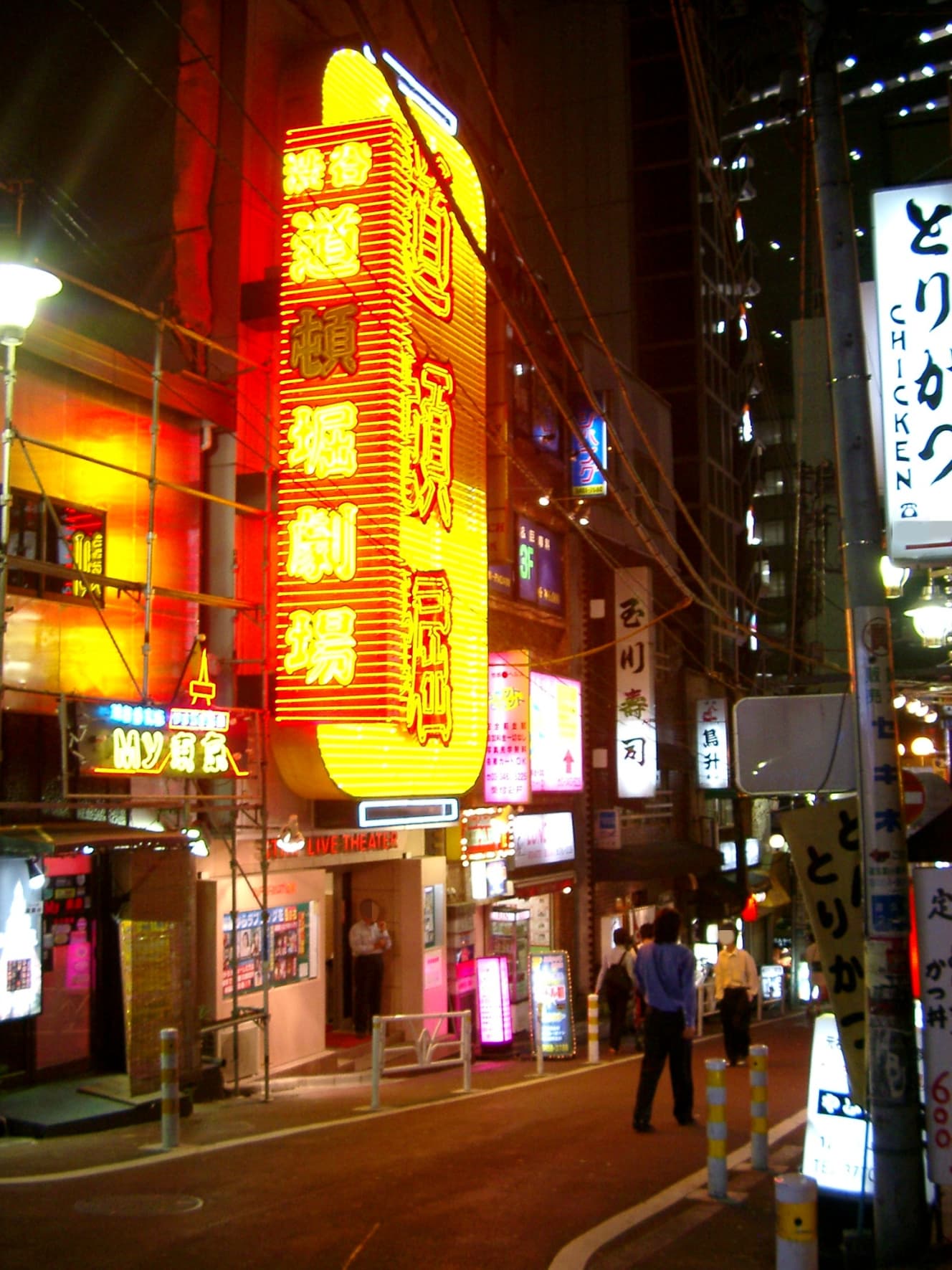
Shibuya Dōtonbori Theater — the landmark of Hyakkendana
The only remaining strip theater in Shibuya today, Shibuya Dōtonbori Theater, opened in January 1970. Originally it was a love hotel, but after a fire around 1965, it was rebuilt as a strip theater. “Dōgeki” (short for Shibuya Dōtonbori Theater) is a long-established, prestigious venue in the strip world and has produced numerous legends.
The greatest of these was Hitomi Shimizu, who took the scene by storm. In 1985, an ordinary office worker suddenly found herself appearing in strip shows. Her masturbation show became explosively popular, drawing more than 500 people to the theater every day. The line stretched out of Hyakkendana, down Dogenzaka, all the way to the area near what is now SHIBUYA109. Shimizu even had a column in a women’s weekly magazine and became a true idol.
From the late 1980s to the 1990s, Rina Kageyama performed an astonishing 9,800 shows over nine years, earning praise from fans as “a world record,” “worthy of Guinness,” and “the legendary dancing princess.” Comedians who filled the intermission slots included big names such as Leonardo Kuma, Konto Akashingo, and Maggy Shiro. They honed their craft in strip theaters like this and survived in the entertainment industry thanks to that training.
The theater once closed in 1995 due to complications over the land and building contract, but it reopened in 2001 and continues to operate today. Dōgeki boasts a spacious waiting room, excellent lighting and stage equipment, and highly skilled dancers. Alongside Asakusa Rokkuza, it remains one of the premier strip theaters in Japan. The author recalls a time when they followed a dancer who belonged to Dōgeki and visited the theater constantly—lining up from early morning to secure a front-row seat.
With outcall (delivery) sex services now being the main focus

Shibuya today is one of Tokyo’s most competitive districts for outcall sex services (deriheru), with over 300 shopsavailable. The variety of concepts is wide—M-sensual massage, high-end services, erotic massage, plus-size specialists, and more. There are also more than 20 hotel health (hote-heru) establishments.
Since outcall services became the main industry, what has surprised me in reporting on Shibuya’s sex industry is the exceptionally high level of the women working there. When I used deriheru undercover in 2008, I was taken aback by how stylish and cute the woman who arrived at the hotel was. And when I went to photograph at a long-established store-based health shop in 2012, I was stunned by the idol-like beauty of the woman waiting in the private room.
Store-based health shops have gradually declined in number. Today, there are only five remaining: Shibuya Heisei Jogakuen (school-uniform cosplay), Dogenzaka Crystal (magic-mirror selection), Milky Latte (near Hyakkendana), Sea Fairy, a long-established, inexpensive shop south of Shibuya Mark City
Shibuya Justine, an SM-style shop operating inside a Shin-sen-chō apartment building (scheduled to relocate to Sasazuka in autumn 2026)
The famous shop Shibuya Strawberry Jam, which had operated for over 30 years, closed due in part to the COVID-19 pandemic. Another well-known local health shop, Shibuya JJ Club, also closed in January 2023. I have visited both, and the level of the women was very high; their closures are truly regrettable.
There is only one soapland left in Shibuya: Shibuya Kaku-Ebi, a long-established shop near the Udagawa Police Box by Center-gai. Perhaps due to the heavy foot traffic, its main front entrance is no longer used; customers now enter through a small side door.
In the drama Moshigaku, the fictional “Happun-zaka” shines with colorful neon lights, but the real Shibuya Hyakkendana is surprisingly subdued and calm. From Shibuya Station—located at the bottom of a basin-shaped terrain—Hyakkendana and Maruyamachō feel like a floating world on the hill. The sight of store-based health shops lining the gentle stone steps has a non-ordinary, atmospheric charm. The labyrinth-like layout of Maruyamachō’s love-hotel district also gives a sense of entering another realm.
This other world at the top of the slope has a deep allure that has remained unchanged for the past century, ever since the area prospered as one of Tokyo’s liveliest entertainment districts and as a flourishing hanamachi (geisha district).


Interview, text, and photographs: Akira Ikoma