Soka University Masahiro Tateishi: The Relentless Competitor Behind Hanshin’s Top Draft Choice


“A rising star expected to carry the Tigers’ future” — Long interview
A 21-year-old who likes TWICE
The standout slugger of the 2025 draft, sought after by three teams
On October 10, two weeks before the professional baseball draft, Soka University infielder Masahiro Tateishi (22) spoke anxiously.
“I keep wondering whether I’ll really get drafted. I’ve seen players suffer disappointment in past drafts. Take Kenta Yamada (now with Nippon Life Insurance), who went from Osaka Toin to Rikkyo University—everyone thought he would be drafted for sure. You never know what will happen in the draft. Honestly, I’m surprised by how highly the media is evaluating me, but if I truly have a chance, I want to go pro as a top pick.”
With multiple teams expected to compete for him and his fate to be decided by a lottery, his mind was far from calm.
This offseason, not only did Tokyo Yakult’s Munetaka Murakami (25) get approved for a posting transfer, but the Giants’ Kazuma Okamoto (29) was also permitted to go to MLB. Even Hanshin’s Teruaki Sato (26) is expected to head overseas in the near future. With Japanese baseball’s star infielders inevitably flowing to the majors, Tateishi—an infielder who can hit—became the centerpiece of this year’s draft.
In the end, several teams avoided competition, and with Fukuoka SoftBank and Yokohama DeNA pursuing Rintaro Sasaki (20) of Stanford University, only Hiroshima, Hokkaido Nippon-Ham, and Hanshin selected Tateishi. Hanshin won the negotiation rights when manager Kyuji Fujikawa (45) drew the winning lottery. Reportedly, Hanshin had decided to select Tateishi as early as a year ago. Wearing the pinstripes, Tateishi said at the press conference:
“I’m really looking forward to meeting Manager Fujikawa as a baseball fan.”
He continued:
“I haven’t worn pinstripes since the Japan University team. It’s simple, but pinstripes make your legs look thicker and overall give you a sharper look, so I’m happy. Playing in front of a huge crowd has always been my dream. I want to be the kind of player who can compete for batting titles every year.”
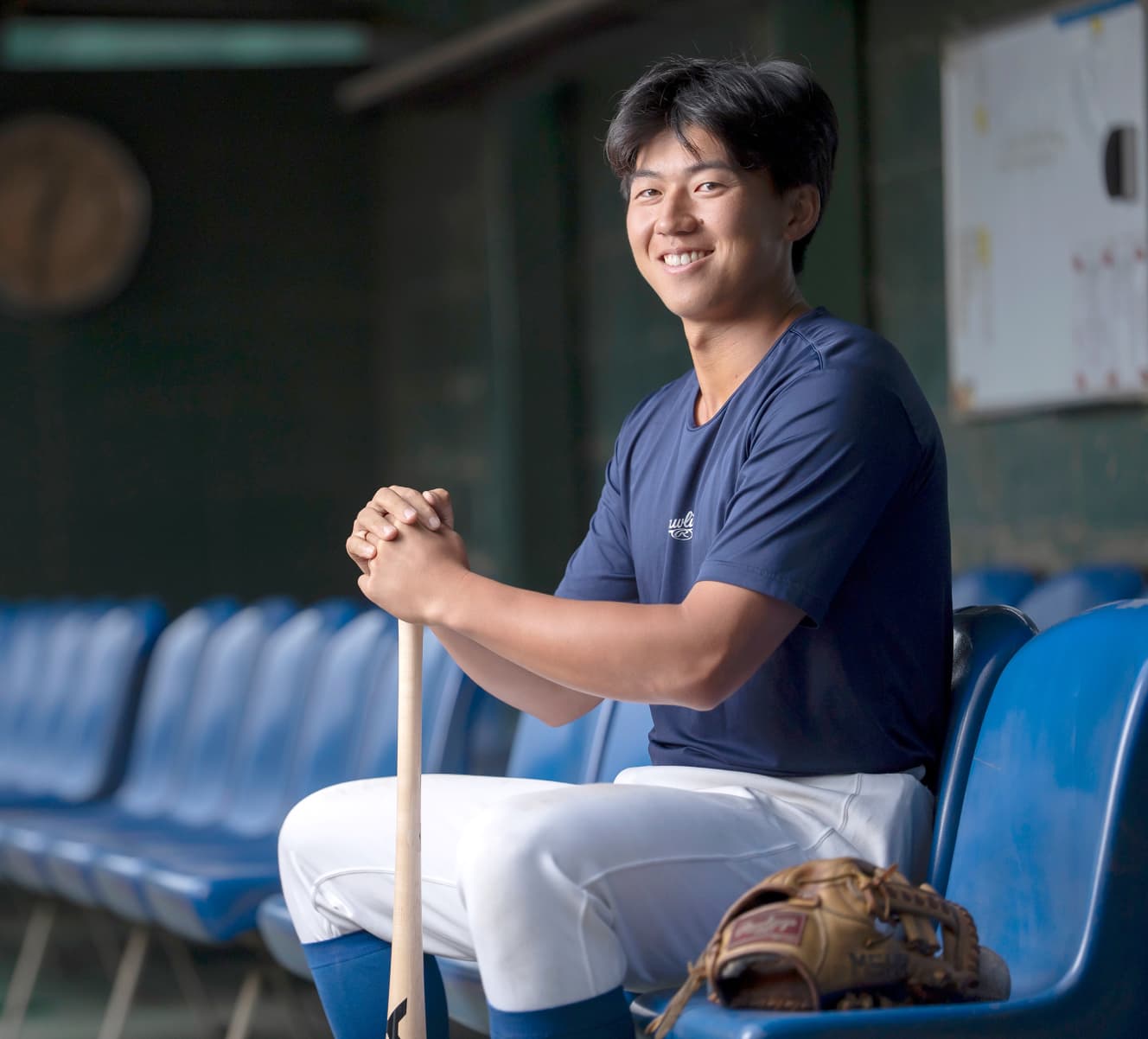
During our interview at Soka University’s baseball grounds, I teased him when he gave a sweet, charming expression during the portrait shoot—something that seemed like it would make him popular. He laughed:
“I’ve basically been playing baseball to be popular!”
Indeed, the traditional Hanshin uniform seems like it would suit him well.
Hanshin has drafted position players from universities or corporate teams as their first-round picks in 2016 (Yusuke Ohyama, 30), 2018 (Koji Chikamoto, 30), 2020 (Teruaki Sato), and 2022 (Shota Morishita, 25), all of whom have become core contributors and led the team to this season’s Central League championship.
“They’re all clutch hitters. I find Morishita and Ohyama’s batting especially appealing, and I hope to learn from them as much as I can.”
Tateishi’s strengths lie in his powerful wrists and the ability to avoid being jammed by high-velocity pitches. He can drive the ball with force to all fields.
“People pay attention because I’m a rare type— a right-handed hitter who can hit for power while playing second base. But honestly, playing second is coincidental, and I’m a right-handed hitter simply because I can only hit right-handed (laughs). I see myself as a developing player. I’m still growing, and I want to refine my fielding and base running.”
Tateishi’s mother, Ikuyo, is a former volleyball player who represented Japan in the 1992 Barcelona Olympics. His father was also a volleyball player, and his two older sisters play in the SV League and V.League. But the youngest child, Tateishi, fell in love with baseball at age seven.
“Volleyball was always around me, and I actually played it, but baseball interested me more. My mother probably wanted me to pursue volleyball, but my father loved baseball and wanted his son to play it too. Doing both sports, I sort of sensed I would eventually choose baseball.”
He enrolled at Takagawa Gakuen (Yamaguchi), known for its strong baseball environment, and soon began dreaming of becoming a professional player. His inherited athletic ability—such as jumping power and wrist action—also helped him in baseball.
“I think it shows in my fielding movements and throwing. But my family apparently thought I looked clumsy and didn’t expect me to go far as an athlete. Through weight training and experimenting with different sports methods, I improved—my running speed increased and my weight went up after entering university. I feel like I still have plenty of potential in terms of physical ability. The more I train, the more I’ll grow.”
Why He Chose Soka University
During the summer 2021 Koshien tournament, held without spectators due to the pandemic, Tateishi hit a massive home run to center field in the opening game against Komatsu Otani (Ishikawa). With offers from many strong university programs, including members of the Tokyo Big6 League, he ultimately chose Soka University — part of the Tokyo New University Baseball Federation — after being passionately recruited by then-coach Takanori Horiuchi (now head coach of Soka High School). In the spring league of his sophomore year, he captured the triple crown (batting average, home runs, and RBIs), and by his junior year he was selected for the Japan national collegiate team.
“I felt there was no other place that wanted me this much. In my freshman year, there was senior Makoto Kadokawa (24, now with the Giants), three years above me, and people told me, ‘Just watch him and learn.’ That meant a lot. Honestly, if I had gone to a university filled with elite players, I might have lost motivation (laughs). I really felt my growth during last year’s Meiji Jingu Tournament. Hitting two home runs there led to me being talked about as a 2025 draft prospect. I realized my reputation could change drastically in such a short period.”
In August this year, just as his final league season approached, Tateishi tore ligaments in his right ankle. Then, a week before the interview, he developed back pain and had to leave the Surugadai University game mid-way. It was the first season of his baseball life plagued by injury, and he was unable to end his amateur career with a championship.
For now, fully recovering from injury is his first step toward a professional career.
“The stretched ligament itself healed well, but because it was immobilized, my range of motion became very limited. While returning to practice carefully and playing in games with that restriction, I started feeling severe back pain—like sudden acute low back pain—which made it hard to put strength into my swing. Everything is connected from the feet upward. I’m glad I learned before turning pro that neglecting the base of your body can throw your entire condition off. I want to restore 100% of my ankle mobility by the end of the year.”
At Soka University, he played second base, but for Hanshin, that position belongs to Takuya Nakano (29), who is also on the Samurai Japan national team. Tateishi can also play third and first, but those spots are held by Sato and Ohyama—two core pillars of the team. With Hanshin’s elite infield, it wouldn’t be surprising if the versatile Tateishi were asked to convert to shortstop in the pros.
“It’s common for shortstops to move to second after turning pro, but almost unheard of for someone who has never played shortstop before turning pro to suddenly play it at that level. So I don’t think shortstop is realistic (laughs).”
On off-days, he either sleeps or visits day-trip hot springs to recover.
“I don’t go to saunas because I don’t want to sweat on my days off,” he laughed.
Away from the field, he’s a down-to-earth college student who loves the K-pop group TWICE, with Dahyun as his favorite member.
“At the dorm, I play games with my teammates—Super Smash Bros., Knives Out, things like that. But I’m terrible at them. Still, I hate losing, so I keep playing until I win.”
His favorite player is Hisayoshi Chono (40), who recently announced his retirement.
“In Yamaguchi, most of the games we could watch on TV were Giants games (laughs), so I was glued to Chono’s play.”
The era of doubting whether Japanese position players can succeed in MLB is over. It is now a time when not only pitchers but also hitters move overseas as valuable assets.
“In the future, I want to try playing in the majors like Seiya Suzuki (31). I want to take it step by step, fighting through each year.”
To earn the fans’ trust, his first challenge is clear —
winning a spot in the starting lineup on Hanshin’s powerhouse roster, the strongest among the 12 teams.


From the November 14-21, 2025 issue of “FRIDAY”
Interview and text by: Yuji Yanagawa (Nonfiction writer) PHOTO: Masaki Fujioka