Why Osaka Expo Ditched Its No-Smoking Rule—The Untold Story


A complete reversal from total no-smoking to designated smoking areas
A week has passed since the Osaka–Kansai Expo closed on October 13. Dismantling work on the pavilions is reportedly now in full swing.
At the beginning of the Expo, it faced criticism from every angle—such as the toilets that sparked massive outrage after reports claimed they cost 200 million yen to build, the rest areas with suspended rocks that were frightening and impossible to relax in, and the mass outbreak of midges. However, evaluations improved day by day, and toward the end, the Expo became so popular that people formed overnight queues just to buy same-day tickets. The operating budget, once feared to end in the red, is now expected to show a profit of up to 28 billion yen. The Expo can be said to have become a legacy that left a deep impression on many people.
The smoking area issue was also one of the problems targeted in the wave of criticism. Initially, the Expo grounds were set to be completely non-smoking, and the two designated smoking areas were located outside the venue. Concerns were raised about the long distance to the smoking areas and their small number. However, on June 28—about two and a half months after the opening—the policy was reversed. Two smoking areas for general visitors and three for staff were newly established inside the venue.
At the time, the reported reasons for the reversal included “complaints from staff and visitors that the smoking areas were too far and inconvenient” and “numerous incidents of cigarette butts being found behind the back entrances of overseas pavilions.”
But the real reason was different. Now that the Expo is over, an Expo operations official, referred to as Mr. A, revealed what truly happened: “The truth is that undercover smoking among foreign staff working inside the venue was widespread. That was the biggest reason.” The underlying issue seemed to be differences in smoking etiquette between Japan and other countries.
Globally speaking, Japan is often said to have relatively lenient smoking rules, but there are many countries where the general etiquette is that as long as you’re not bothering anyone, it’s acceptable to smoke almost anywhere. In Osaka Prefecture and Osaka City, the Expo prompted the expansion of no-smoking zones on public streets, and efforts were underway to create an environment where smoking restrictions would be assumed from the start. However, in a place like the Expo—where people from many cultural backgrounds gather—it may have been difficult to fully control behavior. Mr. A explained the circumstances that led to the installation of smoking areas.
“Originally, the venue was supposed to be entirely non-smoking, but due to visitor feedback and relationships with participating countries, they had no choice but to install smoking areas—and as a compromise, they placed them outside the gates. At first, they believed that having only the smoking area outside the East Gate would be fine, but due to crowds far beyond expectations, going back and forth between the venue and the smoking area became unrealistic. Undercover smoking by staff in the overseas pavilions wouldn’t stop. And it wasn’t just staff—some visitors were secretly smoking as well. That’s why they ultimately decided to create smoking areas inside the venue.”
The newly installed smoking areas were packed to the brim
So then, did the smoking situation improve after smoking areas were installed inside the venue? I conducted interviews on the Expo’s smoking situation in mid-September. First, I visited the smoking area near the East Gate (outside the venue), which had been set up from the beginning. Even at the shortest distance, it took about 15 minutes to walk from the edge of the Expo grounds to the East Gate at a normal adult male walking pace. When the venue and gate area were crowded, a one-way trip could take more than 30 minutes. For pavilion staff, it was questionable whether they could go there and back during a break. A man in his 40s, a repeat visitor who had been to the Expo many times since it opened, described the reality.
“Actually, going back is harder than going to smoke. Once you exit the gate, you have to undergo a baggage check again to re-enter. That means you have to wait in the long entry line all over again for several minutes. After they created smoking areas inside the venue, from the inner ring of the Expo, you could get to either location in about 10 minutes.”
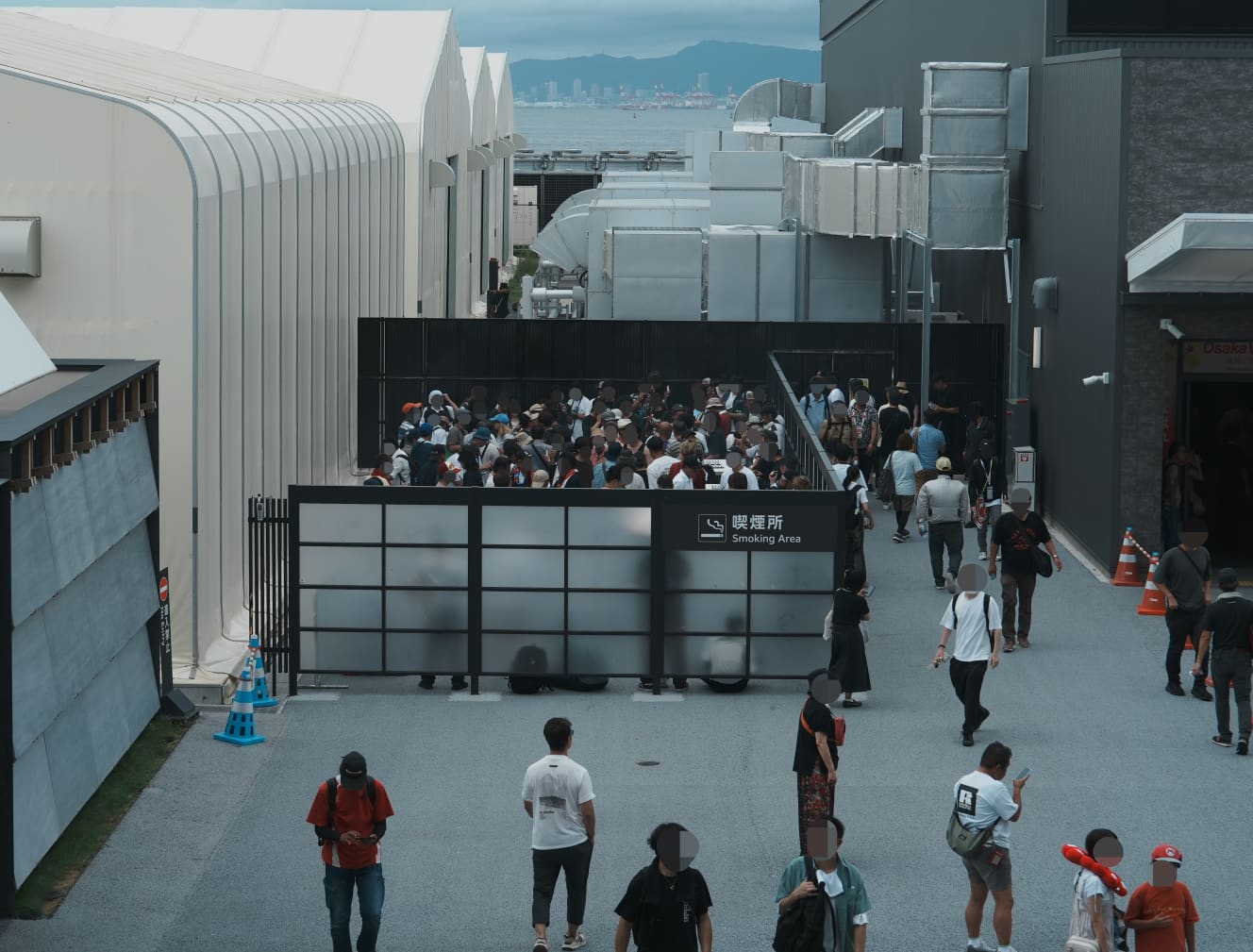
Next, I headed to the newly installed smoking areas inside the Expo grounds. There were two: one on the north side of the ring and another on the south side of EXPO Messe (WASSE). By around noon, many people were using the smoking areas. People were overflowing all the way to the entrance, suggesting there were indeed capacity issues. I spoke with a man in his 30s who was leaning against the exterior wall and smoking.
“There are just too many people, and I can’t even get inside,” he said.
“I’m grateful they made smoking areas, but they aren’t nearly spacious enough, and it’s completely packed. Still, for heated tobacco products, even smoking out here (outside the smoking area) is better than smoking in restrooms or on the walkways inside the venue, don’t you think?”
If you simply consider the ratio of smoking areas to total site size, the Expo grounds have the equivalent area of 33 Tokyo Domes (1.24 million m²), yet there were only seven smoking areas inside and outside the venue combined (three of which were for staff only). Since the Tokyo Dome itself is entirely smoke-free, it may be more appropriate to compare with the similarly sized Kyocera Dome (1.20 million m²), which has five smoking areas. Even then, the number still seems low. While many still felt it was inconvenient, it may have been somewhat better than at the beginning.
At a major international event like the Expo, unexpected situations are inevitable. The smoking issue, which forced organizers to flexibly abandon their initial policy, may itself be another legacy of the Expo.


Interview, text, and photos: Blank Green