Playback ’15] Deep Scars of the Disaster… Walking in the Disaster Area One Month after the Great East Japan Floods


What did “FRIDAY” report 10, 20, or 30 years ago? In “Playback Friday,” we revisit the topics that were hot at the time. This time, we will introduce a report from the October 30, 2003 issue, which was published 10 years ago, titled “All-out report: One month after the Great East Japan Floods, the victims’ lives were spared”.
The “Torrential Rainstorms in Kanto and Tohoku in September 2015,” which occurred from September 9 to 11, 2003, caused extensive damage throughout eastern Japan. Among them, the Kinugawa River in Joso City, Ibaraki Prefecture, overflowed in several places in the early morning of September 10, killing 15 people, including disaster-related deaths. Fifteen people died, including disaster-related deaths, 40 were injured, and more than 5,000 houses were completely destroyed. One-third of the city was flooded. The following is a report on the disaster-stricken areas one month after the disaster (descriptions in parentheses are taken from previous articles).
The situation has not changed at all.
The house managed to survive, but the warehouse, garage, and all the cars parked there were washed away. I am now evacuating to my parents’ house in Tsuchiura (in Ibaraki Prefecture) with my son. My father-in-law and husband live in an evacuation center near their home because they also have jobs, so our family is scattered.
My son’s elementary school reopened on September 24, so I drive an hour to take him to and from school every day. Immediately after the disaster, I thought that within a month we would all be living together, even in temporary houses. But nothing has changed.
Ms. A told this magazine that she had come from Tsuchiura that day with her 9-year-old son to see her husband and father-in-law for the first time in a long while.
In Joso City, Ibaraki Prefecture, the Kinugawa River, which runs through the city, burst its banks and overflowed its banks in several places, and many houses were swallowed by the muddy waters. Many people living within the flooded area lost everything they had built. The same was true for Mrs. A’s husband (40) and father-in-law (70), who lived in the town of Misaka and survived the disaster. Her husband, 40, and father-in-law, 70, lived to the bitter end.
“On the morning of the 10th, I went to check the levee and found that the area where the levee had burst had already begun to overflow with water. I immediately evacuated my daughter-in-law and grandchildren to my daughter-in-law’s parents’ house in Tsuchiura. The water was flowing out in front of our house like a river, but we were confident that the water level would not rise any higher. My son and I did not evacuate.
It was a mistake. The water level, which had been below our knees, rose steadily to above our knees and below our groins. By midday, it became a muddy river. From the second floor window of our house, we could see our neighbors fleeing the water and taking shelter on top of their huts. The hut was knocked down by the muddy water and disappeared into the current. We were unable to save him. I later heard that he had died.”
At around 16:00 the same day, Ms. A’s father-in-law and her husband were rescued by helicopter.
Restoration Work Not Progressing Well
One month after the flood, debris was still piled up here and there in the Misaka-cho area, and utility poles that had been knocked down by the muddy waters were still standing. Not much had changed since the disaster. Of course, water and electricity were still out. The city official said, “We are doing our best,” but restoration was slow, especially in the areas where the levees had collapsed.
As of October 13, 2003, 300 people were forced to live in evacuation centers at seven locations in the city. An 83-year-old woman living in an evacuation center at Ishishita Sports Park said, “It’s hard to sleep, and I wake up every hour. I don ‘ t want to be extravagant, but I really want to go home as soon as possible. More than 200 households in Ibaraki Prefecture had applied to move into public housing, but at this point, only four had actually been able to do so.
The Kinugawa Onsen spa resort in Tochigi Prefecture was also severely damaged. Among the images that shocked the nation when broadcast on TV was that of the open-air bath facilities at the Kinugawa Plaza Hotel, which stands along the upper Kinugawa River valley, collapsing into the river. We interviewed Mr. B, who worked at the hotel.
On September 10, about 240 guests were staying at the hotel. When I rushed to the hotel at around 7:30 a.m. after receiving a report from the staff, I found that the women’s open-air bath had collapsed in a heap. It is fortunate that no guests were injured. The collapsed area included the water supply system, so we had a hard time because all the water in the hotel building was shut off,” he said.
At another lodging facility, the leaky ceiling was replaced, and water-absorbing tatami mats and bedding, as well as the broken boiler, were all replaced. Even so, recovery was still far from complete, and sales plummeted due to a string of cancellations.
However, the hot spring resort was making step-by-step progress toward recovery. The Plaza Hotel was also planning to completely renovate the women’s bath, which had collapsed, with the aim of reopening for business in November, the season of autumn leaves. The “Tsukiakari Hanakairo” illumination event at Kinugawa Park, which had been held every year, was also in jeopardy for a time, but was to be held from September 25 to October 4. Meanwhile, in Joso City, Mr. A’s father-in-law, mentioned above, was also looking forward.
He said, “The house in Misaka-cho is still in no condition to live in. I just want to go back as soon as possible and have meals at the table at home with the whole family again.”
Litigation to hold the government accountable is still ongoing.
Since then, the restoration of infrastructure and roads seems to have progressed steadily.’ In July ’16, a 1.4-meter raised levee was completed at the site of the Kamimisaka levee break. However, as of September ’16, one year after the disaster, some 200 disaster victims had not been able to return to their homes, according to reports at the time. Nevertheless, the region recovered over time. The government spent 78 billion yen to construct about 66 km of levees, and by 2009, there were no more levee-free sections.
The lessons learned from this unprecedented disaster have instilled a high awareness of disaster prevention in local residents. The “My Timeline” disaster prevention action plan, which started in Joso City, has been adopted in about 900 cities, towns, and villages across Japan.
On the other hand, a lawsuit is underway to challenge the government’s inadequate river management, claiming that the flooding was a man-made disaster. The plaintiffs claim that the reason the Kami-Misaka area levee failed was because it was the lowest in the lower reaches of the Kinugawa River and should have been repaired as soon as possible, but the government put off the maintenance of the levee. The overflow of water that occurred in the Wakamiyado area upstream was also attributed to the fact that the sand dunes that had served as “natural levees” had been excavated by the contractor and could no longer fulfill their role, and that the government had not designated the area as a “river area.
In the first trial decision in July ’22, the court acknowledged the government’s responsibility for the designation of the Wakamiyado area as a river area, but rejected the plaintiffs’ suit on the issue of the embankment in the Kamimisaka area. The case is still pending after two trials.

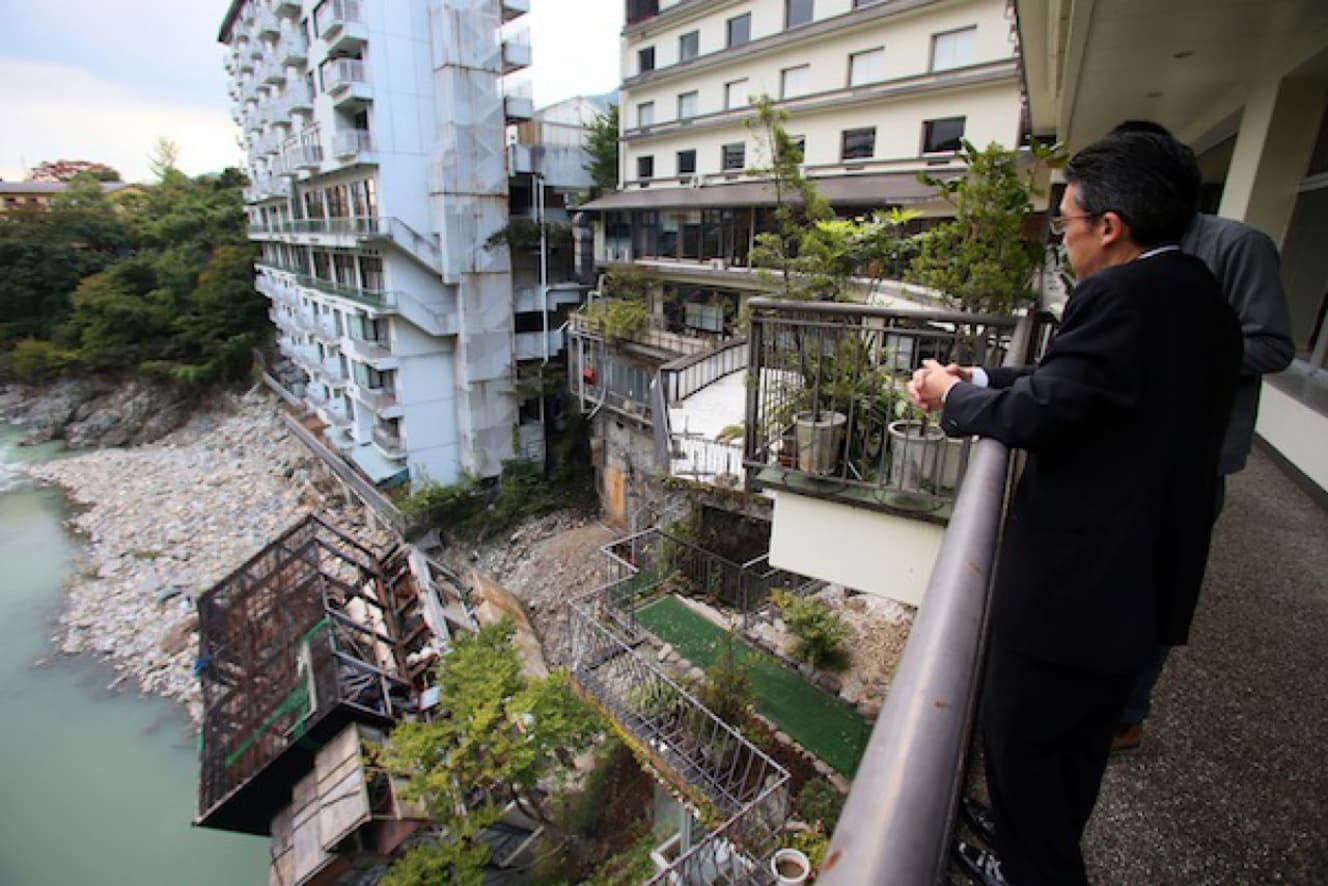


PHOTO: Shinji Hamasaki (1st, 3rd, and 7th photos), Takeo Yuzuna (4th photo), Kazuhiko Nakamura (6th photo)