The Carefree Life of Junji Takada — “Now I Move So Lightly I Could Almost Fly”
Junji Takada, 78, talks about the 10th anniversary of "Jun Walk," a show in which he teases the townspeople and makes them laugh.


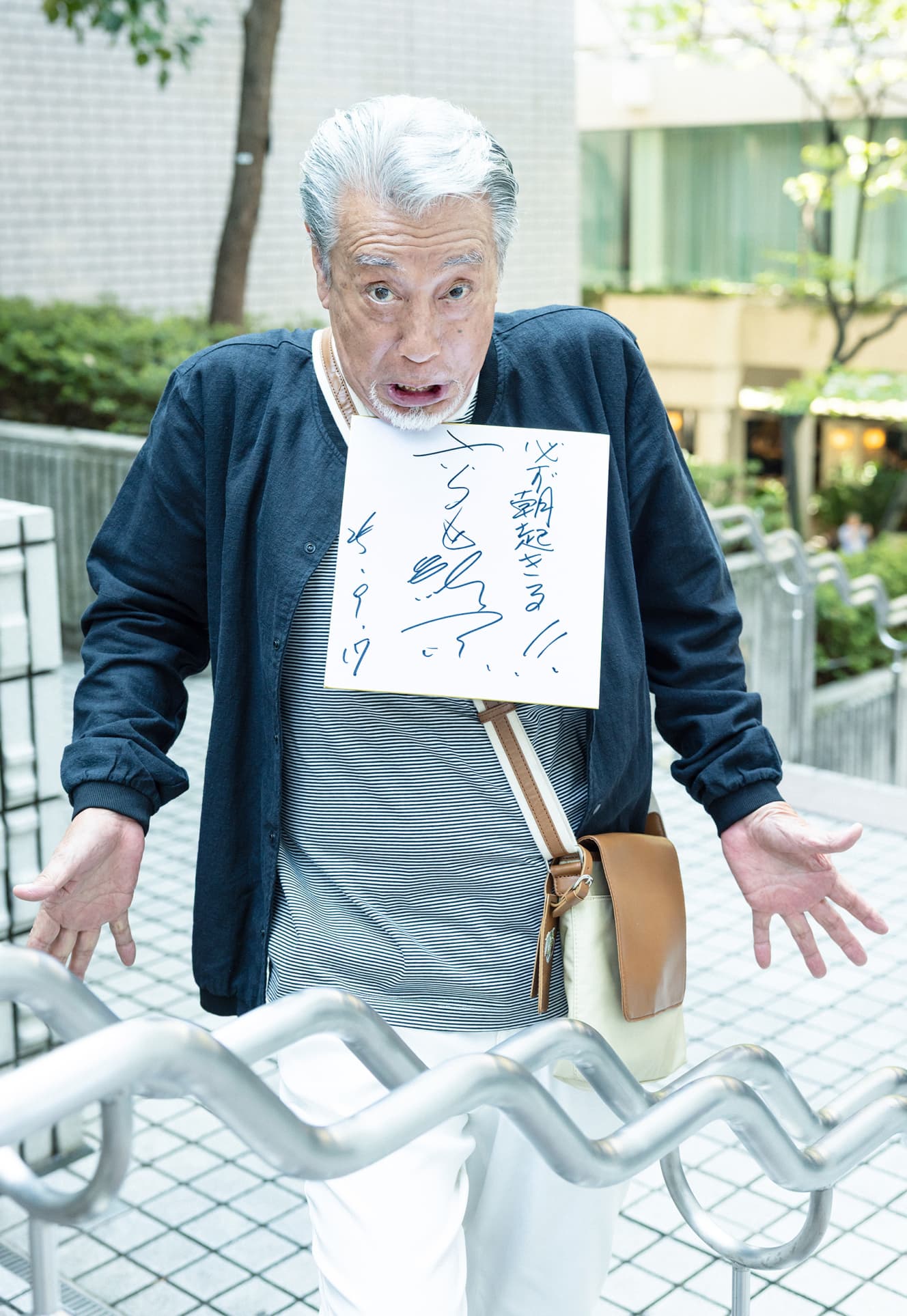
The reason he always makes jokes
“Hello. Japanese George Clooney here.”
The appearance of this charming older gentleman with such a clichéd greeting instantly lightened the atmosphere on the interview set――.
Actor, comedian, TV personality. None of these titles seem entirely adequate. If anything, he is an entertainer: Junji Takada (78). His self-titled program, Jun Sanpo (TV Asahi), in which he strolls through Tokyo, marked its 10th anniversary in September. One of the reasons for the show’s popularity is Takada’s humor-filled words to people he meets on the street. Below, the easygoing man Takada reveals more.
“If I just said, ‘Hello, I’m Junji Takada,’ it wouldn’t be interesting. People are nervous in front of TV cameras, so I have to throw in something like, ‘I’m George Clooney.’ First, I make them laugh to help them relax.”
Takada’s way of easing people is unique. For example, when a woman of a certain age is walking by.
Takada: “Miss, which women’s university do you go to?”
Woman of a certain age: “How old do you think I am?”
Takada: “I’ll guess. Between 20 and 80, right?”
Or when he says, “Oh my, such a beautiful lady,” and the woman replies, “I’ve met you before, Mr. Takada.”
Takada: “See, right? We lived together for a while, didn’t we?”
He explains:
“Basically, filming is done in the morning, so there aren’t many students or office workers in the streets. Most people walking by are elderly. But if I talk to elderly men, nine out of ten times it turns into sexual jokes. Since it’s a morning show, those would get cut anyway. So I try not to make eye contact with men and focus on talking to women.”
Whether he’s serious or joking is hard to tell, but the show has no script. Takada’s ability to improvise quick-witted comments may be linked to a life full of unexpected twists and turns.
“My life has been full of setbacks. Believe it or not, I was called a ‘child prodigy’ in my hometown of Kokuryo (Chofu City, Tokyo) until I was in elementary and middle school. I was always in the top ten of my class. I imagined an ordinary life—going to university, working at a company—but I failed all universities, both as a fresh graduate and after repeating a year. It was shocking. Among my close high school friends, I was the only one who didn’t go to university. Even now, I dream that I can’t find my exam number on the results notice.”
“I quit without telling my wife.”
After failing his university entrance exams, Takada enrolled in a specialized graphic school. For a time, he became a research student at the theater troupe Jiyu Gekijo, aspiring to be an actor. However, after getting married and having a child, he joined a jewelry sales company at the age of 26.
“My life as a company employee didn’t last long either. About three years after joining, I tried to woo the receptionist, and we went together to an izakaya in Shinjuku. There were friends from my research student days there too, including Akira Emoto and Bengal, who had just founded the theater troupe Tokyo Kandenshi. Listening to them reignited my burning desire to become an actor. So, I quit the company without telling my wife. I remember she cried a lot when she found out.”
After joining Tokyo Kandenshi, he lived a life of rehearsals and performances during the day and construction site part-time jobs at night to support his family. Later, he landed his first regular spot on the variety show Waratteru Baai Desu yo! (Fuji TV) and broke through with Tensai Takeshi no Genki ga Deru TV!! (Nippon TV). From 1988, the Chugai Pharmaceutical commercial for Glonsan with the catchphrase “Man from Five O’Clock” became a buzzword, cementing his image as the easygoing “Tekito” man. He was already over 40.
“I never had a particular mentor, no hit comedy routines, and wasn’t much as an actor. I survived in a niche of the entertainment world that no one else occupied, so maybe that’s why I’ve been able to keep going even after 40. But when someone tells me, ‘Do something random,’ I really don’t know what to do. Should I go to the bathroom and leave it unflushed? I can’t dwell on it, so I just go with the flow.”
At 67, Takada faced another challenge: herniated discs and spinal canal stenosis, requiring major back surgery.
It was just after this that he received the offer for Jun Sanpo.
“It was perfect timing. The doctor told me to take walks for rehabilitation. At first, the program was tough. I think I sometimes walked as much as 17,000 steps. But over time, my body got used to it, and my posture improved. Thanks to that, I haven’t had any serious illnesses since the show started. Now I feel so light on my feet, I could almost fly.”
Takada’s liveliness is on full display in Jun Sanpo, as introduced at the beginning. Still, he will be 80 in two years. Does he have any special health regimen?
“I’d like to play the piano elegantly for an hour every morning and think up poems for 30 minutes but I haven’t managed a single thing. Haha. I just walk long distances on Jun Sanpo. I even talk to foreigners in broken English, which probably keeps my brain sharp too.”
After ten years of the show, he has noticed many things:
“Sometimes people with outrageous outfits are surprisingly serious, and those who look stern can unexpectedly share funny stories appearances can be deceiving. I’ve visited the same streets in Shibuya and Shinjuku multiple times, and they keep renewing and getting prettier. It’s a bit lonely to see the landscape completely changed. Lately, I find charm in old Showa-era houses and streets with a slightly mysterious atmosphere.”
His enthusiasm for continuing the show remains strong:
“I want to do it until I’m 100, even with a cane. But would it be okay if this old man didn’t walk and used a self-driving taxi for filming? Oh, then I wouldn’t be able to interact with people on the street, and I couldn’t use the ‘Japanese George Clooney’ bit.”
Until the very end, it was pure “Jun-chan style.”


“I want to keep doing it until I’m 100, even if I have to use a cane.”


PHOTO: Hiroyuki Komatsu, courtesy of his office (2nd and 3rd past 2 photos)