Aika Kanda Joins The Himura Couple’s Route 66 Trip – Caught by the Police Edition
No.97] Me, Pink, and Sometimes New York


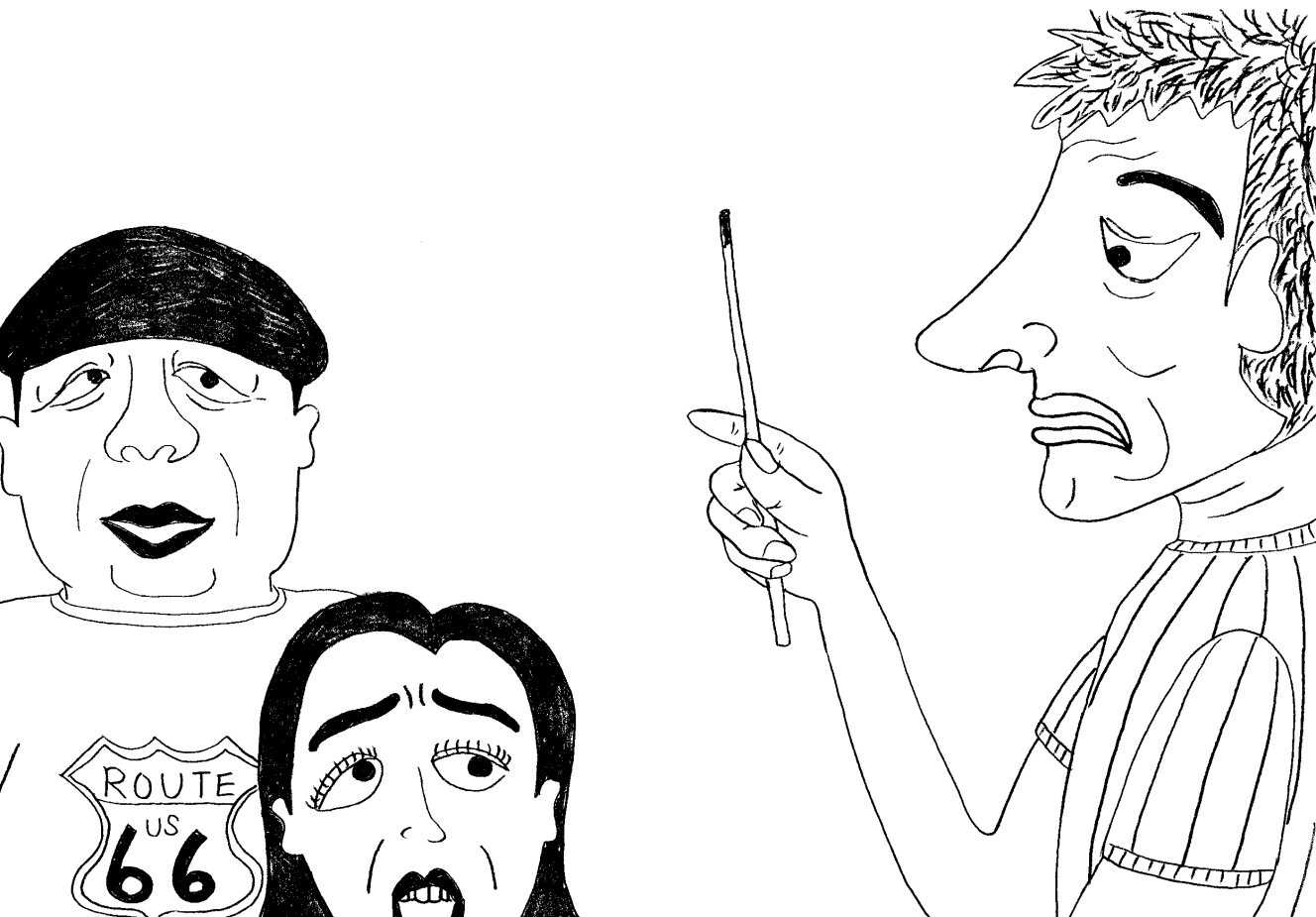
Once you find a kind person, don’t let them go—rely on them completely!
It was the second day of our road trip across America, driving along Route 66. Suddenly, the message “Change Engine Oil Soon” appeared on the dashboard of our rental car. We hurried to a gas station, but—as is typical in the U.S.—it was entirely self-service. There were no attendants anywhere. Who could we ask for help? We went into the small convenience store attached to the station.
At the register stood a middle-aged man. I said, “Excuse me,” and showed him a photo of the warning message on my phone. He spoke quickly—something like “blablabla!”—and pointed toward the back of the store, where the engine oil section was. There were so many kinds that I couldn’t tell which one to buy, so I went back to him and said, “First time!” He came out from behind the counter and, I think, told me, “This one—I use it too.”
At that moment, my personal travel motto kicked in: “Once you find a kind person, don’t let them go—rely on them completely!” So while paying, I asked one more thing: “How to change engine oil?” He handed the register over to a woman in the back room and followed us out to our car.
Skillfully, he popped open the hood and checked the dipstick. Then he said something that sounded like, “Try starting the engine again!” I did, and the same warning appeared. After the second attempt, he suddenly started talking very fast. I used a translation app, which said:
“Go to a nearby auto repair shop. There’s nothing more I can do right now. Tell them my name, and they’ll help you.”
Realizing the seriousness of the issue, we braced ourselves for the possible impact on the rest of our trip.
We arrived at the repair shop he mentioned—but no one was there, and the door was locked. It was Sunday, and they were closed. Despair set in. My husband and I fell silent. We were in the rural town of Springfield, Illinois, about 330 km from our starting point in Chicago. Going back would take hours, so we decided it was better to move forward while figuring things out. My husband made the call: we’d continue along Route 66.
I quickly pulled out the “Emergency Contact List” I had prepared before the trip and called the rental car company. When I said, “Japanese, please,” a woman answered in Japanese: “I’m an interpreter. I’ll assist you.” She explained, “If you’re driving more than 500 km, please stop by an airport branch and exchange the car.”
We still had over 1,000 km left to go. About 160 km ahead was St. Louis Lambert International Airport, so we decided to swap cars there to minimize any disruption to our journey. We did so successfully and continued on our way, covering roughly 400 km that day before spending the night in Rolla, Missouri.
Out of one trouble and into another
On the third day, there were no troubles, and we simply enjoyed the scenery. In Missouri, we saw endless stretches of farmland where livestock grazed peacefully. After driving about 350 km, we stayed overnight in a town called Joplin.
Day four — the final day of this year’s “Route 66 Journey: Part 1.” Our destination was Oklahoma City, about 420 km ahead. Everything went smoothly in the morning, but after lunch, while passing through a small town, something unexpected happened.
We stopped at a stop sign, turned left slowly, and had gone only a few meters when a slightly high-pitched siren — “WEE-OOO!” — sounded. Having traveled to the U.S. over 70 times and watched countless American dramas, I immediately knew what that sound meant: a police car signaling us to pull over.
I thought, “Oh, some car’s been pulled over,” and looked around — but there were no other cars on the road. Wait, what?When I checked the rearview mirror, a patrol car was right behind us. Nervously, I asked my husband, “Could it be… us?” He said, “I’ll turn right at the next corner. If they follow, then yeah, it’s us.” He turned — and sure enough, the police car followed.
We hadn’t committed any traffic violation. So why? From my knowledge as an American culture enthusiast, I knew that in such situations, if you don’t follow instructions immediately, the police might draw their guns. My husband kept driving slowly, but I panicked: “No! Stop right now!” He pulled over — and so did the patrol car.
We were in a rural American town with no Japanese residents in sight, unable to communicate in English. We had no idea that the Himura couple was about to spend the next hour locked in a standoff with the American police.
(To be continued…)
★ The author’s first book, “Ōdō tte iu michi, doko ni tōtte masu ka?” (“Where Exactly Does the ‘Main Road’ Lead?”), compiling this series, is now on sale to great acclaim!

Aika Kanda — Born in 1980 in Kanagawa Prefecture. After graduating from the Faculty of Science, Department of Mathematics at Gakushuin University, she joined NHK as an announcer in 2003. She left NHK in 2012 and became a freelance announcer. Since then, she has been active mainly in variety programs and is currently a main MC and regular host on the daytime show “Poka Poka” (Fuji TV).
—from “FRIDAY”, October 17, 2025 issue
Illustrations and text by: Aika Kanda