Love Hotel Streets Hide Tokyo’s Best Chinese Food?


In recent years, authentic Chinese restaurants, or gachi-chuka, have been gaining momentum, particularly in areas like Ikebukuro and Nishi-Kawaguchi. These restaurants, known for serving the same deep, local flavors found in mainland China, have become popular among people seeking genuine regional Chinese cuisine. Interestingly, many of them tend to open in areas where adult entertainment businesses have been shut down — often right next to love hotels, or even on the first floor of one.
To explore this phenomenon, we asked blogger Asei, a popular “Tokyo office worker who eats his way through Chinese restaurants,” to introduce a few gachi-chuka spots that might be a little awkward to enter — but are absolutely delicious once you do.
————
Why Authentic Chinese Restaurants Cluster Around Love Hotel Districts
There’s a clear reason why gachi-chuka (authentic Chinese restaurants) tend to gather near red-light or entertainment districts — lower rent.
While many Japanese restaurant owners hesitate to open in areas dense with love hotels or adult entertainment venues due to concerns about image or safety, Chinese (and other foreign) owners are often less deterred. As a result, rents in these neighborhoods are comparatively cheaper, presenting an opportunity for those willing to take the plunge and keep fixed costs low.
In this feature, we’ll spotlight restaurants in Ikebukuro, Nishi-Kawaguchi, and Koiwa — all located near or right beside love hotel zones. These are places you might hesitate to enter at first glance, but once you muster the courage to step inside, you’ll be rewarded with truly authentic regional Chinese cuisine.
1. Ikebukuro — “Yummy Duck”: Cantonese-Style Roast Duck
The exterior of “Yummy Duck” has a somewhat uninviting atmosphere, with few seats inside — which is why most customers tend to order through food delivery services. The contrast between the hotel’s white sign and the restaurant’s bright red Chinese sign makes it stand out, yet the interior is difficult to see from outside, giving some people pause before entering. Once inside, however, you’ll find a simple setup with just four tables lined up neatly.
Orders are placed through a ticket vending machine that also supports Japanese, so there’s no need to worry if you don’t speak Chinese. The menu mainly features roast duck, roast pork, and char siu (barbecued pork), served over rice. You can choose just one type of meat, or opt for a more indulgent two- or three-meat combo. The roast duck and pork — handcrafted daily at a central kitchen by skilled cooks — are tender and flavorful. It’s a curious experience: eating in a love hotel’s first-floor restaurant in Ikebukuro, yet feeling as if you’ve been transported to a local eatery in Hong Kong or Guangzhou.

The contrast between the hotel’s white sign and the restaurant’s red Chinese sign makes “Yummy Duck” stand out, yet the interior is hard to see from the outside, making some people hesitate to enter. Once inside, however, the space is simple, with just four tables neatly arranged.
Orders are placed through a ticket vending machine that also supports Japanese, so even those who don’t speak Chinese can order without worry. The main offerings are roast duck, roast pork, and char siu (barbecued pork), served over rice.
You can choose just one kind of meat or go all out with two or three types. The roast duck and pork — both handmade daily by skilled chefs at a central kitchen — are tender, flavorful, and deeply seasoned. It’s a curious place where, despite being on the first floor of a love hotel in Ikebukuro, you might feel as though you’ve been transported to a local diner in Hong Kong or Guangzhou.

2. Koiwa — “Laxiangfang”: Northeastern Chinese Cuisine
While Ikebukuro’s love hotel x Chinese restaurant “Yummy Duck” opened in 1924, there is a pioneering restaurant in Koiwa that has been operating on the first floor of a love hotel for more than 10 years. It is “Luo Xiang Bo,” located a few minutes’ walk from the Koiwa North Exit. Koiwa also has a busy shopping area in front of the station, where you can find Chinese, Filipino, Thai, and other local foreign cuisine restaurants that blend in with the nightlife.
The hotel on the upper floor is brick, making it look like an apartment building, so it does not have the same impact as “Yummy Duck”. However, it is a little difficult to enter the restaurant due to its semi-subterranean structure with several steps leading down to the restaurant and the many signboards placed in front of the restaurant.

However, once you step inside, you’ll find an interior that resembles a fairly typical Chinese restaurant. What sets this place apart is its extensive menu and excellent value for money. There are over 40 lunch options, with prices starting at just 680 yen — a welcome deal in today’s economy. The regular à la carte menu is also impressively large, likely offering over 100 dishes, making it hard to choose just one.

According to the staff, both the owner and the chef are from Liaoning Province in northeastern China, so ordering from the Dongbei (northeastern) menu is highly recommended. Popular regional dishes include yangrou chuan (grilled lamb skewers) and suancai paigu (stewed pork ribs with fermented cabbage), both staples of northeastern home cooking.
The suancai (fermented cabbage) is made in-house by salting and fermenting napa cabbage, giving the soup a rich, distinctive tang that’s absolutely delicious. Another must-try is chunbing, a type of thin wheat pancake similar to what’s used for Peking duck, used to wrap various fillings — a beloved comfort food in northeastern China that’s hard to find in Japan. It pairs wonderfully with dishes like stir-fried shredded pork, stir-fried potatoes, or leek and egg stir-fry.
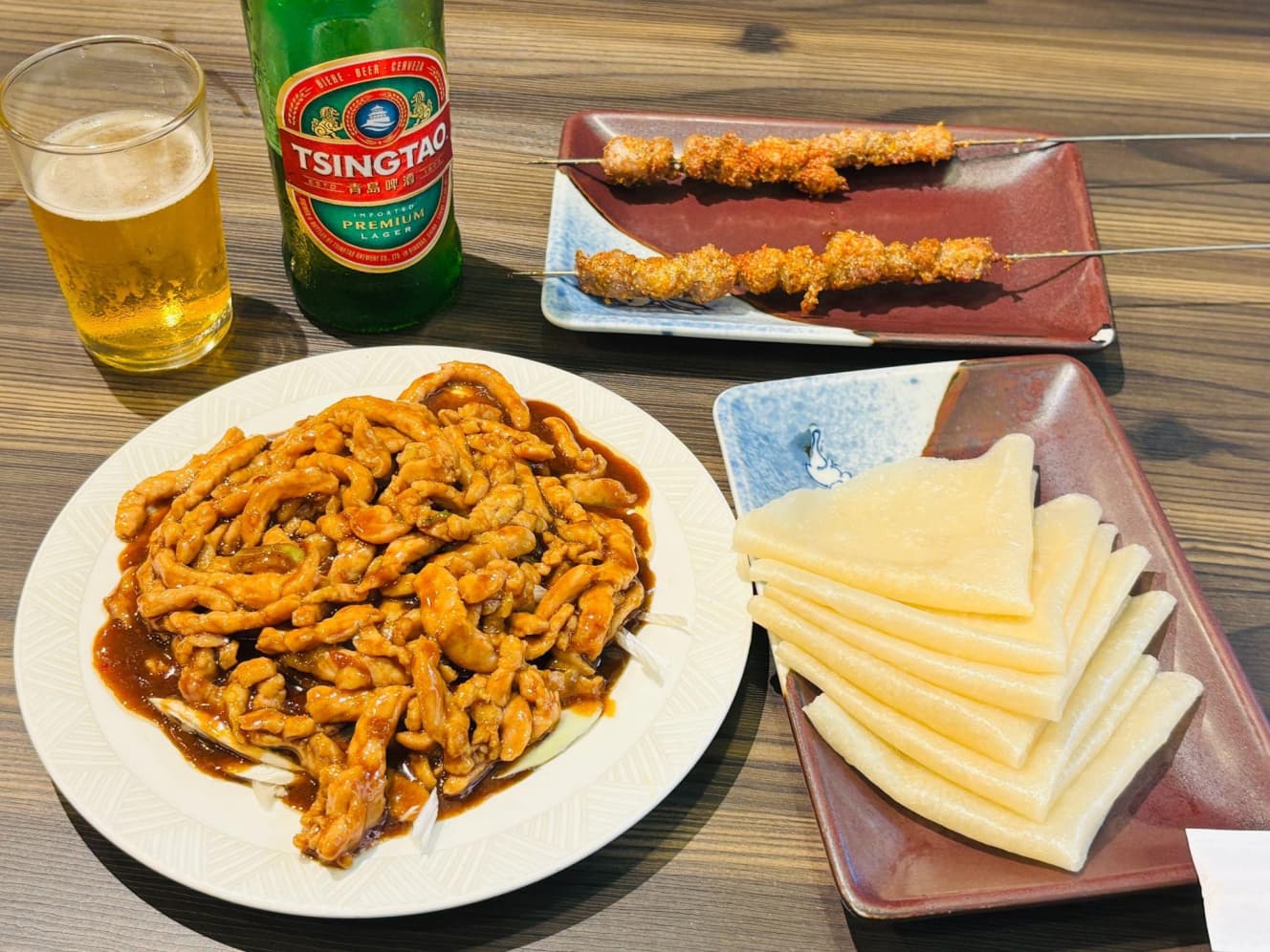

3. Nishikawaguchi “Yijia Da Paidang” Fujian Snacks
Finally, we arrive in Nishikawaguchi, an area well known as a Chinatown. Walking through the west exit area, you’ll see numerous signs written only in Chinese, and if you listen closely, you’ll hear Chinese being spoken all around. Originally, this district was a red-light area filled with adult entertainment establishments, but after a series of crackdowns, many of those places closed, and Chinese businesses began moving in, gradually transforming it into something like a Chinatown.
These days, even if the neighboring building happens to be a love hotel or an adult establishment, the foreign shop owners don’t mind—in fact, they consider it lucky to be able to rent space cheaply. Thanks to this pragmatic attitude, not only Chinese but also Vietnamese shops and markets have been increasing in recent years.

The northern part of the west exit area still retains traces of its past, when rows of adult entertainment venues lined the streets. Even today, you can still find stretches filled with hotels and soaplands. Along one such street stands a restaurant called “Yijia Da Paidang.”
After dusk, the area becomes quite dim, and the neon lights from the adult establishments give it a rather shady atmosphere, making it a bit uncomfortable to walk around. However, this restaurant is run by an owner from Fujian Province and offers snack-style dishes from Fuzhou, the provincial capital. Of particular note are the handmade snacks prepared only in the morning, which are a highlight worth trying.


Dishes like Haoli Bing—a deep-fried fritter filled with oysters, pork, cabbage, and seaweed, wrapped in a batter made from rice and soybeans—and its seaweed-focused variant, Zicai Bing, are wonderfully versatile. They work just as well as light snacks as they do as perfect beer accompaniments.
Another signature Fujian snack is Rouyan, Fujian-style wontons made by wrapping minced pork or fish filling in a thin, delicate skin. The small dumplings, with their smooth, springy texture, slip down effortlessly and leave you wanting more. Other uniquely Fujian dishes include seafood menmian (seafood braised noodles), said to be the inspiration for Nagasaki champon, and seafood stir-fried rice noodles, both staples of authentic Fujian cuisine.
For this feature, we intentionally picked restaurants that are a bit hard to approach—those located in areas lined with hotels or adult establishments in Ikebukuro, Koiwa, and Nishikawaguchi. Personally, I found Yijia Da Paidang in Nishikawaguchi—the one on a street filled with adult entertainment shops—to be the hardest to walk into. However, if you visit in the morning, when their handmade snacks are served, the atmosphere feels more approachable, so it’s worth giving it a try.
Beyond the spots introduced here, these neighborhoods are full of other authentic “Gachi-Chinese” restaurants, so I highly recommend exploring more on your own. Once you’ve conquered the hardest-to-enter places, you’ll be ready to step into any restaurant with confidence.
All prices include tax. Information is current as of early September 2025.
For more, check out A-Sheng’s blog “Eating Chinese Food in Tokyo.”
Interview, text, and photographs: Asei
A corporate employee and writer who eats Chinese food in Tokyo. While in college, he studied abroad at Fudan University in Shanghai for a year and fell in love with Chinese food. Currently, while working for an IT company, he eats his way around newly opened Chinese restaurants in Tokyo.