Naming Desire: The Media Origins and Evolution of Japan’s Delivery Health System


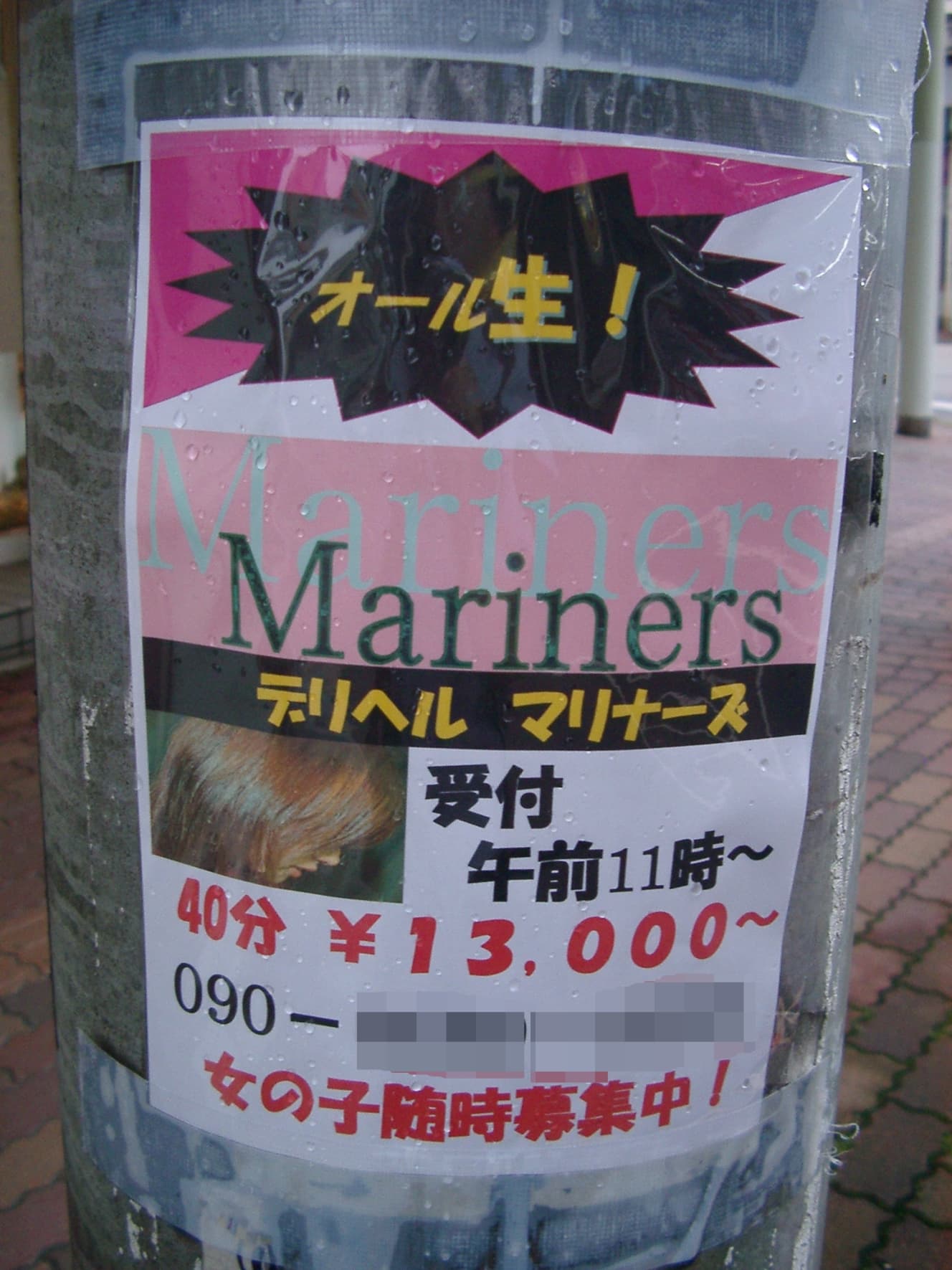
 Delivery health services spread even to rural areas with few establishment-based sex businesses (Toyama, 2002)
With the enforcement of the revised Adult Entertainment Business Law in June, apartment-based men’s esthetic salons suffered a major blow, and it is expected that sex-related businesses will increasingly shift toward non-store models such as delivery health. Since its birth in 1998, how has delivery health evolved up to the present day? This is the latter half of the first installment, explained by adult industry journalist Akira Ikoma.
Police Struggled to Control Dispatch-Type Illegal Sex Businesses
From the late 1980s to the 1990s, non-storefront illegal sex businesses such as date clubs and hotel telephone clubs (hotetoru) rapidly opened and spread across urban areas. Along with this boom, pink leaflets and pink flyers advertising such services were scattered not only in entertainment districts but even into ordinary households, becoming a major social issue. The police struggled to control these dispatch-type prostitution businesses whose actual operations were difficult to grasp.
To bring such establishments under regulation, the Adult Entertainment Business Law was revised in 1998 and the new version took effect on April 1, 1999. Under this revision, a new category called “Non-Storefront Type Sex-Related Business” was created, officially recognizing delivery health (deriheru) as a regulated form of sex business. In other words, dispatch-type sex services were effectively legalized.
Under the revised law, delivery health was defined as providing services that satisfy sexual curiosity without engaging in sexual intercourse prohibited by the Anti-Prostitution Law. Thus, it was positioned as something distinct from the earlier hotel telephone clubs and date clubs. The creation of delivery health aimed to register and monitor the actual number of dispatch-type services through a notification system under police supervision, while eliminating truly illegal prostitution businesses.
At first, many operators feared that filing notifications might lead to mass crackdowns, so they cautiously waited to see how the police would react. However, no targeted raids occurred. Seeing that, many underground operators felt reassured and rushed to submit their notifications to the police—preferring to operate legally without fear of arrest.
Soon, reception offices for delivery health services (today known as hotel health shops) began openly operating until morning in nightlife districts where previously only unlicensed illegal establishments had been open past midnight. This was a groundbreaking change.
Currently, however, the situation differs from that time. After the 2005 revision of the Adult Entertainment Law, hotel health establishments were prohibited from operating between midnight and 6 a.m. Meanwhile, delivery health services without reception offices can still operate 24 hours a day.
Following the emergence of delivery health and stricter enforcement, illegal hotel telephone club businesses gradually declined. With the widespread use of mobile phones—and the disappearance of public phones where pink flyers were once posted—hotel telephone clubs have now almost completely vanished.

Was the godfather “MAN-ZOKU”?
The term “deriheru” (short for delivery health) is a Japanese-made English word that originated in Japan. It’s also referred to as “shucchō health” or “haken-gata health” (both meaning dispatch-type health service), but it’s said that the adult information magazine “MAN-ZOKU” was the one that came up with the name delivery health.
The rise of deriheru reflected a shift in the sex industry from traditional, in-person establishments toward more remote or technology-mediated forms. In the 1980s, phone-based services such as telephone clubs and message dial systems flourished, and in the 1990s, the spread of the internet brought about online dating sites. These, in turn, drew attention to compensated dating.
The progression of the sex industry—from red-light districts and entertainment quarters, to telephone clubs, online dating sites, and finally to deriheru (non-storefront delivery services)—demonstrates a shift from spatially concentrated businesses to more dispersed, non-physical ones. As strict regulations tightened on in-store sex businesses, and as technologies like the internet and mobile phones developed, demand for deriheru rose—an unmistakable sign of this trend.
For customers, deriheru was convenient, as it offered services even after midnight. They could use it anytime without worrying about time, and its system of delivering service providers not only to hotels but also to private homes was well received.
Because customers didn’t have to go to a shop and could receive services in private spaces, they enjoyed a sense of intimacy and relaxation—“as if inviting a lover into one’s own room.” Compared to ordinary in-store sex businesses, deriheru also offered the comfort of larger rooms. Moreover, there was no need to wait alongside other customers in a waiting room, and no risk of running into acquaintances—factors that made it appealing for privacy reasons.
Before deriheru, the practice of calling sex workers to one’s home or meeting them in hotels was mostly associated with illegal operations like hotel calls or date clubs, where full intercourse was expected. As a result, many people initially misunderstood deriheru as offering the same.
At first, many customers used to traditional in-store establishments found it strange that deriheru required separate fees for the playroom (hotel charges). The author was one of them. From 1999 to 2000, I regularly traveled to sex-related businesses in western Japan—Nagoya, Osaka, Fukuoka, Kumamoto—for interviews. My job was to take profile photos and conduct interviews with sex workers for weekly and monthly magazines. When I checked the pricing systems during interviews, I thought, “It’s kind of expensive that, on top of the service fee, you also have to pay for the hotel and transportation.”
At that time, there were still very few low-cost delivery-type services, and in-store sex businesses were thriving. So, it felt like, “If you want something easy and affordable, the in-store ones are still the best.”
A Major Impact on the Sex Industry
The emergence of deriheru also brought changes to the people working in the adult entertainment industry. For business owners, there was no longer a need to maintain a physical store, allowing them to cut costs for property upkeep and staff salaries. Compared to traditional storefront operations, deriheru required a smaller initial investment, making it easier to enter the business.
Some operators even used their homes as offices, minimizing their physical infrastructure. Since authorities tended to focus their regulations on physical stores and reception facilities, the lack of a large, fixed location also meant they were less likely to be targeted for crackdowns. Moreover, because it was said that “you could start a business with just one phone line,” the barrier to entry was extremely low, and the number of businesses quickly multiplied.
For women, deriheru offered a more flexible and convenient work environment. Unlike storefront operations, being able to work late at night was a major advantage. There was no need to match the number of rooms with the number of women working, and no rigid two-shift system (day and night), allowing them to work at their own pace—an arrangement that many found appealing.
A new profession also emerged: the deriheru driver, responsible for driving the women to the clients’ locations. Before this, drivers in the sex industry mainly worked for storefront businesses, transporting customers from train stations or driving the women to and from the shop. With the rise of deriheru, demand for drivers who could transport workers directly to clients skyrocketed.
A major turning point for the sex industry came with the 1998 amendment to the Entertainment Business Act (Fūeihō), which officially brought non-storefront sex businesses under regulatory oversight for the first time. Until then, many unlicensed and illegal establishments offering full-service sex operated freely. The amendment introduced a legal pathway for deriheru businesses to operate, provided they filed the proper notifications and complied with regulations.
This was in sharp contrast to traditional storefront sex businesses, which faced extremely strict location restrictions that made opening new shops nearly impossible. With a legal framework in place, the deriheru industry expanded rapidly—first in the Tokyo metropolitan and Kansai regions, and later spreading to regional cities across Japan.


Interview, text, and photographs: Akira Ikoma