The Ground Self-Defense Force enters a “new stage”…The 2nd Special Forces Group conducts live-fire training of “Type 12 surface-to-ship guided missiles” in Australia!


35,000 participants from 19 countries
The “first domestically produced cruise missile” with a range of 1,000 km to protect the southwestern islands.
It was a little after 6:00 a.m. when the sun began to rise, brightly illuminating the surrounding area. On a hill facing the sea, a large vehicle resembling a heavy machine was sitting on top of the hill, and a huge cylinder loaded on the back of the vehicle was standing up, pointing toward the sky.
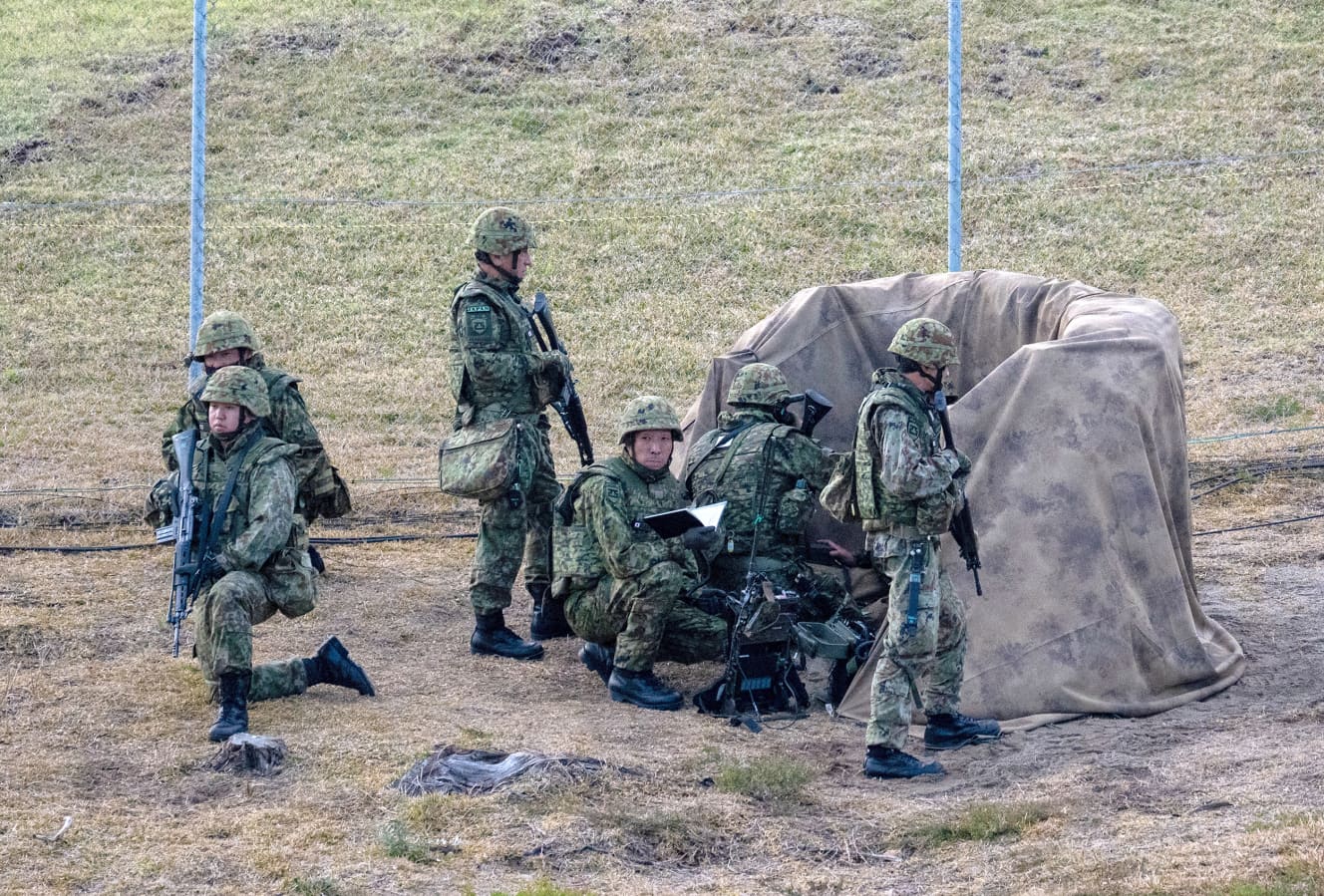
Several Self-Defense Force personnel, who were holding rifles around the vehicle, descended the hill and disappeared at once. At exactly 7:00 a.m., about 30 minutes after the area was enveloped in silence, a missile was launched with a roar, spewing out intense flames from the cylinder on the back of the vehicle, and in a flash, it was beyond the sky (first photo).
A few seconds later, a second shot was fired, followed a few moments later by a whoop and a cheer. Applause could also be heard. It was the moment when the Ground Self-Defense Force stepped onto a new stage.
Talisman Saver 25, a multinational military exercise sponsored by the United States and Australia, was held across Australia for 23 days from mid-July.
Held every two years, this was the 11th such exercise, and this time a total of 35,000 participants from 19 countries, including the Philippines, Thailand, India, and Indonesia, all of which are concerned about China’s naval buildup and expansion into the South China Sea and East China Sea, took part. This year’s event was the largest ever held.
Japan has participated since 2003. This year again, the Amphibious Task Force, the “Japanese version of the Marine Corps,” along with the U.S. Marine Corps and the Australian Army, conducted a series of field exercises, including landing drills.
Another major purpose of participating in Talisman Saber 25 was the missile launch training exercise mentioned above. The 2nd Special Forces Group, which was established in March 2012, is in charge of the Kyushu-Okinawa area, the most important area for Japan’s national security. This missile is designed to attack enemy naval vessels at sea from land, and is said to have a maximum range of 200 km.
It is an extremely important missile for defense, intercepting Chinese naval vessels entering Japan’s territorial waters and protecting remote islands scattered in the southwestern islands. Therefore, under the framework of the “Talisman Saver” program, the Australian Army’s training grounds were rented to conduct the shooting.
The target was a small yacht-like vessel.
The yacht was towed to the sea more than 10 km away from the hill where the shooting was to take place, and was searched in cooperation with the Australian Army. Upon discovery, the yacht’s location information was sent to the ground forces, and Type 12 surface-to-ship guided missiles were used to destroy the yacht. Assistant General Hisashi Ito, commander of the 2nd Special Forces Group, told the author, “This was a landmark training exercise for the Ground Self-Defense Force.
This was the first time we tried the simultaneous landing of two missiles on different axes, hitting the target from different directions at the same time. Not only did we land the missiles, but we also jammed the enemy ship. This was also a first attempt.
In Japan, the Ministry of Internal Affairs and Communications does not permit training to send out actual radio waves. It was only in Australia that we were able to conduct this training.
This “groundbreaking drill” will accelerate Japan’s missile defense strategy.
This is because beyond the various training and verification exercises for the Type 12 surface-to-ship guided missile is Japan’s first domestically produced cruise missile. Currently under development is a “Type 12 Surface-to-Ship Guided Missile Capability Enhanced” with a range of 1,000 km, based on the Type 12 surface-to-ship guided missile, which is planned to be deployed to the 2nd Special Forces Group in the next fiscal year.
Until now, it has targeted enemies approaching the coasts of islands, but the Type 12 surface-to-ship guided missile capability-enhanced type is capable of attacking from outside the range of enemy missiles. This is a change to a defense strategy of “not letting them get close” in the first place. Research and development will continue in order to eventually extend the range to 1,500 km.
Japan is facing a severe security environment that is said to be more serious than that of the Cold War era.
The deployment of domestically produced cruise missiles capable of preemptive strikes may provoke its neighbors, but it is not an option for Japan, which is threatened daily by Chinese and Russian naval vessels and air force aircraft, and is forced to deploy more than 100 times a month.


From the September 12-19, 2025 issue of FRIDAY
Interview, text, PHOTO: Masayuki Kikuchi